Women groups raise 10 concerns in Triple Talaq Bill
New Delhi, Dec 27 : A group of 40 women rights activists has opposed the Muslim Women (Protection of Rights on Marriage) Bill, 2018, in its present form, raising concerns over 10 points in the Bill which was passed by the Lok Sabha Thursday.
In a statement, they urged the government to withdraw the Bill from consideration in the Rajya Sabha, and review the fundamental flaws pending broad-based community consultations.
Following are the 10 concerns raised by the activists.
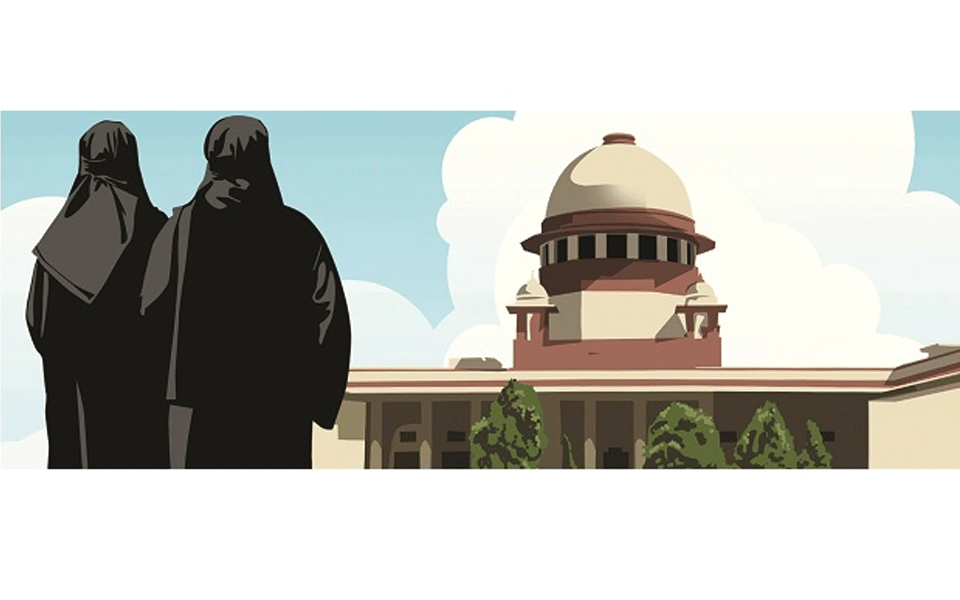
- This Bill disregards the fact that its very objective - to protect the rights of married Muslim women and prohibit divorce by pronouncing 'talaq' by their husband - has already been achieved by the judgement of the Supreme Court.
- The Supreme Court in Shayara Bano's case held that the practice of 'talaq-e-bidat' is manifestly arbitrary, and therefore, unconstitutional. An act that has no legal consequences being made a criminal offence, cognizable and non-bailable is manifestly arbitrary and therefore, violative of Article 14.
- There is no rationale to criminalise the practice of talaq-e-biddat and imprison Muslim men. The effect of the Supreme Court's judgment is that the marriage is legally valid and the persons continue to be lawfully wedded. Now, the Muslim men will be incarcerated, thus violating the rights of conjugality of these two persons. Criminalising the husband would also lead to unwanted separation between the couple, against the wishes of the wife.
- Since Muslim marriage is a civil contract between two adult persons, the procedures to be followed on its breakdown should also be of civil nature. Penal action to discourage the practice of instant triple talaq is a myopic view as it leaves many other issues of economic and social security of women unaddressed
- The government should strengthen the negotiating capacities of women by providing them economic and socio-legal support rather than criminalising the pronouncement of triple talaq.
- The pronouncement of triple talaq having no legal consequences on the marriage means that such a proclamation by a Muslim man is essentially a desertion of the wife. In any of the Personal Laws, the desertion of wife by a man is not a criminal offence. Therefore, while the Bill aims to criminalise the pronouncement of talaq, in effect, it is only criminalising the act of desertion of a Muslim wife by her husband. Criminalising desertion by Muslim men, which constitutes only a civil offence for men of all other religions, is discriminatory under the Constitution.
- If there is violence within the marriage in addition to the pronouncement of triple talaq, the woman could use the existing provisions of the Protection of Women from Domestic Violence Act, 2005 and Section 498A of the Indian Penal Code. These two laws, taken together, represent a wide spectrum of legal options available for women survivors of domestic violence, encompassing both criminal and civil provisions.
- No economic and socio-legal support is provided by the government in the Bill to women, children and other dependents, when the erring men are put behind bars. The Domestic Violence Act, 2005 under Section 21 already provides for the aggrieved woman to be provided custody of the child and Section 20 provides for maintenance to be paid to her. Section 125 of the Code of Criminal Procedure, 1973 also provides for maintenance for the aggrieved woman. In fact, the Bill takes a step back in only providing for subsistence allowance for the woman. Subsistence allowance is not defined and is open to interpretation.
- The Bill allows for the aggrieved woman as well as anyone related to her by blood or marriage to be the complainant. There is no provision for a relative to seek the consent of an aggrieved woman before filing a complaint. The problem becomes particularly acute in the case of inter-religious marriages of Muslim men with a woman of another religion.
- The terms of imprisonment up to three years is arbitrary and excessive. Serious crimes like Causing death by rash or negligent act (IPC Sec 304A), Rioting (IPC Sec 147), Injuring or defiling place of worship with intent to insult the religion of any class (IPC Sec 295) - all punishable by two years in jail or fine or both. All these criminal acts have lesser punishment than pronouncing triple talaq, which is arbitrary and excessive, and violative of Article 14 of the Constitution.
The statement was signed by 40 activists and women's groups, including Ayesha Kidwai of Jawaharlal Nehru University, Kavita Krishnan of All India Progressive Women's Association (AIPWA), Shabanam Hashmi, Anhad and groups like Bebaak Collective, National Alliance of People's Movements (NAPM), Humsafar Support Centre, Kashmir women's collective, Mahila Sarvangeen Utkarsh Mandal (MASUM), People's Union for Civil Liberties (PUCL), Women's Research & Action Group among others.
The Lok Sabha Thursday passed the Bill which criminalises the practice of instant triple talaq, with the government rejecting the contention that it was aimed at targeting a particular community.
The Muslim Women (Protection of Rights on Marriage) Bill, 2018 was passed by the Lower House with 245 voting in favour and 11 opposing the legislation.
Let the Truth be known. If you read VB and like VB, please be a VB Supporter and Help us deliver the Truth to one and all.
AIITA welcomes Karnataka’s ban on obscene songs in school events
Bhatkal: The Karnataka unit of the All India Ideal Teachers Association (AIITA) has welcomed the Karnataka government’s decision to strictly ban school children from dancing to obscene songs during educational and cultural programmes in government, aided, and private schools across the state.
AIITA Karnataka State President M. R. Manvi congratulated the government for taking what he termed an important step to preserve the sanctity of education.
“Such decisions to safeguard the dignity of school children and uphold the values of education are the need of the hour. This rule should not be limited to government schools alone but must be strictly implemented in all private educational institutions as well,” he said.
He further urged the government to address other concerns within school programmes.
“The government should not only prohibit obscene dances in the name of school anniversaries, but also ensure that plays and dialogues that incite religious hatred are avoided. Schools should be centres of harmony, not platforms for spreading hatred,” he added.
According to a recent circular issued by the Department of School Education and Literacy, obscene dances are adversely affecting the mental health and moral values of students.
In this regard, schools have been advised to use songs that promote nationalism, positive thinking, the greatness of Kannada culture, and value-based traditions instead of inappropriate content during programmes.
The circular also emphasises that students should be dressed in decent attire.
AIITA also backed the department’s warning that disciplinary action would be taken against head teachers if such guidelines are violated. The association has further demanded that district Deputy Directors of Public Instruction strictly monitor the implementation of these rules.