Women shine at Smart India Hackathon at IIT Kharagpur
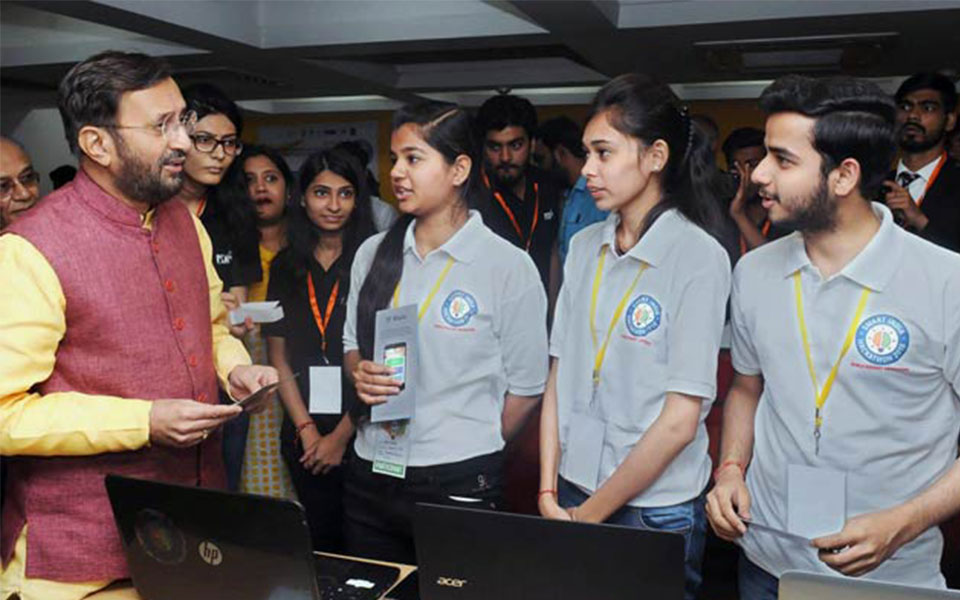
Kharagpur, June 22: Coimbatore's Whistling Cookers of Avinashilingam Deemed University for Women bagged a cash prize of Rs 1 lakh by winning the Smart India Hackathon 2018 - Hardware Edition on Friday.
The first runner-up was from the same college -- Team Buddies. And the second runner-up was Team Askurvara from the Silicon Institute of Technology.
The winner and runners-up were all women's team, a IIT Kharagpur release said.
The two runner-ups were richer by Rs 75,000 and Rs 50,000 respectively.
SIH2018 - Hardware edition is the first-of-its-kind innovation challenge initiated by the Union Human Resource Development to provide a national platform to young technical minds of India to showcase their disruptive innovations and creative products which can bring about revolutionary changes in crucial sectors like agriculture, health, clean water, waste management, automotive, smart communication, and education.
The event has seen unique student innovations in smart drip irrigation, technology-powered mechanical harvesters and soil testing, and cost-effective detection of the status of fruits and vegetables.
The winning team designed a prototype for "non-destructive estimation of sugar content of fruits using visible-light imaging".
Prof. Partha Pratim Chakrabarti, Director, IIT Kharagpur and Chairman, SIH2018, said: "I think innovation challenges such as SIH2018 are going to bring a new era in innovation and transform the process by which we teach engineering."
The nine competing teams at IIT Kharagpur were judged by an external jury made up of some of the top entrepreneurs and partners of leading business incubators in the agri-tech sector, such as a-IDEA, Omnivore, AgNext, Bharat Innovations Fund and Ankur Capital.
Nine teams worked continuously for five consecutive days to build their hardware solutions as a working prototype.
Said Pranav Gawande and Chirag Patil of Team Scrap Stars of G.H. Raisoni College of Engineering, Nagpur, who devised a sugarcane cutting machine: "The competition was stiff as all the teams had great potential. Irrespective of the result, it was great to be in IIT Kharagpur."
M. Charugayathri of Team Buddies, one of the two all-women teams from Avinashilingam Deemed University for Women, Tamil Nadu, said: "Making it to the finals itself was a great experience."
Let the Truth be known. If you read VB and like VB, please be a VB Supporter and Help us deliver the Truth to one and all.
Gujarat Titans beat Royal Challengers Bengaluru by four wickets

Ahmedabad (PTI): Skipper Shubman Gill and Jos Buttler played useful knocks to help Gujarat Titans chase down defending champions Royal Challengers Bengaluru’s modest total, securing a four-wicket win in their Indian Premier League match here on Thursday.
Despite RCB pacer Bhuvneshwar Kumar (3/28) tormenting the hosts, opener Gill scored a belligerent 43 off 18 balls, while Buttler smashed 39 off 19 to power Gujarat to their fifth win of the season and take their points tally to 10. They chased down a modest 155 in 15.5 overs for
the loss of six wickets.
Earlier, RCB were dismissed in 19.2 overs with their batters struggling against the bowling attack led by Kagiso Rabada and Mohammed Siraj.
RCB, who are placed second on the points table, could not stitch together a fruitful partnership, losing wickets at regular intervals as Siraj (1/38) and Rabada (1/44) reduced them to 35 for 2 in the fourth over, from where they could not recover.
Left-arm pacer Arshad Khan (3/22) took the wickets of RCB skipper Rajat Patidar (19), Krunal Pandya (4) and Venkatesh Iyer (12), while Jason Holder (2/29) and Rashid Khan (2/19) also grabbed two wickets each.
Devdutt Padikkal was the highest run-getter for RCB, scoring 40 off 24 balls.
Brief Scores:
Royal Challengers Bengaluru 155 all out in 19.2 overs (Devdutt Padikkal 40, Virat Kohli 28; Arshad Khan 3/22, Mohammed Siraj 1/38, Kagiso Rabada 1/44, Rashid Khan 2/19, Jason Holder 2/29).
Gujarat Titans 158 for 6 in 15.5 overs (Shubman Gill 43, Jos Buttler 39; Bhuvneshwar Kumar 3/28, Romario Shepherd 2/30).