Women's WC: India crush Pakistan by 88 runs to extend unbeaten streak
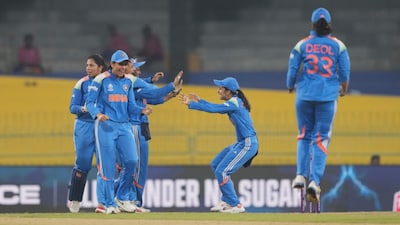
Colombo (PTI): The contrasting knocks of Harleen Deol and Richa Ghosh found ample support from the bowlers as India etched a commanding 88-run win over Pakistan in a drama-filled ICC Women's World Cup match here on Sunday.
Deol’s composed 46 off 65 balls and Richa Ghosh’s spirited 20-ball 35 lifted India to a competitive 247 on a sluggish track after the match referee erroneously ruled the toss in favour of Pakistan, who elected to bowl first.
Pacer Kranti Gaud (3/20) dismantled Pakistan's top order while the spinners cleaned up the middle-order and tail, bundling them out for 159, despite a valiant effort from Sidra Amin (81 off 106 balls).
With this win, India extended their perfect head to head record to 12-0 in ODIs.
The match moved on familiar lines and the expected hostilities were conspicuous by its absence, but the day was not entirely bereft of drama.
India continued their “no-handshake” policy at the toss or after the match, sticking to the precedent set during the men’s Asia Cup in the UAE.
The gaffe during the toss added to the list of amusements which later swelled through a bizarre run out and the 15-minute delay due to bugs invading the field.
Cutting back to cricketing matters, Pakistan's chase of 248 began in chaos when opener Muneeba Ali (2) was sensationally run out.
Facing Gaud, she survived an initial leg-before appeal which was ruled not out, but as she momentarily wandered out of the crease with the ball still in play.
An alert Deepti Sharma swooped in with a direct hit to break the stumps with Muneeba's bat still in the air, much to the disappointment of skipper Fatima Sana who argued with the umpire.
Gaud then struck twice in quick succession, first dismissing Sadaf Shamas (6), caught off her own bowling, and then removing Aliya Riaz (2), leaving Pakistan reeling at 26/3.
As the Indian bowlers tightened their grip, Sidra and Natalia Pervaiz (33) offered resistance with a 69-run stand, briefly steadying the innings before the inevitable collapse followed.
Earlier, Indian batters struggled to get going on a slow track but Deol’s knock provided some stability in the middle overs, during Richa's cameo, pushing India near the 250-run mark.
Opener Pratika Rawal (31) gave India a brisk start, smashing Diana Baig for three consecutive fours, but star batter Smriti Mandhana (23) once again fell inside the power play, putting the top-order under early pressure.
After surviving an unsuccessful leg-before appeal off Baig, Mandhana was trapped in front of the wicket by Pakistan skipper Fatima.
The disciplined Pakistan bowlers kept the batters on a leash with tight lines and clever variations in pace, denying them any rhythm and chipping away at regular intervals.
Pacers Baig (4/69) and Sana (2/38) did the maximum damage, sharing six wickets between them.
Rawal was next to go, her attempted cut shot brushing the top of the off stump.
Deol showed composure, stitching together a 39-run stand with Harmanpreet (19) and then added 45 with Jemimah Rodrigues (32).
However, Harmanpreet fell to an inside edge just when she looked set, while Deol, after doing the hard work by playing herself in, squandered the chance to push on in an attempt to hit a boundary.
Jemimah, who had an early reprieve on two after being caught off a no-ball, was the next to depart for 32 as Pakistan maintained relentless pressure.
Thereafter, the experienced pair of Deepti) and Sneh Rana (20) steadied the innings with a 42-run partnership.
But just as India looked poised for a late flourish, Sana and Baig returned in the death overs to dismiss both.
Just when Pakistan seemed to have choked India's momentum with five late wickets, Richa unleashed a blistering little innings, hitting three fours and two sixes, including an audacious sweep to push India to an adequate total.
Let the Truth be known. If you read VB and like VB, please be a VB Supporter and Help us deliver the Truth to one and all.
KKR defeat LSG via Super Over

Lucknow (PTI): Kolkata Knight Riders edged Lucknow Super Giants via Super Overs in a battle between two bottom-placed teams in the IPL, here on Sunday.
Chasing a modest 156, LSG suffered a batting collapse and managed to tie the contest and take it to Super Over with No. 9 Mohammed Shami striking a last-ball six against a wayward Kartik Tyagi, who leaked 16 runs in the final over.
But Sunil Narine bowled a stunning Super Over conceding just one run and taking two wickets to give KKR an easy target.
Rinku Singh then finished the chase with a boundary off first ball from Prince Yadav.
Earlier the KKR were in deep trouble with 93/7 in 15 overs but Rinku smashed a sensational 83 not out from 51 balls including four sixes in a row in the final over to lift them to 155/7.
Cameron Green (34) was the only other batter to reach double-digit scores as KKR suffered a familiar batting meltdown with Mohsin taking his maiden fifer.
In reply, LSG continued their dismal show with the bat to succumb to their fifth loss in a row.
Brief Scores:
Kolkata Knight Riders 155/7; 20 overs (Rinku Singh 83 not out, Cameron Green 34; Mohsin Khan 5/23). Lucknow Super Giants 155/8; 20 overs (Rishabh Pant 42). KKR won via Super Over.