X may be held responsible for Grok generated content: Govt source

New Delhi, Mar 20 (PTI): Social media platform X may be held responsible for content generated by its artificial intelligence tool Grok, and a legal view in this regard will be firmed up soon, a government source said.
Recently, users on X have been asking various questions about Indian politicians from Grok and the AI platform was coming up with responses which were unpalatable.
Grok is an AI tool on social media platform X.
"Prima facie, it seems Yes. It is my personal view, but the same has to be legally scrutinised," the government source said when asked if X can be held responsible for Grok-generated content.
The source said the Ministry of Electronics and Information Technology is in discussion with the social media platform to understand and assess its working.
Last year, the government had taken immediate action and issued guidelines on AI after Google's Gemini made some unpleasant remarks against Prime Minister Narendra Modi in response to queries.
The guidelines to check social media content are in place, and the companies need to adhere to them, the source added.
Talking about X case against the government challenging section 79 (3) of the IT Act, the source said that the courts will have final words on the contention of social media platforms on content blocking.
Elon Musk-owned X has filed a lawsuit in the Karnataka High Court against the Government of India, contending that content regulations are unlawful and arbitrary.
It has also raised concerns over the Centre's interpretation of the Information Technology (IT) Act, particularly its use of Section 79(3)(b), which 'X' argues violates Supreme Court rulings and undermines free expression online.
"Section 79(3)(b) comes into play if an intermediary does not remove objectionable content as per the order authorised government bodies. By doing so, if a social media platform is ready to take liability or ownership of user-generated content, then it can be prosecuted, and the social media platform will always have the option to approach court against the prosecution. Therefore, it is finally courts that will have the final say in the contention," the source noted.
The lawsuit alleged that the government is using the section to create a parallel content-blocking mechanism, bypassing the structured legal process outlined in Section 69A.
X claimed this approach contradicts the Supreme Court's 2015 ruling in the Shreya Singhal case, which established that content can only be blocked through a proper judicial process or the legally defined route under Section 69A.
If a platform fails to comply within 36 hours, it risks losing its safe harbour protection under Section 79(1) and could be held accountable under various laws, including the Indian Penal Code (IPC).
Section 79 (1) of the IT Act provides protection to social media platforms from liability for objectionable content posted by their users. The sub-section 2 of section 79 describes the condition for an intermediary, and sub-section 3 of section 79 of the IT Act prescribes the conditions when the protection granted to a social media platform will not apply.
Let the Truth be known. If you read VB and like VB, please be a VB Supporter and Help us deliver the Truth to one and all.
KSCA expresses disappointment over missing IPL playoffs, says it was ready to host matches in B’luru
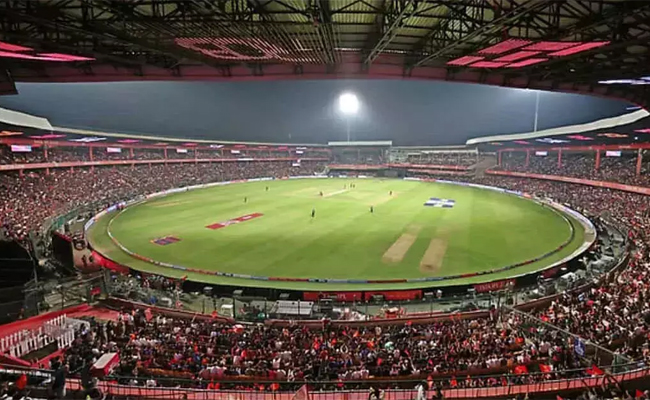
Bengaluru: The Karnataka State Cricket Association (KSCA) has issued a clarification stating that it was fully prepared to host the IPL playoffs and final matches in Bengaluru but the fixtures were allotted to other venues.
In a media note, KSCA said it was disappointed with the decision. The association stated that its president, former India cricketer Venkatesh Prasad, had been in touch with the Board of Control for Cricket in India (BCCI) and had formally conveyed the association’s readiness and interest in hosting the matches at the M. Chinnaswamy Stadium.
KSCA said the IPL matches held in Bengaluru this season were appreciated for smooth conduct, crowd management and overall experience for spectators. It said this reflected its ability to handle high-profile matches.
The association also stated that it had sent a detailed communication to the BCCI explaining its preparedness and the operational arrangements followed during the current IPL season. According to KSCA, these systems have been in place since the start of the Indian Premier League in 2008 and were followed consistently, including during previous playoff matches hosted in Bengaluru.
The clarification added that the communication sent to the BCCI was only meant to provide factual and operational details and to bring clarity on logistical and stakeholder-related requirements involved in hosting such matches.
KSCA said that although it had shown willingness and preparedness, the BCCI has decided to allocate the playoff matches to other venues. It added that the reasons for this decision have not been formally shared with the association, but it respects the authority of the board in taking such decisions.
The association further said it remains ready to host matches of national and international importance and will continue to cooperate with the BCCI, franchises, government authorities and other stakeholders for conducting cricket events.
The statement was issued by KSCA official spokesperson Vinay Mruthyunjaya, who also thanked the media and cricket fans for their continued support.