Ambulance topples as car hits it near waterlogged road in Kasaragod
patient dies in hospital, seven injured

Kasaragod: A patient who was being taken to hospital in an ambulance sustained serious injuries following a collision between a car and the ambulance near Uppala Gate on Tuesday evening and died in hospital.
The accident victim is identified as Shaheena (48). She was rushed to a hospital in Mangaluru immediately, but could not be saved as she failed to respond to the treatment.
Seven other people, including Shaheena's daughter Riya Fathima (9), sister Shajeena (45) and relative Asif (22), as well as the ambulance driver Akram (38), are reported to have been injured in the accident.
The accident is said to have occurred due to waterlogging of the road following heavy rain in the area. The ambulance was taking Shaheena from a hospital in Kannur of the district to Mangaluru for further treatment when the driver, finding the road to be inundated, applied the brakes suddenly. A car that was behind ambulance is learned to have collided with the ambulance that halted unexpected. Due to the force of the collision, however, the ambulance driver reportedly lost control and the vehicle overturned on the road.
The collision also resulted in a serial accident as five vehicles that were behind the car crashed into the vehicles ahead of them.
Let the Truth be known. If you read VB and like VB, please be a VB Supporter and Help us deliver the Truth to one and all.
Ordinance issued to increase number of Supreme Court judges from 34 to 38
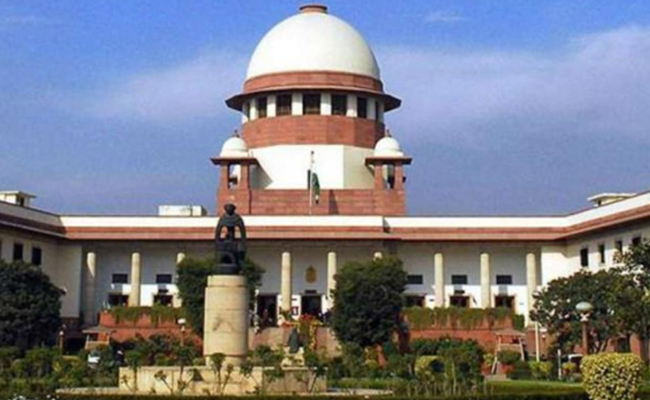
New Delhi (PTI): The government has promulgated an ordinance to increase the strength of the Supreme Court from the present 34 judges to 38, including the Chief Justice of India.
The law ministry notified the ordinance on Saturday, which amended the Supreme Court (Number of Judges) Act, 1956, to increase the sanctioned strength of the top court.
So far, the sanctioned strength of the top court was 34, including the Chief Justice of India (CJI). Now, the number of judges has been increased by four, taking the sanctioned strength to 38.
The top court will now have 37 judges, other than the CJI.
With the apex court having two vacancies at present, and the ordinance coming into force immediately, the Supreme Court Collegium will now have to recommend six names for appointment as judges in the top court.
A bill will be brought in the Monsoon Session of Parliament to convert the ordinance – an executive order – into a law passed by Parliament.
The Union Cabinet had cleared a draft bill on May 5 to increase the number of apex court judges.
The strength of the Supreme Court was last increased from 30 to 33 (excluding the CJI) in 2019.
The Supreme Court (Number of Judges) Act, as originally enacted in 1956, put the maximum number of judges (excluding the CJI) at 10.
This number was increased to 13 by the Supreme Court (Number of Judges), Amendment Act, 1960, and to 17 by another amendment to the law.
The Supreme Court (Number of Judges) Amendment Act, 1986, augmented the strength of judges from 17 to 25, excluding the CJI.
A fresh amendment in 2009 further increased the strength from 25 to 30.
Article 124(3) of the Constitution lists the qualifications required to become a Supreme Court judge.
An Indian citizen who has either served as a high court judge for at least five years, or as an advocate for 10 years, or is a distinguished jurist, can be appointed to the top court.
The strength of the Supreme Court is increased based on the recommendations of the CJI, who writes to the Union law minister. After consulting the finance ministry, the Department of Justice under the law ministry moves the Cabinet with a draft bill.