Country passing through toughest of times: Harsh Mander says in Mangaluru
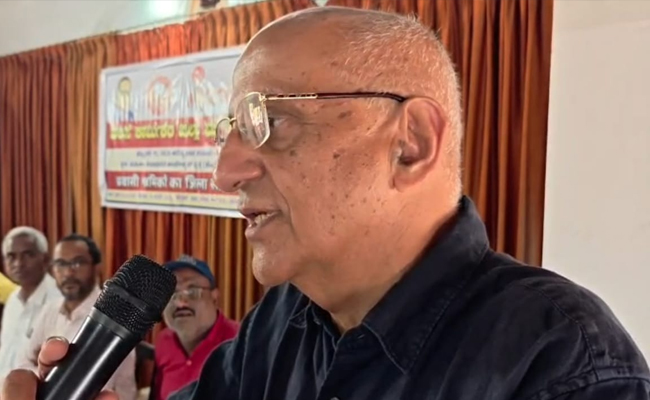
Mangaluru: A district-level conference of migrant workers was held at Mahila Sabha Bhavan, Ambedkar Circle (Jyothi Circle), under the banner of the All India Central Council of Trade Unions (AICCTU), Dakshina Kannada District Committee.
The event, organised with the call to unite migrant workers and raise issues related to safety, dignity and justice, saw the participation of workers from different backgrounds. The poster of the programme carried the message: “Migrant Workers Are NOT Slaves, NOT Terrorists — They are Workers Who Came to Earn a Living!”
Addressing the gathering, social activist Harsh Mander said the country is passing through a difficult phase and alleged that unorganised workers are among those facing the most serious challenges.
He said that unorganised workers have been repeatedly affected by major policy decisions in recent years. Referring to demonetisation, he questioned its impact on workers who depend on daily earnings. He also spoke about the sudden announcement of the nationwide lockdown during COVID-19 with four hours’ notice, stating that a large number of people in the country live in single-room houses, making physical distancing difficult.
He pointed out that a majority of workers in India are part of the unorganised sector and depend on daily wages. According to him, when work was abruptly stopped during the lockdown, many workers were left without income or support.
Harsh Mander said he had approached the Supreme Court seeking directions that unorganised workers should receive wages during the lockdown period. He stated that the demand was not accepted and alleged that crores of workers were left without adequate assistance, forcing many to return to their native places under harsh conditions.
He further claimed that labour protections have weakened in recent years and said workers were given limited security under new legal changes.
Raising another concern, he said that in the past decade there has been an increasing trend of branding workers as “traitors” or “infiltrators”. He alleged that Muslim labourers in particular were being called “Bangladeshis” and “ghuspetis”. He argued that people migrate in search of livelihood and do not leave their homes without reason.
He said that the term “ghuspeti” suggests conspiracy against the country and added that such labels create fear among workers. Referring to statements made by political leaders, including Union Home Minister Amit Shah and some Chief Ministers from the BJP, he said such language contributes to suspicion and division.
Harsh Mander also spoke about incidents where, following terror attacks in Kashmir, Muslim labourers in other parts of the country faced fear and hostility. He urged workers not to see such issues as affecting only one community.
He said that a worker’s primary identity is that of an Indian and a labourer, irrespective of religion. Calling for unity among workers across communities, he said injustice against any worker must be opposed collectively.
He urged the gathering to build solidarity among labourers and concluded his speech with a call to uphold the Constitution.
Let the Truth be known. If you read VB and like VB, please be a VB Supporter and Help us deliver the Truth to one and all.
Two killed as college tour bus crashes into parked tanker, lorry near Maravanthe
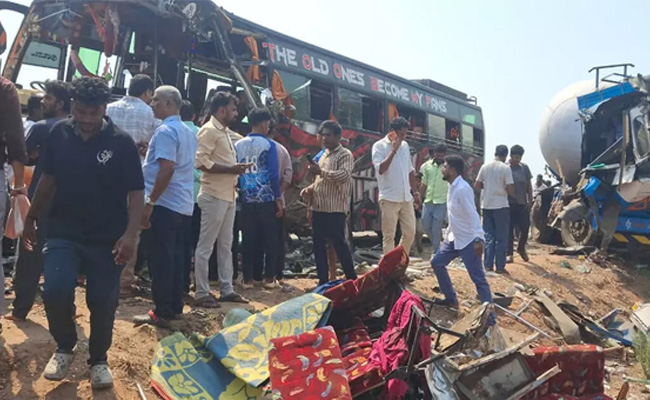
Kundapur: Two persons died and several students were injured after a college tour bus rammed into a tanker and a goods lorry parked by the roadside near Maravanthe Beach in Trasi on Wednesday afternoon.
The bus was carrying final-year B.Com students of Rambhapuri College from Shivamogga district. According to sources, the group had left for the tour two days ago.
There were around 50 persons in the bus, including 24 male students and 23 female students.
The students had visited Murdeshwar and were travelling towards Udupi on Wednesday when the accident occurred.
Police said the bus driver reportedly lost control of the vehicle, following which the bus first hit a parked gas tanker and then crashed into a goods lorry stationed ahead.
The front portion of the bus was badly mangled in the impact. Preliminary information said the bus cleaner and a cooking assistant travelling with the group died in the accident. Several injured students were shifted to different hospitals in Kundapur for treatment.