Mangaluru (Press release): Canara Plastic Manufacturers & Traders Association (CPMTA) Mangalore has whole heartedly welcomed the DCPC Govt of India for in principle approval for Mangalore Plastic Project.
With the commissioning of Polypropylene Petrochemical Complex and the proposed Polyethylene Project in Mangalore by MRPL the opportunities for Plastic Industries Canara Plastic Manufacturers Association(CPMTA) had requested with the Union Minister for Chemicals & Petrochemicals to set up a PLASTIC PARK in Mangalore.
Our Honorable Member of Parliament Mr.Nalin Kumar Kateel has persistently put his efforts to get the Plastic Park to Mangalore. But for his continous effort we would not have got this project to Mangalore.
Objective of Plastic Park is to
- Increase the competitiveness, polymer absorption capacity and value addition in the domestic downstream plastic processing industry through adoption of modern, research and development led measures. 2. Increase investments in the sector through additions in capacity and production, creating quality infrastructure and other facilitation to ensure value addition and increase in exports.3. Achieve environmentally sustainable growth through innovative methods of waste management, recycling, etc.
- Adopt a cluster development approach to achieve the above objectives owing to its benefits arising due to optimization of resources and economies of scale.
An amount of Rs. 40 crore will be provided by the Central Govt. as Grant in aid for this project. This Plastic Park will be implemented through KIADB will be initially in area of 96.05 acres. Entrepreneurs have already shown their expression of interest to investment in Mangalore Plastic park. This will create more employment opportunities for the people of this region.
Let the Truth be known. If you read VB and like VB, please be a VB Supporter and Help us deliver the Truth to one and all.
Delhi HC Judge Justice Sharma to pass order on recusal plea by Kejriwal at 4.30 pm
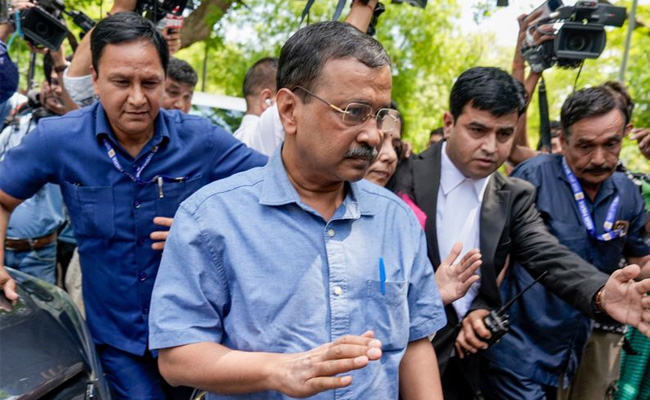
New Delhi (PTI): Delhi High Court Judge Justice Swarana Kanta Sharma on Monday said that she would pronounce her verdict at 4.30 pm on pleas by Arvind Kejriwal and others seeking her recusal in the liquor policy case, as she took on record additional pleadings by the AAP chief on his plea.
Justice Sharma said although the pronouncement was scheduled for 2:30 pm, she was "going out of her way" in accepting Kejriwal's rejoinder as a written submission in the matter.
The former chief minister virtually appeared before the judge through video conferencing and urged her to take on record his rejoinder to the written submissions filed by the CBI.
Even as Kejriwal asserted that the registry's refusal to take his rejoinder on record was "miscarriage of justice", Justice Sharma remarked that since he was not being represented by a lawyer, the court went "out of its way" for him when it permitted him to file his additional affidavit last week even after the order on the recusal issue was reserved.
The judge said that as per the registry's rule, a party in-person must take permission from the court to file anything and since the present case was not "extraordinary", the same practice was being followed.
She added that in law, there is no concept of filing a "rejoinder" to the opposite party's written submissions, and she would permit Kejriwal to tender his pleadings as written submissions instead, so that he does not feel that he was not heard.
"You say you have respect for me. I have respect for every litigant. The rule of court will not be changed for anyone so I will treat it as written submissions. I am taking it on record. I am giving the indulgence to Mr Kejriwal," the court stated.
Solicitor general Tushar Mehta appeared for the CBI and opposed Kejriwal's request to file rejoinder. Mehta said nowhere in the country were pleadings taken on record after order was reserved a court.
He also said there is no concept of filing rejoinder to a written submission, and the court should do what it would do for any ordinary litigant.
Kejriwal had raised several objections against the judge hearing the CBI's plea against his discharge in the liquor policy case, including that she had earlier denied him relief on his petition challenging his arrest and refused to grant relief on the bail pleas of other accused, including Manish Sisodia and K Kavitha.
He also claimed that Justice Sharma had made "strong and conclusive" findings.
The former Delhi chief minister further alleged a "direct conflict of interest", claiming that the judge's children are empanelled central government lawyers who receive work through the solicitor general, who is appearing in the matter for the CBI.
Besides Kejriwal, the applications for recusal of the judge were also filed by AAP leaders Manish Sisodia and Durgesh Pathak.
Other respondents, including Vijay Nair and Arun Ramchandra Pillai, have also sought her recusal.
Solicitor General urged Justice Sharma to initiate contempt action against Kejriwal and others for seeking her recusal.
Terming concerns by Kejriwal and others as "apprehensions of an immature mind," Mehta told the court it was a matter of "institutional respect" and Justice Sharma should not succumb to pressure as her recusal on "unfounded allegations" would set a bad precedent.
On February 27, the trial court discharged Kejriwal, Sisodia and others in the Delhi liquor policy case, saying that the CBI's case was wholly unable to survive judicial scrutiny and stood discredited in its entirety.