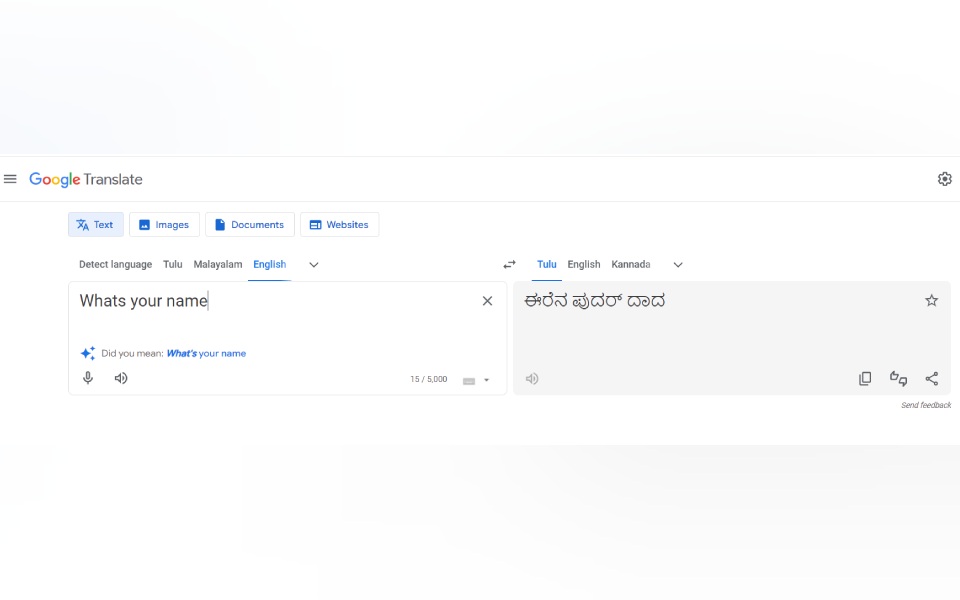
Mangaluru: In a significant stride towards preserving and promoting regional languages, Google has added Tulu to its translation services.

Tulu joins 110 new languages on Google Translate from June 27, marking a historic moment for the millions of people who speak this language. This addition allows users to easily translate Tulu words and phrases, enhancing the accessibility and understanding of this cherished language.

The Tulu-speaking community, which has long sought greater recognition for their language, is celebrating this achievement as a major honour, especially since Tulu is not officially recognised in the Eighth Schedule of the Indian Constitution.

While the initial translations for Tulu on Google Translate may contain some errors, the system is expected to improve over time. Users are encouraged to provide accurate translations in the feedback section to help refine and enhance the service's accuracy.

Google's inclusion of Tulu leverages advanced Natural Language Processing (NLP) technology. This involves a statistical-based method that relies on large amounts of data. For Tulu, approximately 2 million translated sentences, including nouns and verbs, were fed into the system, allowing the machine to learn and improve its translations progressively.

Expressing satisfaction over the new global acclaim of the Tulu language, Tharanath Gatty Kapikad, president of Karnataka State Tulu Academy, told PTI that the Tuluva people must make extensive use of this new global service and take forward the literary heritage of Tulu language.

He said it is natural that there could be some misgivings in translating from one language to another. In such cases, he advised the Tuluvas to use the feedback button on Google translator to correct such misgivings.

Former Karnataka Chief Minister M Veerappa Moily had been a strong votary of inclusion of Tulu language into the Eighth schedule of the Constitution and had taken a delegation to meet various Central leaders to include Tulu language into the Eithth Schedule.

He expressed happiness over the new global recognition given to Tulu language by Google through creating a translation interface with other languages. That means Tulu has gained much more ground on a global scale.

Even non-Tulu speakers in Karnataka may have encountered Tulu phrases through popular Kannada movies such as 'Ulidavaru Kandanthe,' 'Garuda Gamana Vrishabha Vahana,' and 'Kantara,' as well as the Hindi movie 'Welcome.' Despite some initial challenges and the need for ongoing refinements, the inclusion of Tulu in Google Translate is a milestone. It paves the way for greater preservation and broader usage of the language. This global recognition not only brings pride to the Tulu-speaking community but also ensures that Tulu remains relevant and vibrant in the digital age.

Tulu has a script of its own but not popularised. The Dharmasthala Museum for art has displayed Tulu script.

Efforts are on at the national level to include Tulu into the Eighth Schedule of the constitution. Tulu is also a language of entry for TOEFL examination.

Kuppam University in Andhra Pradesh has a chair for Tulu development. Tuluva scholars like Prof. Viveka Rai, late Amrut Someshwara and late K S Haridas Bhat recognised Tulu as one of the 'Pancha Dravida Bhasha' - Tamil, Malayalam, Telugu, Kannada and Tulu.

Get all the latest, breaking news from Mangaluru and Dakshina Kannada in a single click. CLICK HERE to get all the latest news from Mangaluru.

Let the Truth be known. If you read VB and like VB, please be a VB Supporter and Help us deliver the Truth to one and all.


Bengaluru (PTI): The Karnataka government has issued directions to municipal corporations across the state to regulate and prohibit feeding pigeons in public places, citing serious public health concerns.

Deputy Secretary to Government V Lakshmikanth has written to the Urban Development Department requesting it to issue directions to the Greater Bengaluru Authority (GBA) and all municipal corporations to take immediate steps to implement the measures.

In an official note dated December 16 issued by the Health and Family Welfare Department and released to the media on Wednesday, the department said uncontrolled feeding of pigeons in public places has resulted in large congregations of birds, excessive droppings and serious health concerns, particularly respiratory illnesses linked to prolonged exposure to pigeon droppings and feathers such as hypersensitivity pneumonitis and other lung diseases.

 ALSO READ: Chinese GPS tracker found on seagull near Karwar Coast

"The commissioner, the Greater Bengaluru Authority and the Commissioners and chief officers of other municipal corporations shall take necessary action to mitigate the causes of dangerous disease spread by pigeon and enforce specified guidelines in their respective jurisdiction," the note said.

According to the department, these include a prohibition on feeding pigeons or causing pigeons to be fed in areas where it may cause nuisance or pose a health hazard to the public. Pigeon feeding shall be permitted only in designated areas in a controlled manner, subject to certain conditions.

"The designated areas may be selected in consultation with stakeholders. The responsibility for upkeep of the designated areas and compliance to the directions shall be taken up by some charitable organisation or an NGO. The feeding in designated areas shall be permitted only for some limited hours in the day," it said.

The note further stated that authorised officers of local authorities shall issue on-the-spot warnings and may impose fines for violation of the order, or lodge complaints to prosecute offenders under Sections 271 (Negligent act likely to spread infection of disease dangerous to life) and 272 (Malignant act likely to spread infection of disease dangerous to life) of the Bharatiya Nyaya Sanhita.

It also directed local authorities to conduct public awareness campaigns, including the display of signboards, banners and digital messages, explaining the health hazards associated with pigeon droppings and feathers, the content of the regulatory directions and penalties for violations, and alternative humane methods of bird conservation that do not endanger public health.