Rules will be formed for transfer of police personnel: Home Minister G. Parameshwara
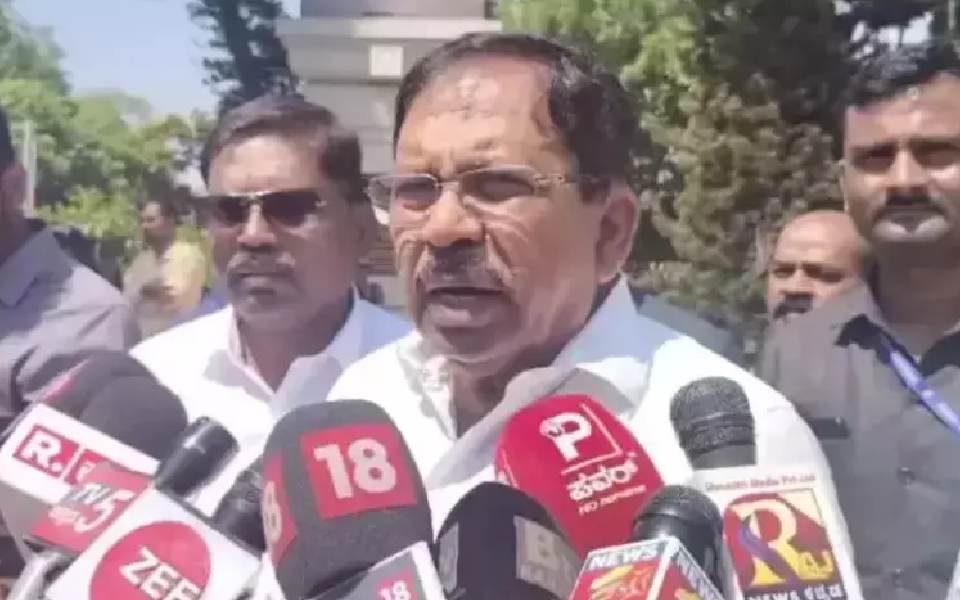
Bengaluru: Karnataka Home Minister announced that proper rules will be formulated for transfer of police constable at inter-district level. He was addressing the reporters in the city on Monday.
He pointed out that till now there were no rules on the transfer of constables. “This time, transfers involving husband and wife will be done. I have discussed this matter with the Director General of Police. The issue of inter-district transfers will be resolved soon."
Responding to allegations from the BJP that the government is showing partiality in cases, particularly in the illegal activities involving the Valmiki Corporation compared to actor Darshan's case, Parameshwara asserted that the government is not protecting any wrongdoers. "Action will be taken according to the law, regardless of whether the culprits are officers or political figures," he said.
ALSO READ: Got a call from BJP to rejoin party, says expelled leader Eshwarappa
He clarified that the CBI is investigating the fraud involving bank officials, while the SIT is probing the fraud within the department. Addressing the BJP's protests and threats to besiege the Chief Minister's house, he remarked, "Let them protest, who says no? It is natural for accusations to be made against ministers and MLAs during investigations. Action will be taken based on the investigation report."
Regarding the impact of the three new criminal laws enacted in the country, Parameshwara noted that it is too early to assess their effects. "These new laws will apply to cases registered from today. We will have to see how they are addressed in court once cases are registered," he added.
Let the Truth be known. If you read VB and like VB, please be a VB Supporter and Help us deliver the Truth to one and all.
Rickelton's ton in vain as SRH beat MI by 6 wickets
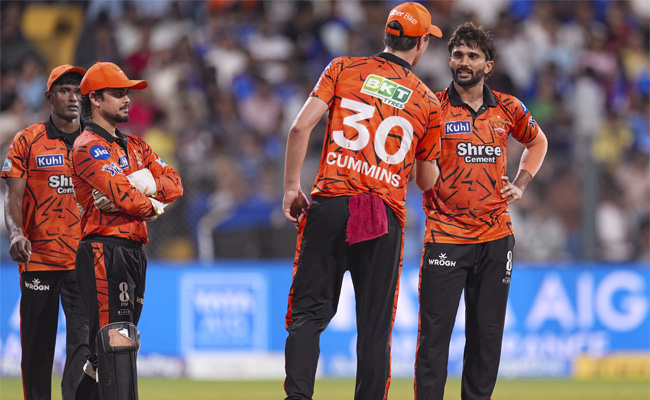
Mumbai (PTI): Ryan Rickelton's whirlwind unbeaten ton was overshadowed by Heinrich Klaasen's unbeaten 65 as Sunrisers Hyderabad defeated Mumbai Indians by six wickets in an IPL match here on Wednesday.
Chasing an imposing 244-run target, Travis Head (76 off 30) and Abhishek Sharma (45 off 24) shared 129 runs for the opening wicket to set the platform for SRH.
Klaasen (65 not out off 30 balls) then displayed his all-round hitting abilities to guide SRH home with the help of Nitish Kumar Reddy (21) and Salil Arora (30 not out off 10) in 18.4 overs.
Earlier, Rickelton's knock powered MI to 243 for five.
MI rode on a 93-run stand between Rickelton (123 not out off 55 balls) and Will Jacks (46 off 22) in 7.1 overs for the opening stand to power the side.
MI skipper Hardik Pandya scored a valuable 31 off 15 balls before being dismissed.
Praful Hinge (2/54), Eshan Malinga (1/29), Sakib Hasan (1/39) and Nitish Kumar Reddy (1/31) were the wicket-takers for SRH.
Brief Scores:
Mumbai Indian: 243 for 5 in 20 overs (Ryan Rickelton 123 not out; Praful Hinge 2/54).
Sunrisers Hyderabad: 249 for 4 in 18.4 overs (Travis Head 76, Heinrich Klaasen 65 not out; AM Ghazanfar 2/51).