Haji KS Sayeed Karnire Charitable Trust hands over 7 houses, foundation stone for 14 other laid
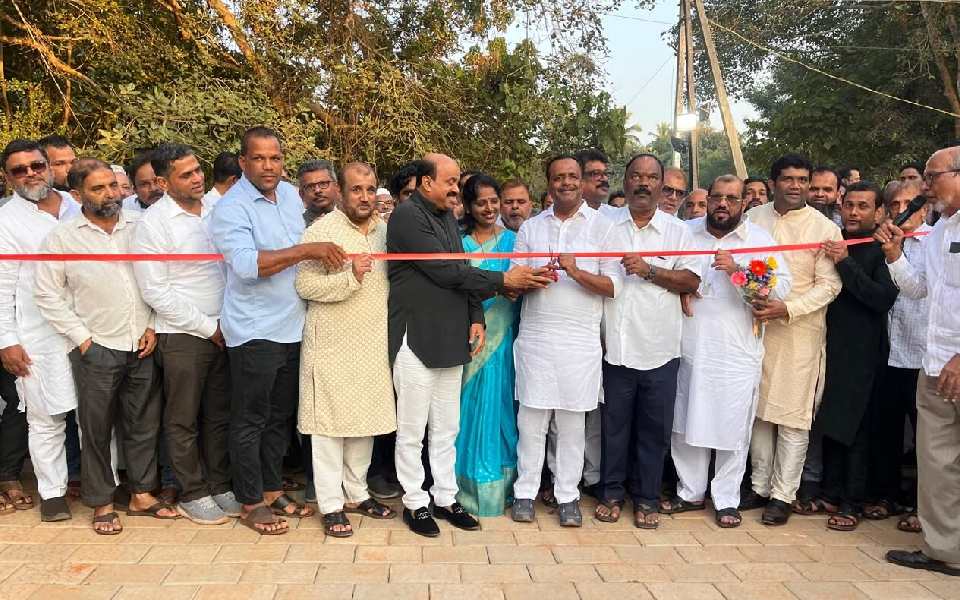
Padubidri: The Haji KS Sayeed Karnire Charitable Trust handed over seven newly constructed houses and laid the foundation stone for fourteen more in Karnire on Sunday.
Assembly Speaker U.T. Khader, who inaugurated the houses, highlighted the significant impact of this initiative, noting that while owning a home is a universal dream, many are unable to realize it.
He commended the project as a model of compassion and inspiration, emphasizing that such achievements go beyond financial capability and reflect a commitment to serving marginalized communities. He expressed hope for more transformative projects from the trust in the future and wished the beneficiaries a life of peace and harmony in their new homes.
Managing Trustee K.S. Sheikh, presiding over the event, detailed the trust’s ambitious project to construct 50 houses on two and a half acres of land. Each house, valued at approximately ₹20 lakh, is fully furnished with modern amenities, including a kitchen, hall, two bedrooms, and a washing machine. Sheikh explained that these homes are provided to deserving families in Karnire who lack proper housing.
He further revealed that with the foundation stone being laid for the construction of 14 more houses. There is a plan to build 50 houses on this land again, on two and a half acres of land.
Kaup MLA Gurme Suresh Shetty lauded the trust for its compassionate service in sheltering the underprivileged.
Former MLA Mohiuddin Bava praised the legacy of Syeed Haji’s hard work, which has turned his family into a beacon of service and harmony. He remarked that the family's actions have become a model for communal unity.
Federation of World Bunts Vice President Karnire Vishwanath Shetty said, "Even though I have added Karnire to my name, the credit for taking the small village of Karnire to the world level belongs to the Syeed Haji family. Karnire is a town where everyone lives in harmony, regardless of caste, religion or difference. While Hindus have helped in the reconstruction of the mosque here, the Muslim community has also joined hands in the construction of the Hindu temple."
Speaking in the opening remarks, K.S. Ashraf recalled the guidance of his late parents, expressed his gratitude for their teachings of kindness and service, which continue to inspire the family’s charitable efforts. He said, "We should do good to people. Our father used to preach to wish others well. Seeing his preaching and service, we have continued it. It is a great loss that our father and mother are not with us today. If they were here, they would have been happy now."
On this occasion, U.T. Khader honored K.S. Sheikh on behalf of Karnire Juma Masjid and Karnire Khidma Young Men's Association.
Abdul Jalil MH of Design Plus Architects, contractor H.N.G.C. Hussain, and supervisor Ramesh Kotian were also recognized for their contributions.
Karnire Juma Masjid Qatheeb Umarul Farooq Saquafi performed the dua. Family elders M.K. Abdul Hamid Mulki, K.S. Aboobacker were present.
Also present during the program were Balkunje Grama Panchayat President Mamata D. Poonja, Harishchandra Shetty, Karnire Juma Masjid President Muhammad Ali, Adv. Bhaskar Shetty, Kote Shekhabba Kannangar, T.K. Muhammad Kote Palimaru, Karnire Harishchandra Shetty, Khidma Youngmen's President Khidma B.N, Ismail, K.S. Ashfak.
K.S. Ashraf delivered the welcome address, K.S. Abdul Rahim offered a vote of thanks, and Muhammad Ali Kammaradi moderated the event.
Let the Truth be known. If you read VB and like VB, please be a VB Supporter and Help us deliver the Truth to one and all.
Two people killed as poultry vehicle rams into parked truck in Belagavi

Belagavi (Karnataka) (PTI): Two people were killed, and another was severely injured after a goods vehicle transporting poultry birds allegedly rammed into a stationary truck on a national highway in Belagavi in the early hours of Tuesday, police said.
The deceased have been identified as Wasim (28) and Mubarak (22), both natives of Shivamogga district, they said.
The driver of the vehicle, Basavaraj Eerappa Hanchinamani (37), suffered critical injuries and has been admitted to a hospital, police said.
According to police, the accident occurred when the driver reportedly lost control of the vehicle, allegedly due to drowsiness, and crashed into a truck parked along the highway.
The goods vehicle was en route from Kolhapur to Sorab in Shivamogga district, carrying poultry. Several chickens were also killed in the impact, a senior police officer said.
Police personnel from the Hirebagewadi Police Station visited the spot and conducted an inspection.
Injured people and the bodies of the deceased were shifted to a hospital, police added.