Kundapur: Two ancient standing stones (megalithic menhirs) discovered during archaeological survey
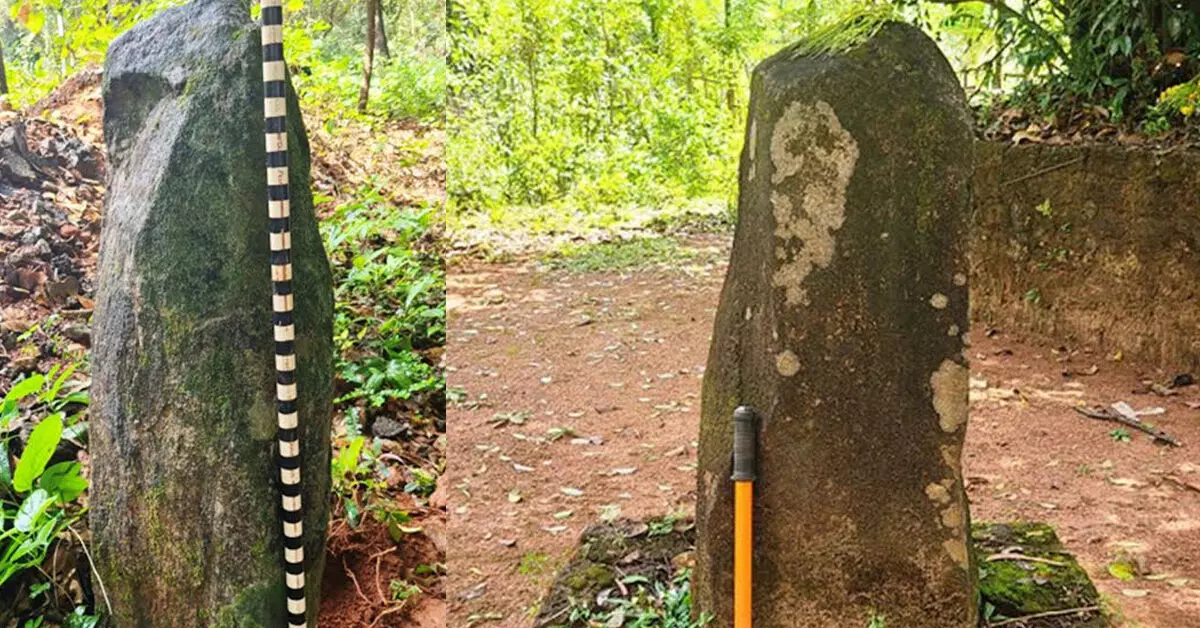
Udupi: Two ancient standing stones dating back to the Iron Age have been discovered in the Kundapur taluk of Udupi district during an archaeological exploration carried out recently by the national cultural organisation Adima Kala Trust, according to its founder-director and archaeological researcher Prof. T. Murugeshi.
One standing stone is located at Hilkodu, in the Daivada Haadi on the left side of the state highway from Nerlekatte to Aajri in Kundapur taluk. Locals refer to it as the Neecha Daiva or Bobbarya stone. The second standing stone was found at Mavinakere Haadi in Kenchanur village of the same taluk, beside the roadside. Prof. Murugeshi stated in a press release that locals have recently tied a cloth around half of this upright stone and begun worshipping it as Rakteshwari.
The Mavinakere standing stone measures 112 cm in height and is slightly inclined towards the northwest. The Hilkodu stone stands around 135 cm tall. A trial excavation beneath the Hilkodu stone revealed pieces of red and ochre-coloured pottery, indicating its antiquity.
People of the Megalithic culture traditionally erected large upright stones either on burial sites or nearby as memorial monuments after funeral rites. Such stones typically range from 3 feet to as much as 16 or 17 feet in height. Across South India, these are known by various names including Rakkasagallu, Nilskal, Nintikallu, Garbhiniyar Kallu, Basurikal, and Anekallu.
Historical significance
The standing stones at Mavinakere and Hilkodu belong to the later phase of the Megalithic period. The pottery fragments found beneath the Hilkodu stone support this assessment. The standing stones at Nilskal and the Heragal group in Hosanagar taluk of Shivamogga district are believed to date back to around 800 BCE.
The newly discovered stones in Kundapur are estimated to belong to a period between 300 BCE and the 1st or 2nd century CE. Prof. Murugeshi noted that remnants from the Megalithic age have greatly influenced the cultural life of Tulu Nadu and stressed that preserving such heritage structures is a collective responsibility.
He expressed gratitude to those who assisted in the research, including Vishwanath Gulwadi, Sudhakar Shetty, Agriculture Officer C. Nagaraj Shetty, Manju Poojary of Hilkodu, and Adima Kala Research Team members Murulidhar Hegde (Iduru–Kunjadi), Shreyas Bantakal, and Gautham Belman.
Let the Truth be known. If you read VB and like VB, please be a VB Supporter and Help us deliver the Truth to one and all.
Speaker Khader dismisses BJP's charges of 'delay' in swearing-in of Jeevaraj as MLA
Bengaluru (PTI): Karnataka Assembly Speaker U T Khader on Wednesday rejected opposition BJP's allegations of delaying the swearing-in of D N Jeevaraj as MLA, asserting that the process was being handled strictly in accordance with constitutional provisions and rules.
BJP candidate Jeevaraj, who had lost the 2023 Sringeri Assembly election to Congress leader T D Raje Gowda, was declared elected late Sunday night after reverification and recounting of postal ballots in compliance with a High Court order.
The recount reduced 255 votes from Gowda's tally, overturning his earlier victory margin of 201 votes and reversing the result.
The recount followed an election petition filed by Jeevaraj.
Addressing reporters, Khader maintained that there was no delay in administering the oath to Jeevaraj, who was declared elected from the Sringeri Assembly constituency after a High Court-ordered recount of postal ballots.
“Where have we delayed? The application was submitted at 11 am. If an application is given in the morning and by evening someone says it’s delayed — how is that a delay?” he said, dismissing the allegations.
The Speaker said the matter involved 'technical issues' that required examination before fixing a date for oath-taking.
“When such a matter comes, we also need to examine it and take a decision as per rules. If an application is given in the morning, at least 24 hours must be given,” he said.
Khader stressed that his role was bound by the Constitution and not influenced by political considerations.
“When an elected MLA asks for time, we must give it under the Constitution and law. Can we refuse? No, we have to give it,” he said, rejecting suggestions that he was acting under party pressure.
He also underlined the need for trust in democratic institutions amid the controversy.
“A democracy and parliamentary system must function on trust. Without that, how can democracy be strengthened? Trust is essential,” he said, cautioning against creating suspicion around constitutional positions.
On claims that the delay was linked to the ongoing political and legal dispute over the recount, Khader said the issue did not fall within his purview.
“My responsibility is to act as per the Constitution and rules. I will ensure that whatever is due to them is done as soon as possible,” the Speaker explained.
He said he had already communicated his position when contacted and would formally inform the concerned parties. “There is no delay, nor any intention to delay. I will discharge my duties as per the Constitution,” he said.
Khader also pointed to possible legal complications in hastily administering the oath.
“If I give the oath to one person and tomorrow the court declares someone else the winner, what happens then? Will it automatically cancel? Will confusion arise?” he asked, indicating the need for due diligence.
On concerns that Jeevaraj had lost over two years of tenure, the Speaker said representation was linked to that constituency rather than an individual.
“Whoever becomes the MLA represents the constituency. Benefits are not given to an individual,” he said, adding that issues of alleged irregularities should be examined by the Election Commission.
The remarks come after the Leader of Opposition BJP in the Karnataka Assembly, R Ashoka on Wednesday accused the Speaker of 'deliberately' delaying the oath and approached Governor Thaawarchand Gehlot seeking intervention, even suggesting that the Governor administer the oath if required.
Chief Minister Siddaramaiah termed the process 'Vote Dacoity' by Jeevaraj and said an FIR has been registered against the newly elected Sringeri MLA.
Defending the recount process, Jeevaraj denied allegations of tampering, while the High Court has stayed an FIR filed against him in connection with the postal ballot issue.