Majlis-e-Islah Wa Tanzeem demands action against Bhatkal BJP leaders for communal incitement
Bhatkal: The Majlis-e-Islah Wa Tanzeem, represented by its General Secretary Abdul Raqeeb MJ, has urged authorities to file a suo moto complaint against certain BJP leaders accused of spreading communal tension and false propaganda targeting Muslims and Waqf properties in Bhatkal. In a recent statement, the organization condemned inflammatory remarks that it claims are aimed at creating divisions within society.
Abdul Raqeeb highlighted the importance of Waqf properties in supporting the religious, social, and economic welfare of India’s Muslim community, noting that these properties contribute to essential services like mosques, madrasas, hospitals, and social welfare centres. He stressed that Waqf properties are legally protected under government laws and that the BJP’s 2014 election manifesto included a pledge to safeguard these properties from encroachment.
The Tanzeem raised concerns over recent statements from BJP leader Krishna Naik, who made provocative remarks in Bhatkal, suggesting that Muslims should "be sent to Pakistan" and referring to them as "tenants in India." Abdul Raqeeb criticized these statements as unconstitutional and warned that such rhetoric could disrupt the peace and harmony in Bhatkal, where the Tanzeem has actively worked for over a century to promote communal harmony.
“These baseless statements are spreading fear and undermining the social harmony in Bhatkal,” Abdul Raqeeb stated, adding that the Tanzeem has long been committed to maintaining peaceful coexistence in the region.
The organization has called upon the Karnataka government and local police to take immediate action to curb divisive speech. They urged authorities to initiate legal action against those responsible for propagating communal tensions and requested strict measures to prevent further escalation.
Let the Truth be known. If you read VB and like VB, please be a VB Supporter and Help us deliver the Truth to one and all.
Mamata betrayed Bengal's women by conspiring with parties like Cong: BJP chief
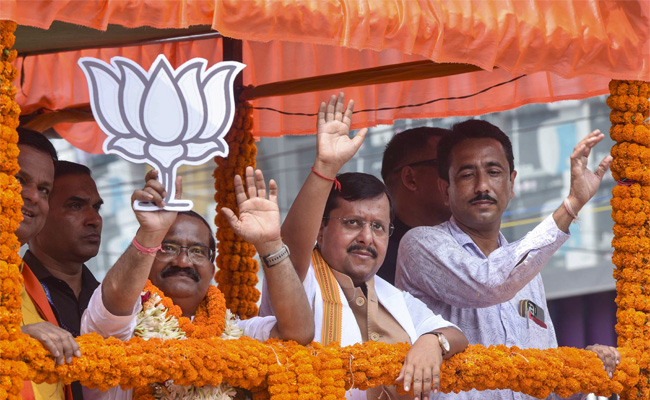
Balurghat (WB) (PTI): BJP president Nitin Nabin on Sunday blamed West Bengal Chief Minister Mamata Banerjee and opposition parties such as the Congress for the setback to the implementation of women's reservation in legislatures.
Addressing a rally in support of BJP candidate Bidyut Roy in Balurghat, Nabin said removing the TMC from power had become essential to drive out infiltrators from Bengal, prevent demographic change and safeguard national security.
"Despite being a woman, Mamata Banerjee betrayed the women of Bengal by conspiring with parties like the Congress so that the women's reservation bill could not be passed in the Lok Sabha," he alleged.
Urging women voters in the state to "teach her a lesson", he claimed that the TMC government had failed to ensure the safety and security of women, citing incidents such as those at RG Kar hospital and the medical college in Durgapur.
A Constitution Amendment Bill to implement 33 per cent reservation for women in legislatures in 2029 and increase the number of Lok Sabha seats to 816 was defeated on Friday.
Nabin also accused the chief minister of protecting infiltrators and said the BJP, if voted to power, would ensure good governance.
"Infiltrators will be driven out, and every bona fide citizen will be able to live peacefully in a secure environment if the BJP comes to power," he said.
Nabin said Prime Minister Narendra Modi had delivered on promises and prioritised national security, citing the abrogation of Article 370 and surgical strikes against Pakistan-backed terrorists.
"We need a government in Bengal which will ensure the state's well-being and security in every aspect," he said.
Appealing to voters to back the BJP, Nabin said, "If not now, then never."
"Let it be a historic victory. A new dawn will come, and after May 4, a government that will look after the aspirations of mothers, sisters, youth, the elderly and farmers will be installed in Bengal," he said.
At another election rally at Ratua in Malda district, Nabin claimed that time has come for the chief minister to “bid goodbye”.
Alleging deterioration in law and order, he said women were unsafe “from Park Street to Kamduni, and from R G Kar to Durgapur Medical College”, while there were many “unreported cases”.
He also alleged the involvement of ruling party leaders in various illegal activities.
“Wait for a few days. Members of the ‘bhaipo (nephew) syndicate’ of the TMC will be on the run, and caught one by one with legal action taken against them,” Nabin asserted.
He was referring to allegations by state BJP leaders about extortion syndicates “patronised by top TMC leaders” running into crores of rupees.
“At least one minister had been jailed, while many officials are behind the bars. Those involved in corruption would face strict action after May 4,” the BJP chief said.
Promising employment and welfare measures, Nabin said a BJP government would create job opportunities for the youth and ensure support for farmers.
He also assured the people of transparent recruitment based on merit, implementation of the Seventh Pay Commission, and direct transfer of benefits to bank accounts without “cut money” (commission).
Referring to the ‘Sabka Sath Sabka Vikas’ slogan of the Narendra Modi government, Nabin said “there will be inclusive growth involving all sections of society under the double engine government.”
“There will be no appeasement for one particular community, which caused change in the demography in several border districts of Bengal,” he said.
Nabin also took part in a programme of the ‘Balmiki Samaj’ – an outfit of backward Hindu castes – where he stressed on the need for inclusive growth.
Earlier, the BJP president led a colourful roadshow covering around 2 km in Balurghat town and adjoining areas of Dakshin Dinajpur district.