Mangaluru: Maddur man finds his mother, lost 14 years ago, at nursing home in Kulshekhara
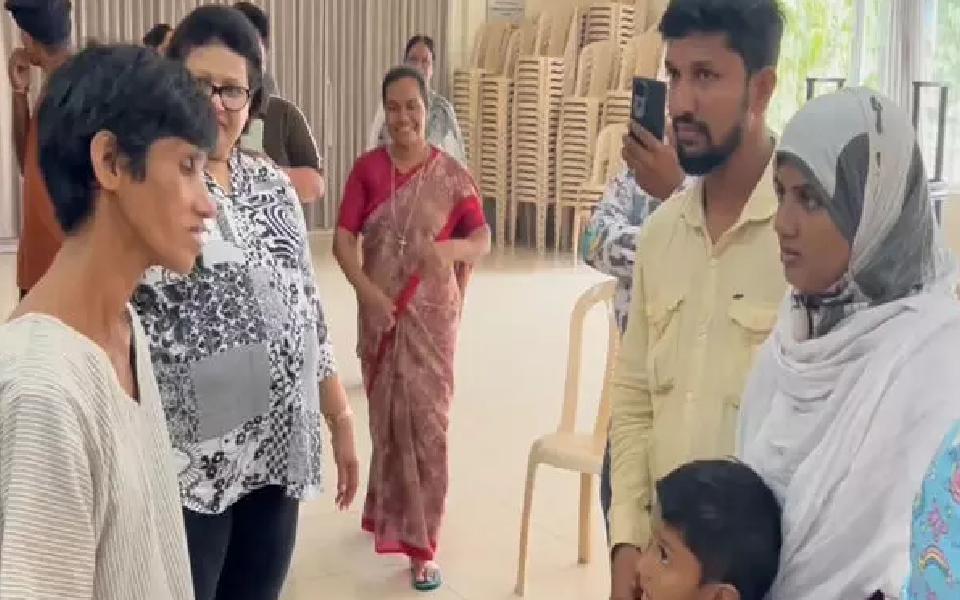
Mangaluru: White Doves Psychiatric Nursing and Destitute Home in Kulshekhara was witness to another heartwarming moment on Sunday. A mother, who was separated from her children for last 14 years due to her mental illness, was finally reunited with them.
In 2009, Corrine Antoinette Rasquinha, the founder of White Doves, received information about a mentally ill woman who was in the streets of Mangaluru. She brought the sick woman to her nursing home and provided necessary psychiatric treatment. Despite all her earnest attempts, Rasquinha could not find much about the mysterious woman, as is normal in many such cases. Farzana, the sick lady, could only say that she was from Maddur and her house was near a butcher's shop.
As there are lot of places with similar name, Rasquinha and her dedicated team at White Doves couldn't really locate the village or the family of Farzana. Despite the lack of clarity, the institution had sent people to different locations to find the woman's family. All attempts were in wain, until 2024.
After 14 years, Farzana was finally found by her family in Maddur of Mandya district. Asif, her son, got to know that his mother was at a nursing home through an acquaintance. Along with his wife and children, he came to Mangaluru to take his mother home.
Asif said that the family members had kept up their search to locate his mother for many years. When Farzana disappeared in 2009, Asif and his sister were very young. "My sister hadn't seen my mother at all. Now we are very happy that we have got her back", Asif told Vartha Bharati.
"We found Farzana in 2009. She couldn't give us any proper information then. We had lost all hopes about her going back. Two weeks ago, we reunited a woman from Maddur in Mandya with her family. We had informed them about Farzana. With their kind help, we could now reach Farzana's family", Corrine Antoinette Rasquinha said.
When she left home 14 years ago, Farzana was a young mother with two small kids. Today, she has aged prematurely and her kids are all grown up; they are married and have kids themselves. When Farzana, unable to identify her adult son, drew his three year old son into an embrace, mistaking him for his father, there were a lot of moist eyes around. Now she has set sail to her long lost home with a family that has vowed never to lose her again.
Let the Truth be known. If you read VB and like VB, please be a VB Supporter and Help us deliver the Truth to one and all.
8 children between ages of 1 and 14 dead after mass shooting in Louisiana, police say
Shreveport(US) (AP): A gunman in Louisiana killed eight children in shootings at two different homes early Sunday in the nation's deadliest mass shooting in more than two years, police in Shreveport said.
The victims ranged in age from one to about 14 years old, said Shreveport police spokesperson Chris Bordelon. A total of 10 were shot and some of the children were related to the suspect, Bordelon said.
The gunman later died after a chase with officers who fired at the suspect, Bordelon said. The suspect stole a car while leaving the scene of the shootings and was followed by police, according to Bordelon.
Police did not release the name of the suspect but did say he was an adult male. The shootings were the result of a “domestic disturbance,” Bordelon said.
Officials said they were still gathering details at the crime scenes south of downtown Shreveport — the two homes and a third location.
“This is an extensive scene unlike anything most of us have ever seen,” he said.
It was the deadliest mass shooting in the US since eight people were killed in a Chicago suburb in January 2024, according to a database maintained by The Associated Press and USA Today in partnership with Northeastern University.
At a news conference outside the residence where one of the shootings occurred, officials appeared stunned, requesting patience and prayers from the community as they sorted through multiple crime scenes.
“I just don't know what to say, my heart is just taken aback,” Shreveport Police Chief Wayne Smith said. “I cannot begin to imagine how such an event could occur.”
“This is a tragic situation — maybe the worst tragic situation we've ever had,” said Tom Arceneaux, mayor of the city in northwestern Louisiana with about 180,000 residents. “It's a terrible morning.”
Louisiana State Police say their detectives have been asked by Shreveport police to investigate. In a statement, state police say no officers were harmed in the shooting that involved an officer after a police pursuit into Bossier City on Sunday morning.
State police are asking anyone with pictures, video or information to share it with state police detectives.
Louisiana Gov Jeff Landry said in a statement that he and his wife were heartbroken. “We're deeply grateful to the law enforcement officers and first responders working tirelessly on the scene,” he added.