Mangaluru: Police arrest two individuals on charges of drug trafficking
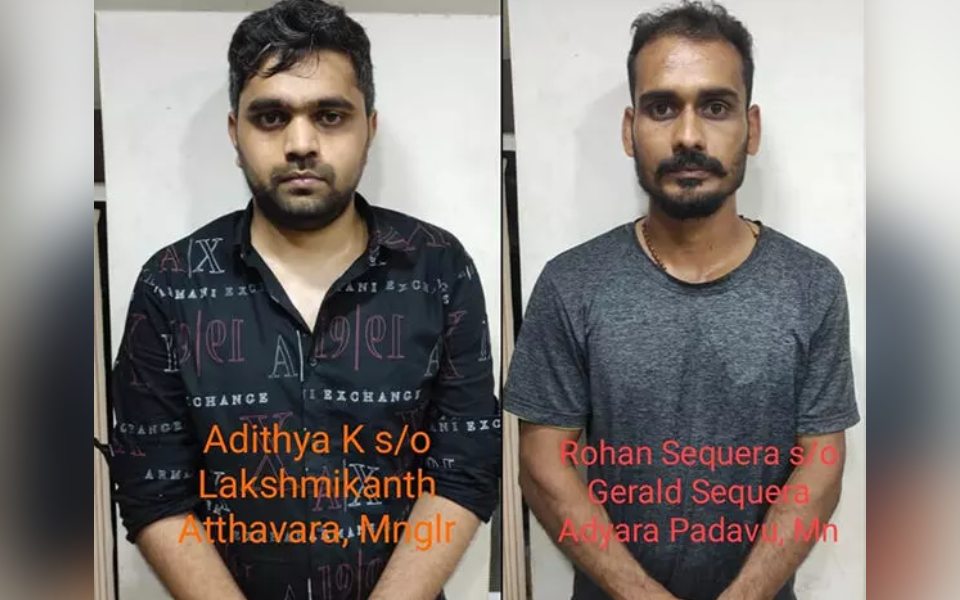
Mangaluru: In an operation, the ‘anti-drugs’ team of the central sub-division on Sunday evening arrested two individuals for their alleged involvement in drug trafficking.
The arrested accused identified as Aditya K (29), resident of Attavar and Rohan Sequeria (33) a resident of Adyarpadav, were reportedly selling drugs openly near New Balmatta Road in the city.
During the operation, the police have confiscated 27 grams of ‘hydro weed’ worth Rs. 50,000, 2.95 kg ganja worth Rs 1 Lakh, Ganja oil worth Rs. 8,000, LSD worth Rs 16,800 and 2 digital scales, 2 mobile phones worth Rs 90,000 used in the crime, a car worth Rs 20 lakh from the possession of the accused.
ALSO READ: Immoral policing: 4 held for harassing young couple at Panambur beach
Meanwhile, a case under the NDPS act(Narcotic drugs and psychotropic substances act,) has been registered against the accused at the Bunder Police Station. Additionally, the Police have also informed that an investigation into the matter is underway.
Let the Truth be known. If you read VB and like VB, please be a VB Supporter and Help us deliver the Truth to one and all.
BJP to resolve decades-old Gorkha issue within 6 months of forming govt in Bengal: Shah
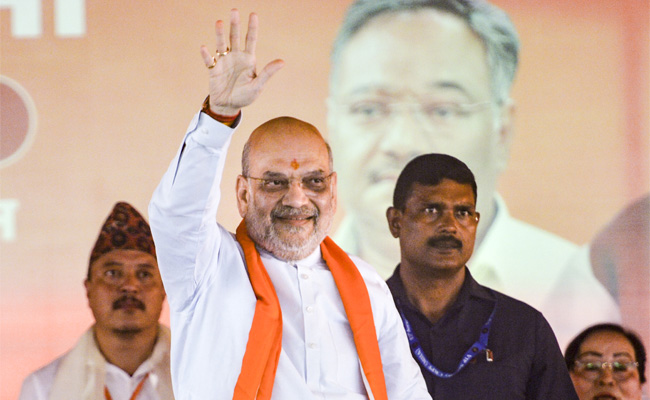
Kurseong (WB) (PTI): Seeking to strike an emotional chord with the politically crucial hill electorate, Union Home Minister Amit Shah on Tuesday promised that the BJP would resolve the decades-old Gorkha issue within six months if the BJP comes to power in West Bengal.
He said no party other than the BJP could find a solution acceptable to the Gorkhas.
Addressing a rally at Kurseong in Darjeeling district, Shah said the BJP understands the concerns and aspirations of the Gorkhas and would work towards a settlement on their terms.
"Within six months of the BJP forming the government in West Bengal, every Gorkha will have a smile on his face. We will find such a solution to the Gorkha issue that Gorkhas can live in peace," he said.
The Gorkha issue refers to the century-old demand for a separate state in the Gorkha-majority hill districts of north Bengal, although Shah did not utter the words 'Gorkhaland' or 'statehood' in his speech.
Instead, echoing the BJP's long-standing promise of a "permanent political solution" to the hill question, Shah said the issue would be resolved in accordance with the aspirations of the Gorkhas.
ALSO READ: APCR fact-finding team reports gaps between records, public narrative in Nashik TCS case
"I am leaving today after promising you that as soon as the BJP government is formed, the decades-old Gorkha issue will be resolved according to the Gorkhas' terms," he said.
The BJP, which has won the Darjeeling Lok Sabha seat in every election since 2009, has consistently promised a permanent political solution to the hill issue without committing itself to a separate state.
The home minister accused the Mamata Banerjee government of refusing to engage with efforts to resolve the issue and said that after becoming home minister, he had convened three meetings on the matter.
"After becoming home minister, I convened three major meetings to resolve the Gorkha issue, but not even once did a representative from Mamata's side attend," Shah said.
"Mamata Didi, we are not dependent on you for a solution to the Gorkha issue. We have appointed an interlocutor who is preparing a report by engaging with Gorkha organisations here and officials of the West Bengal government," he added.
Claiming that the BJP alone understands the concerns of the hill residents, Shah said, "We understand you and your problems. No one except the BJP can resolve the Gorkha issue."
The home minister alleged that the Congress and the TMC had betrayed the people of the hills for decades.
"The Congress and the TMC have done injustice not only to Darjeeling but also to our patriotic Gorkha brothers," he said.
Seeking to broaden the BJP's pitch beyond the Gorkha issue, Shah sought to portray the election as a battle to free north Bengal and the hills from what he called years of neglect and injustice under the TMC rule.
"This election is to free the entire West Bengal from TMC's crimes. In a way, it is an election to gain freedom from the injustice happening for decades in north Bengal and Darjeeling," he said.
Referring to the Sandeshkhali controversy, Shah said, "The whole of West Bengal has decided that it is time for Didi to step down. This election is about protecting our sisters across the state. The Sandeshkhali incident has brought shame to the state."
The BJP leader told the gathering that while Darjeeling had repeatedly backed the BJP, the party needed support from the rest of West Bengal this time.
"For three elections, Darjeeling has been voting for the BJP anyway, but the rest of West Bengal did not provide as much support. But this time, the whole of West Bengal has made up its mind that it's time to oust Didi," he said.
Shah also raised the issue of Gorkhas' names being allegedly deleted from the electoral rolls during the Special Intensive Revision (SIR) exercise.
"The names of some Gorkhas were deleted during SIR. Once the BJP government is formed in West Bengal, all such names will be included in the electoral rolls again," he said.
He further alleged that hundreds of false cases had been slapped on Gorkha activists and promised that these would be withdrawn if the BJP formed the government.
"They have filed hundreds of false cases against our Gorkha brothers and sisters. The results will come out on May 4, and a BJP government will be formed on May 5. Before July 31, the BJP government in West Bengal will withdraw all cases against Gorkha brothers and sisters," Shah said.
The home minister also attacked the Mamata Banerjee government over budgetary allocations for the tribals.
"For tribal development, for Adivasis, for the hills, and for north Bengal, the Mamata government's total budget is Rs 2,000 crore. But for Muslims and madrasas, the Mamata government's budget is Rs 5,800 crore. This injustice will not last much longer," he said.
The demand for Gorkhaland and greater political autonomy for the Darjeeling hills has remained one of the most enduring and emotive political issues in north Bengal, often shaping electoral outcomes in the region.
Successive agitations -- from the Subhash Ghising-led GNLF movement in the 1980s to the later stir spearheaded by Bimal Gurung and the GJM, have repeatedly convulsed the hills.
Yet, despite the BJP's rise in Darjeeling and its continued dominance in the Lok Sabha seat since 2009, the party has so far stopped short of endorsing a separate state as it would have an adverse impact on south Bengal, preferring instead to speak of a "permanent political solution".