Mangaluru: Serial killer Cyanide Mohan Kumar gets life term until death
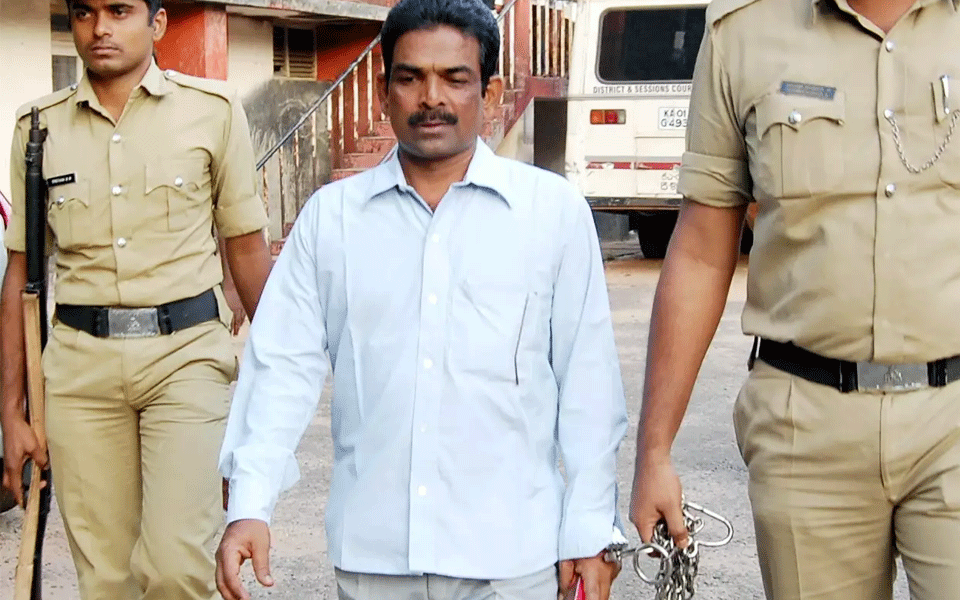
cJan 31: The Sixth District and Additional Court convicted serial killer Cyanide Mohan Kumar in the sixth case of raping and killing a woman of Mittur for life imprisonment until death without remission, here on Thursday.
Mohan Kumar developed friendship with the woman aged 31 years who was working as a nurse in a private nursing home at Puttur, in the name of Sudhakar Gowda. After getting her phone number, he called her to Puttur bus stand on April 22, 2009. After taking Rs 2,000 from her bank account, they went to Mysuru.
Assuring of marrying her, he raped her at a lodge on the same day. Under the pretext of giving her contraceptive pills, he forced her to consume Cyanide at the bus stand. But later she died in a toilet at the bus stand. After conducting the postmortem, the police registered an unnatural death case.
Meanwhile, he returned from Mysuru to Puttur and called her family over phone that he had married her and not to try to search them. With this, her family members did not search for her even after she was missing. After his criminal activity came to light, Mohan Kumar spilled the beans.
On December 23, 2009, Bantwala inspector Nanjunde Gowda interrogated Mohan Kumar. Later he was taken to Mysuru to confirm his stay in the lodge booked in the name of Sudhakar Gowda. Public prosecutor Judith M Casta argued against Mohan Kumar.
Hearing through video conference
The court has awarded life imprisonment until death under various sections. The hearing of the accused who is in Belagavi Hindalga jail was conducted through video conference. Total 38 evidences, 72 records and 35 materials were considered for the hearing.
It was the sixth case. In one case, the High Court upheld the death sentence verdict given by the district court. Along with this, Mohan Kumar was getting life imprisonment for life in three cases.
Convection details
Under IPC Section 366, six years rigorous imprisonment, Rs 3,000 penalty and if fail to pay the penalty, he has to undergo one more month additional improvement. Under section 376 (Rape), seven years rigorous imprisonment and Rs 3,000 penalty and if failed to pay the penalty, he has to serve another one month imprisonment.
Under section 417(cheating), six months rigorous imprisonment, under section 328 (poisoning), seven years rigorous imprisonment and Rs 3000 penalty and if not paid the penalty, he has to undergo one more month imprisonment. Under section 302 (murder), life imprisonment to his death. Under section 201 (destroying of evidences), five years rigorous imprisonment and Rs 3,000 penalty, under section 392, five years rigorous imprisonment and Rs 3,000 penalty and it was said in the judgement that the family of the victim eligible to get compensation from the legal aid authority.
Let the Truth be known. If you read VB and like VB, please be a VB Supporter and Help us deliver the Truth to one and all.
Udhayanidhi accuses BJP of not releasing funds for TN

Gobichettipalayam (PTI): Tamil Nadu deputy chief minister Udhayanidhi Stalin on Saturday charged the BJP government at the Centre with not releasing funds to the state and accused it of "snatching" TN's rights.
Addressing a poll rally at Gobichettipalayam in the western Erode district, the DMK youth wing chief claimed the Centre has not released funds to the tune of Rs 3,000 crore for education.
"They (union government) have snatched all our rights," he charged.
With regard to the Centre's proposal for delimitation, he said chief minister M K Stalin was the first person in the country to raise the voice against the union government's move. He claimed that it was a "huge victory" for the INDIA alliance, as the bill was defeated for lack of majority after the opposition voted against it in the Lok Sabha.
Listing out various welfare measures implemented by the DMK government, he said the existing "Kalaignar Magalir Urimai Thogai" (monthly financial assistance for women) will be doubled to Rs 2,000 if DMK was voted to power again.
The deputy chief minister charged that the BJP and AIADMK have tried to stall it by moving the court. "At present more than 1.3 crore women have benefited from the scheme", he said.
"Similarly, the breakfast scheme for the government school students will be extended till Class VIII", he said adding "more than 35 lakh college students across the state will be getting free laptops once the DMK government is formed".
Udhayanidhi also pointed out at the "Illatharasi" poll promise, providing Rs 8,000 worth of coupons to non-income tax paying women where they could buy or replace any household appliances of their choice.
Elections to 234 Assembly seats in Tamil Nadu will be held on April 23 and the results declared on May 4 following counting of polled votes.