'My district, my dream' essay competition, TR Suresh distributes prizes
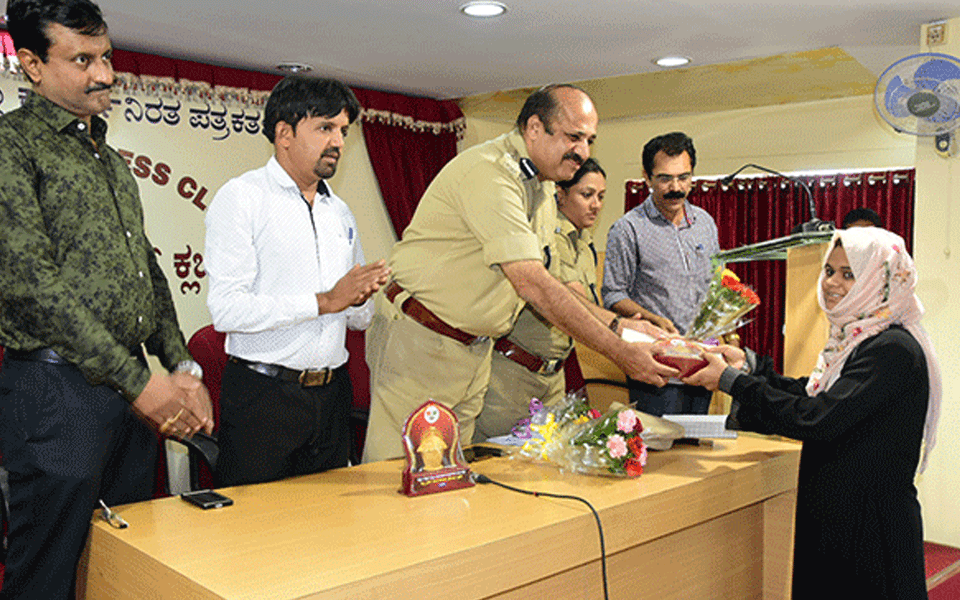
Mangaluru: City Police Commissioner TR Suresh on Friday distributed prizes among the winners of essay competition organised by District Working Journalist Association as a part of Brand Mangaluru Programme.
The competition was distributed in two categories one each for PUC students and Degree students, who were asked to write essays on the topic “My district, My dream”.
Students from various colleges from across the district participated in the competition and presented their writings.
A student of Mangaluru Government B. Ed College, Vani, bagged the first place in the degree college category while Ayishat Safwana of Karavali Pharmacy College Mangaluru secured the second place.
In PUC category, NR Ananya Rai of St. Agnes PU College Mangaluru bagged first place while Khader Sultana of Kumbra Markazal Huda PU College Puttur secured second place in the category.
Suresh lauded the efforts of all the participants and congratulated all the winners on their victory, while also advising students to not lose heart on not winning, but to rejoice the fact that they participated in the event.
Retired principal of Ganapathi PU College Dr Chandrakala Nandavara, Vice principal of Surathkal Govindadas College, Prof Krishnamurthy Chitrapura, Dr Vijayalakshmi Nayak of Srinivasa College of Education and Journalist Dr Seetalakshmi Karkikodi were the juries for the competition.


Let the Truth be known. If you read VB and like VB, please be a VB Supporter and Help us deliver the Truth to one and all.
J'khand: 4 minors detained for 'raping' girl at birthday party

Ranchi (PTI): Four minors were detained for allegedly raping a 15-year-old girl at a birthday party in Jharkhand’s Ranchi, police said on Saturday.
The incident took place on March 31 within the Namkum police station limits. An FIR in this regard was lodged on April 16 based on the girl’s statement, they said.
“All five, including the victim, were friends, and the girl had gone to attend the birthday party of one of those detained. At the party, the accused consumed alcohol and allegedly raped her,” said Ramnarayan Singh, the officer in-charge of Namkum police station.
“The four, aged between 15 and 17 years, have been detained and the medical examination of the girl is underway,” Singh said.
Further investigation is underway.