Need to create jobs to restore peace among communities in Dakshina Kannada: DK Shivakumar
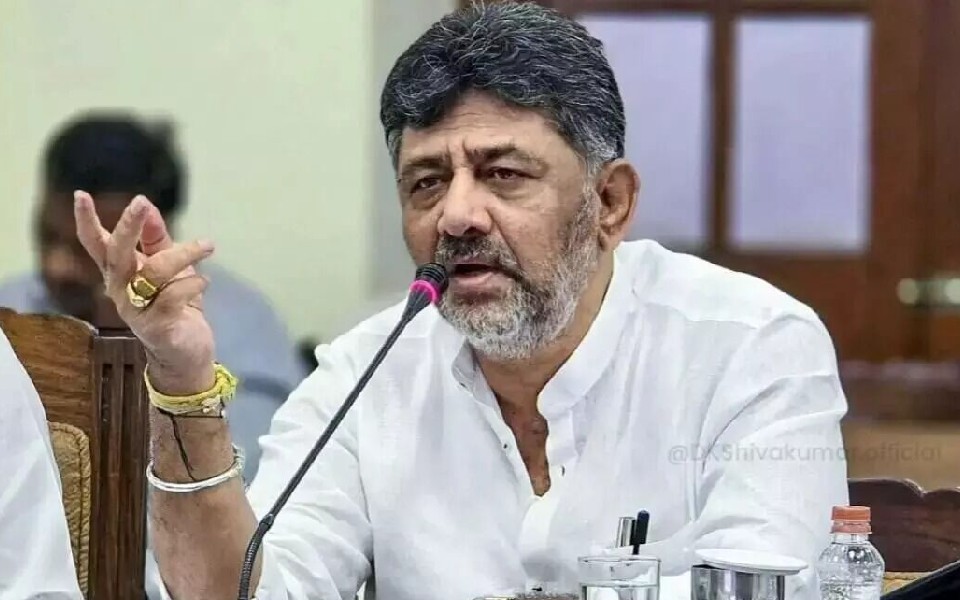
Puttur: Karnataka Deputy Chief Minister D K Shivakumar on Saturday emphasised the need for job creation to restore peace among communities in the coastal and interior regions of Dakshina Kannada.
He made this remark while highlighting the growing concerns over communal disturbances and economic challenges in these areas.
Shivakumar also announced plans for a separate tourism policy aimed at fostering employment in these areas.
Speaking at the "Ashok Jan-Man" saree distribution event organised by MLA Ashok Rai's Rai Estates and Educational and Charitable Trust here, the Deputy Chief Minister highlighted the pressing issues faced by Dakshina Kannada district.
ALSO READ: Mangaluru police bust multi-state scam targeting e-commerce giant; two arrested
"Dakshina Kannada is becoming a barren land, with educational institutions no longer attracting students from outside due to communal tensions and other issues. Many local banks have disappeared, forcing our youth to seek employment in Saudi Arabia, Mumbai, and Bengaluru," he said.
Shivakumar has urged local leaders to prioritise job creation.
"This region is home to numerous temples and boasts a beautiful coastline, making it ideal for a distinct tourism policy. Despite having the largest port, Mangaluru lacks quality five-star hotels," he said.
He praised Rai for his dedication to Puttur's development, stating, "Numerous plans are in place for Puttur's growth, but I cannot disclose them now due to the upcoming by-elections."
He expressed gratitude for the opportunity to support Rai, adding, "Like Purandara Dasa's song, this is a moment of fortune to meet all sections of society in Puttur without any political bias."
Shivakumar reaffirmed the government's commitment to support Rai's educational and charitable initiatives, emphasising the importance of remembering one's roots.
"The memory of our mothers is the source of love, the memory of our teachers is the source of knowledge, and the memory of devotion is the source of divinity," he said.
"By 2028, with the blessings of Panchalingeshwara in Puttur, the Congress party will return to power to serve the people of the state. We do not win with mere words but with heartfelt connections," Shivakumar added.
Let the Truth be known. If you read VB and like VB, please be a VB Supporter and Help us deliver the Truth to one and all.
8 children between ages of 1 and 14 dead after mass shooting in Louisiana, police say

Shreveport(US) (AP): A gunman in Louisiana killed eight children in shootings at two different homes early Sunday in the nation's deadliest mass shooting in more than two years, police in Shreveport said.
The victims ranged in age from one to about 14 years old, said Shreveport police spokesperson Chris Bordelon. A total of 10 were shot and some of the children were related to the suspect, Bordelon said.
The gunman later died after a chase with officers who fired at the suspect, Bordelon said. The suspect stole a car while leaving the scene of the shootings and was followed by police, according to Bordelon.
Police did not release the name of the suspect but did say he was an adult male. The shootings were the result of a “domestic disturbance,” Bordelon said.
Officials said they were still gathering details at the crime scenes south of downtown Shreveport — the two homes and a third location.
“This is an extensive scene unlike anything most of us have ever seen,” he said.
It was the deadliest mass shooting in the US since eight people were killed in a Chicago suburb in January 2024, according to a database maintained by The Associated Press and USA Today in partnership with Northeastern University.
At a news conference outside the residence where one of the shootings occurred, officials appeared stunned, requesting patience and prayers from the community as they sorted through multiple crime scenes.
“I just don't know what to say, my heart is just taken aback,” Shreveport Police Chief Wayne Smith said. “I cannot begin to imagine how such an event could occur.”
“This is a tragic situation — maybe the worst tragic situation we've ever had,” said Tom Arceneaux, mayor of the city in northwestern Louisiana with about 180,000 residents. “It's a terrible morning.”
Louisiana State Police say their detectives have been asked by Shreveport police to investigate. In a statement, state police say no officers were harmed in the shooting that involved an officer after a police pursuit into Bossier City on Sunday morning.
State police are asking anyone with pictures, video or information to share it with state police detectives.
Louisiana Gov Jeff Landry said in a statement that he and his wife were heartbroken. “We're deeply grateful to the law enforcement officers and first responders working tirelessly on the scene,” he added.