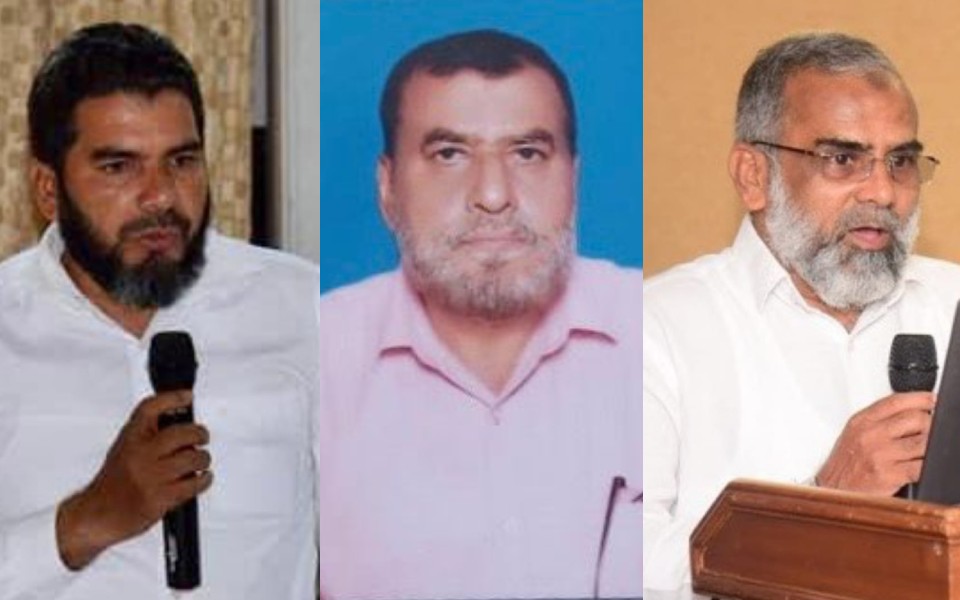
Kumta: In the Annual General Body Meeting of Jamaatul Muslimeen held on Thursday night at Jumma Masjid Kumta, new office bearers were elected to lead the organisation. The meeting was held after Isha prayers and saw participation from members of the community.
Abdul Shukur Sab has been elected as the new President, while Nazeer Khan will take over as Vice President. Mohammed Mohsin Quazi has been re-elected as the General Secretary, marking his third consecutive term in the post. Yaseen Sab will serve as the Joint Secretary, and Mehtab Ali has been appointed as the Auditor.
The new Executive Committee includes Mohammed Aqueel Quazi, Ameen Sab, Amjad Shaikh, Iftiqar Shaikh, Saleem Quazi, Dr. Nazeem Khan, Mehboob Ali Mujawar and Mohammed Gouse Shaikh.
During the meeting, the report of the previous term was presented, highlighting the work and initiatives undertaken by the Jamaat. Members also discussed ongoing projects and appreciated the efforts of the outgoing team. Prayers were offered for the success and unity of the newly elected leadership as they take on the responsibilities of serving the local community.
Let the Truth be known. If you read VB and like VB, please be a VB Supporter and Help us deliver the Truth to one and all.
Kolkata (PTI): Former railway minister Mukul Roy, once regarded as West Bengal Chief Minister Mamata Banerjee's most trusted lieutenant and the TMC's principal strategist, died of cardiac arrest at a private hospital here early on Monday.
He was 71, and is survived by his son, Subhranshu Roy.
He breathed his last around 1.30 am at the hospital in Salt Lake, Subhranshu Roy said.
He had been suffering from multiple ailments and was in and out of the hospital over the past two years. Family members said he had also been diagnosed with dementia and had recently gone into a coma.
His body will be taken to his residence before the last rites are performed later in the day, they said.
A former Union minister and two-time Rajya Sabha member from West Bengal, Roy's four-decade-long political journey saw his stints in the Congress, TMC and the BJP.
His political career began with the Youth Congress, before he joined hands with Banerjee when she broke away from the grand old party to form the Trinamool Congress in 1998.
As a founding member, he quickly emerged as one of the key organisational pillars of the fledgling party and went on to serve as its general secretary.
He was elected to the Rajya Sabha in 2006 and became the party's leader in the Upper House in 2009, turning into TMC's principal troubleshooter in Delhi. In the UPA-2 government, when the TMC was a constituent, Roy first served as Minister of State for Shipping before taking over as the railway minister in 2012.
In West Bengal's political circles, Roy earned a reputation as a backroom operator deft in organisational work. Following the TMC's historic victory in 2011 that ended 34 years of the Left Front rule, he played a significant role in consolidating the party's hold in several districts, overseeing defections from the CPI(M) and the Congress, strengthening the new regime's political base.
However, his career was not without controversy. His name had surfaced in the Saradha chit fund case and the Narada sting operation.
By 2017, relations between Roy and the TMC leadership had deteriorated. In November that year, he joined the BJP in a move that altered the state's political equations. Tasked with strengthening the BJP's organisation in West Bengal, Roy was credited by party leaders with helping engineer defections from the TMC and expanding the saffron party's base ahead of the 2019 Lok Sabha polls, in which the BJP won 18 of the state's 42 seats.
He was elected as a BJP MLA from the Krishnanagar Uttar constituency in the 2021 West Bengal assembly elections. Within months, however, he returned to the TMC, triggering legal and political wrangling. Subsequently, a court disqualified him as an MLA under the anti-defection law for switching parties after being elected on a BJP ticket.
Though he rejoined the TMC, Roy never regained the political centrality he once enjoyed. As his health declined, he gradually withdrew from active politics.
Often described as the 'Chanakya' of West Bengal politics during his prime, Roy remained a pivotal figure in the state's turbulent political landscape -- a strategist who operated as comfortably in Delhi's power corridors as in the backrooms of Kolkata's party offices.
Leader of the opposition in the state assembly, Suvendu Adhikari, condoled Roy's death.
In an X post, he wrote, "Deeply disheartened to learn about the sad demise of senior politician, Shri Mukul Roy. My sincere condolences to his family. Praying that his soul attains eternal peace. Om Shanti."