Philanthropist, Educationist, Dr. MR Shetty passes away
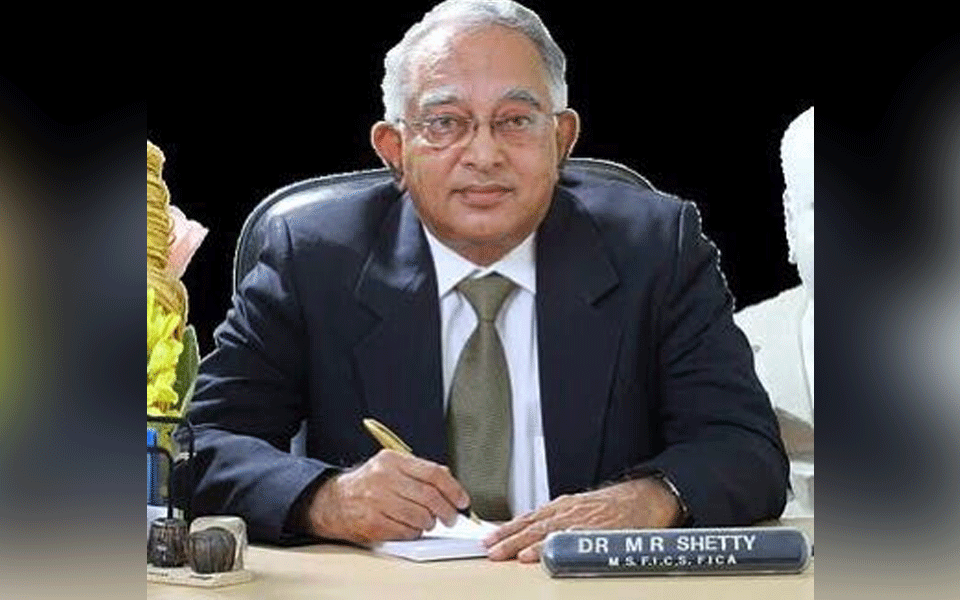
Mangaluru: Prominent philanthropist and Educationist, Dr. MR Shetty, passed away on Monday morning. The funeral rites of Dr. Shetty will be held at his residence "Swagath' between 11 am - 1 pm on Monday, family said in a release.
"It is with indescribable grief, we announce the sad demise of our esteemed and honourable, Dr M.Ramgopal Shetty, Son of Late Dr.M.V.Shetty, Husband of Prof Hima Urmila Shetty, Loving father of Dr Divyanjali Shetty and Dr Rohila Shetty, Father in Law of Dr Ranjith Shetty" the release from the family stated.
Dr M.R Shetty was the Founder Secretary of Dr M.V.Shetty Trust colleges and through the Trust he was instrumental in introducing many vocational courses in Nursing, Physiotherapy, Speech and Hearing, Medical Laboratory Technology and Social Work and Education under Mangalore University.
He also served as executive member in the Rehabilitation Council of India. Under his able guidance and administration the Trust manages 15 different graduate and post graduate courses in eight different streams affiliated to Rajiv Gandhi University of Health Sciences, Bangalore and Mangalore University, Mangalore. Dr. Shetty had his early education at St. Aloysius High School, Mangalore and went on to complete his graduate and postgraduate professional education in Kasturba Medical College, Mangalore. Later he left to UK on a vascular surgery fellowship.
On his return from UK he served as Asst. Professor in Surgery at KMC itself and worked there till 1989.
Dr M.R Shetty had a vision in not only providing quality health services and training of professionals in each of the allied medical fields but also in educating the public and providing affordable diagnostic and therapeutic facilities in collaboration with the Government especially to those in need. Keeping the needy in mind, he also initiated the blood bank at the Govt. Wenlock hospital. It can be said that his contribution has been vital in transforming the paramedical scene in Karnataka State as well in India.
He served as the Syndicate Member for three years at Mangalore University and also at RGUHS, Bangalore. Dr M.R Shetty was a visionary and a humble human being who has touched lives of many students and professionals across the globe.
"It is an irreparable loss and has left a deep void. His loss does us apart,He will never be away from our Heart.
There are special people in our lives that never leave us after they are gone, their legacy always remains" the release further added.
Let the Truth be known. If you read VB and like VB, please be a VB Supporter and Help us deliver the Truth to one and all.
Two arrested in K'taka for assaulting minors, uploading CSAM content

Bengaluru (PTI): Two men were arrested for allegedly sexually assaulting two minor girls, recording the acts on mobile phones and uploading the videos online as child sexual abuse material, police said on Thursday.
The accused have been identified as Kiran Kumar (29), hailing from Chitradurga district, and Aditya M K (20), hailing from Shivamogga district, they said.
A probe was initiated after information was received from the NCRP portal regarding a suspected instance of creation of Child Sexual Abuse Material (CSAM) for online dissemination, police said.
Accordingly, a case was registered at Kaggalipura Police Station under relevant sections of the IT Act on May 10, they added.
Investigation revealed that two minor girl victims were exploited and videos were created and uploaded to the internet. The child victims have subsequently recorded their statements as per procedure and further necessary legal steps have been taken, Pronab Mohanty Director General of Police, Cyber Command, said in a statement.
Based on the statements of the victims, the accused persons, who allegedly assaulted the minors, recorded the acts on mobile phones and uploaded the videos online, were arrested, he said.
Following the probe, sections 65(2) (rape) and 70 (gangrape) of the Bharatiya Nyaya Sanhita, along with relevant sections of the POCSO Act, have been added to the FIR, police said.
Officials collected relevant information and on May 12, arrested the accused persons and seized three mobile phones belonging to them, in which the videos had allegedly been recorded, he said.
The accused were later produced before the court and taken into police custody for further investigation, he added.
According to him, in CSAM cases, police usually apprehend offenders who have downloaded such content or have kept them in their possession after obtaining them from elsewhere, usually the internet.
"The present case is one of the very few instances where content creators and uploaders have been apprehended," Mohanty added.