SKSBV Dakshina Kannada's new district committee formed
Mangaluru: The leaders' camp and district committee formation of Samastha Kerala Sunni Balavedi (SKSBV), a student organization of the Dakshina Kannada District Jamiyathul Muallimeen, was held at the Budoli Samastha Muallim Center near Mani under the chairmanship of SKSBV District Chairman P.M. Yahya Madani Mardhala.
Dakshina Kannada District SKSBV Convener K.H. Ashraf Hanifi Karaya welcomed the gathering, and local Khatib Abubakkar Saadi inaugurated the meeting. SKJMCC Mudarrib Adnan Ansari and Hashim Rahmani conducted the classes. District Jamiyyathul Muallimeen Secretary Muhammad Navavi facilitated the formation of the Mundole Committee.
A new committee was formed for the year 2024–2025, with P.M. Yahya Madani as the chairman. The new team includes I.K. Ishaq Faizi from the Deralakatte Range as the vice chairman, Haris Faizi from the Bombila Range, and K.H. Ashraf Hanifi Karaya as the district convener. Altaf Maulavi from the Moodbidri Range was appointed as the vice convener, with Hafiz Ansari from the Surathkal Range representing the Media Wing. Sharif Faizi Maabari from the Udupi Range and Ansar Ansari from the Surathkal Range were also part of the Media Wing, while Mueenuddin Faizi from the Sulya Range joined as a member.
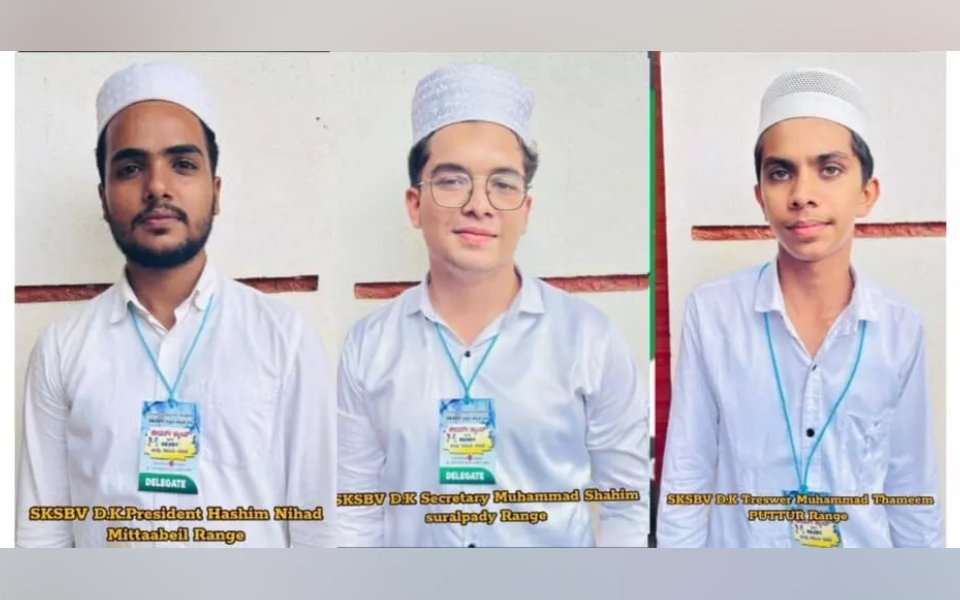
Hashim Nihal from the Mittabail Range was elected as the President. Vice Presidents include Shahid Yusuf from the Kadaba Range, Muhammad Hafeef from the Mangaluru West Range, and Muhammad Sawad from the Madannur Range.
The committee also appointed Muhammad Shahim from the Suralpady Range as the General Secretary, Muhammad Mufiz from the Gurupur Range as the Working Secretary, and Muhammad Aslam from the Athur Range as one of the Joint Secretaries. Additional Joint Secretaries include Muhammad Sahad from the Sulya Range, Muhammad Nihal from the Mani Range, and Muhammad Tamim from the Puttur Range, while Ziyad from the Bombila Range was named the Adab Chairman.
Ahmed Zain from the Deralakatte Range was selected as the Convener, Salman Faris from the Belthangady Range as the Kidma Chairman, and Ahmed Isham from the Uppinangady Range as another Convener.
Ismail Rashim from the Salettur Range was appointed as the Alif Chairman, with Muhammad Zaveer from the Bantwal Range as a Convener. Tech Admin Chairman duties were assigned to Muhammad Anas from the Udupi Range, while Muhammad Shan from the Farangipet Range, Muhammad Asadullah from the Adyar Kannur Range, Ismail Suhail from the Moodbidri Range, Zuhaib Hasan from the Surathkal Range, Muhammad Sihan from the Vitla Range, Imtiaz from the Kumbra Range, Saif from the Kurnadka Range, Muhammad Haneen from the Kalladka Range, and Sinan from the Mangaluru Range were elected as members of the District Executive Committee in the presence of Range Chairmen and Conveners.
District Jamiyyathul Muallimeen members, including Nizar Musliyar from the Bantwal Range, Qasim Arshadi from the Farangipete Range, Majeed Darimi from the Mani Range, P.J. Abdul Aziz Kalak, Abdul Rahman Darimi from the Sattikallu Range, K.P. Abdul Majeed Budoli, Ataullah Kalak, Hanif Kalak, Mustafa Kalak, and Jalil Musliyar, were present at the meeting. Parvez Akhtar Puttur, Vice President of Central SKSBV, delivered the vote of thanks.
Let the Truth be known. If you read VB and like VB, please be a VB Supporter and Help us deliver the Truth to one and all.
One dead due to electrocution on 'Jailer 2' movie set in Chennai

Chennai (PTI): A 28-year-old worker died of electrocution on the sets of the upcoming Tamil film 'Jailer 2', starring Superstar Rajinikanth, at a private film studio here, police said.
The deceased has been identified as Karthikeyan.
The incident occurred at the venue in Panaiyur. According to preliminary reports, Karthikeyan suffered a fatal electric shock while engaging in art direction work, erecting a house-like set for the movie's shooting, police said
Kanathur police said FIR is yet to be filed, but further investigations are underway to determine the circumstances that led to the electrical leak.