Udupi: Man sentenced to 37 years for abduction and sexual assault of minor girl

Udupi: The Udupi Additional District POCSO Special Court has sentenced Sachin Pujari (26), a resident of Kota, to 37 years of rigorous imprisonment for the abduction and sexual assault of a minor girl in 2022. Pujari, a relative of the victim, exploited his relationship to gain her trust, eventually kidnapping and sexually assaulting her multiple times.
The court found Pujari guilty based on evidence, including witness testimonies and the recovery of gold ornaments he had stolen from the victim's family. He was convicted under various charges, including abduction, rape, extortion, and threats.
The court has sentenced the accused to various terms of imprisonment and fines for multiple offenses. The sentences include five years of rigorous imprisonment and a fine of Rs. 5,000 for abducting the girl, ten years of rigorous imprisonment and a fine of Rs. 10,000 for rape, one year of imprisonment and a fine of Rs. 3,000 for extortion of money and gold jewelry, and one year of imprisonment and a fine of Rs. 2,000 for making threats. Additionally, the accused received twenty years of imprisonment and a fine of Rs. 20,000 for the rape of a minor girl.
The total fine imposed amounts to Rs. 40,000, with Rs. 30,000 to be paid to the victim and Rs 10,000 to the government. The court has also ordered that Rs. 2 lakh be given to the victim as compensation, with an additional Rs. 2 lakh to be provided to the victim by the government. All sentences are to be served concurrently.
Special public prosecutor YT Raghavendra represented the government in this case.
Let the Truth be known. If you read VB and like VB, please be a VB Supporter and Help us deliver the Truth to one and all.
Ordinance issued to increase number of Supreme Court judges from 34 to 38
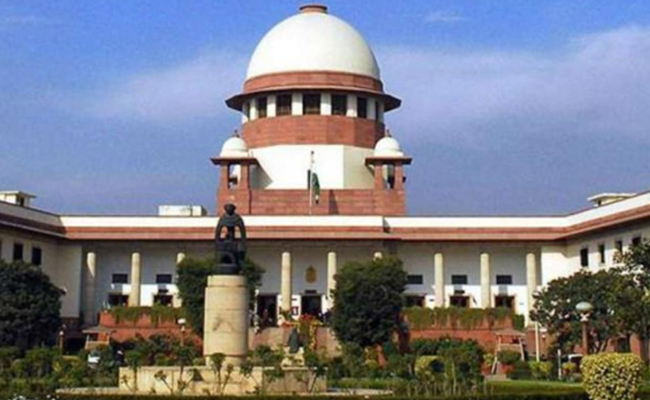
New Delhi (PTI): The government has promulgated an ordinance to increase the strength of the Supreme Court from the present 34 judges to 38, including the Chief Justice of India.
The law ministry notified the ordinance on Saturday, which amended the Supreme Court (Number of Judges) Act, 1956, to increase the sanctioned strength of the top court.
So far, the sanctioned strength of the top court was 34, including the Chief Justice of India (CJI). Now, the number of judges has been increased by four, taking the sanctioned strength to 38.
The top court will now have 37 judges, other than the CJI.
With the apex court having two vacancies at present, and the ordinance coming into force immediately, the Supreme Court Collegium will now have to recommend six names for appointment as judges in the top court.
A bill will be brought in the Monsoon Session of Parliament to convert the ordinance – an executive order – into a law passed by Parliament.
The Union Cabinet had cleared a draft bill on May 5 to increase the number of apex court judges.
The strength of the Supreme Court was last increased from 30 to 33 (excluding the CJI) in 2019.
The Supreme Court (Number of Judges) Act, as originally enacted in 1956, put the maximum number of judges (excluding the CJI) at 10.
This number was increased to 13 by the Supreme Court (Number of Judges), Amendment Act, 1960, and to 17 by another amendment to the law.
The Supreme Court (Number of Judges) Amendment Act, 1986, augmented the strength of judges from 17 to 25, excluding the CJI.
A fresh amendment in 2009 further increased the strength from 25 to 30.
Article 124(3) of the Constitution lists the qualifications required to become a Supreme Court judge.
An Indian citizen who has either served as a high court judge for at least five years, or as an advocate for 10 years, or is a distinguished jurist, can be appointed to the top court.
The strength of the Supreme Court is increased based on the recommendations of the CJI, who writes to the Union law minister. After consulting the finance ministry, the Department of Justice under the law ministry moves the Cabinet with a draft bill.