Ujire: Abduction of businessman's eight-year-old son
Kidnappers demand 17 crores in ransom; Complaint filed

Belthangady: A case has been registered at the Belthangady Police Station over the alleged kidnapping of a businessman’s 8-year-old son by a gang, who are demanding a large amount of money in ransom.
The kidnapped child has been identified as Anubhav (8), the son of Bijoy, a businessman and owner of Bijoy Agencies, and a resident of Ashwattakatte in Ratha Street near Ujire’s Janardhanaswamy Temple. In the complaint registered at the Belthangady police station, the child’s grandfather A.K. Shivan revealed that the child was abducted from near his house by a gang of 3 to 4 people in a white car on the evening of Dec. 17, and subsequently the gang demanded a ransom worth 17 crores for the child’s release.
Shivan had ventured out for an evening walk with his grandson Anubhav, and the duo were returning home after playing it is said. The child was walking in front of his grandfather and heading towards their house. As they approached the gate of the house, two strangers descended from a white car parked nearby and forcibly pushed Anubhav into the car. Shivan then ran towards the car, which quickly drove off towards Ratha Street, the registered complaint reveals.
After the abduction, the kidnappers dialed Shivan's niece and demanded a huge amount in exchange for the child’s release, Shivan said.
The Belthangady police has registered a case and are investigating.
No Information Found Despite Night Long Search
Acting immediately after receiving the complaint about the child’s abduction, the Belthangady police began searching for information. Senior police officers also visited the Belthangady station and guided the investigation. It is learned that despite an overnight search, the police have not found any leads or information related to the abduction.
The information has emerged that the abductors have demanded a huge amount of money as ransom in exchange for the child’s release. The abduction case has created an atmosphere of fear and uncertainty among the residents of Ujire.
Let the Truth be known. If you read VB and like VB, please be a VB Supporter and Help us deliver the Truth to one and all.
Ordinance issued to increase number of Supreme Court judges from 34 to 38
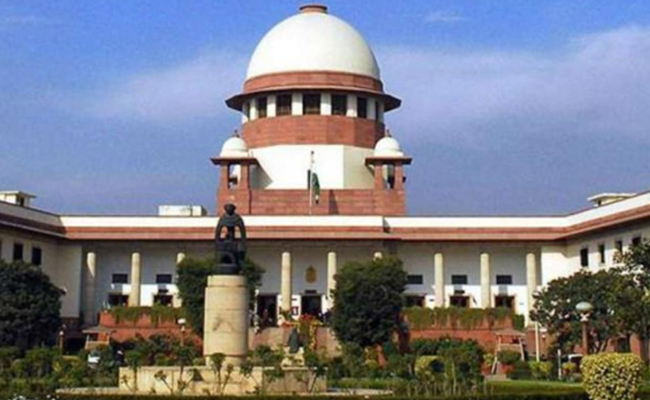
New Delhi (PTI): The government has promulgated an ordinance to increase the strength of the Supreme Court from the present 34 judges to 38, including the Chief Justice of India.
The law ministry notified the ordinance on Saturday, which amended the Supreme Court (Number of Judges) Act, 1956, to increase the sanctioned strength of the top court.
So far, the sanctioned strength of the top court was 34, including the Chief Justice of India (CJI). Now, the number of judges has been increased by four, taking the sanctioned strength to 38.
The top court will now have 37 judges, other than the CJI.
With the apex court having two vacancies at present, and the ordinance coming into force immediately, the Supreme Court Collegium will now have to recommend six names for appointment as judges in the top court.
A bill will be brought in the Monsoon Session of Parliament to convert the ordinance – an executive order – into a law passed by Parliament.
The Union Cabinet had cleared a draft bill on May 5 to increase the number of apex court judges.
The strength of the Supreme Court was last increased from 30 to 33 (excluding the CJI) in 2019.
The Supreme Court (Number of Judges) Act, as originally enacted in 1956, put the maximum number of judges (excluding the CJI) at 10.
This number was increased to 13 by the Supreme Court (Number of Judges), Amendment Act, 1960, and to 17 by another amendment to the law.
The Supreme Court (Number of Judges) Amendment Act, 1986, augmented the strength of judges from 17 to 25, excluding the CJI.
A fresh amendment in 2009 further increased the strength from 25 to 30.
Article 124(3) of the Constitution lists the qualifications required to become a Supreme Court judge.
An Indian citizen who has either served as a high court judge for at least five years, or as an advocate for 10 years, or is a distinguished jurist, can be appointed to the top court.
The strength of the Supreme Court is increased based on the recommendations of the CJI, who writes to the Union law minister. After consulting the finance ministry, the Department of Justice under the law ministry moves the Cabinet with a draft bill.