26 people were killed in Pahalgam as Modi govt did not provide security: Kharge
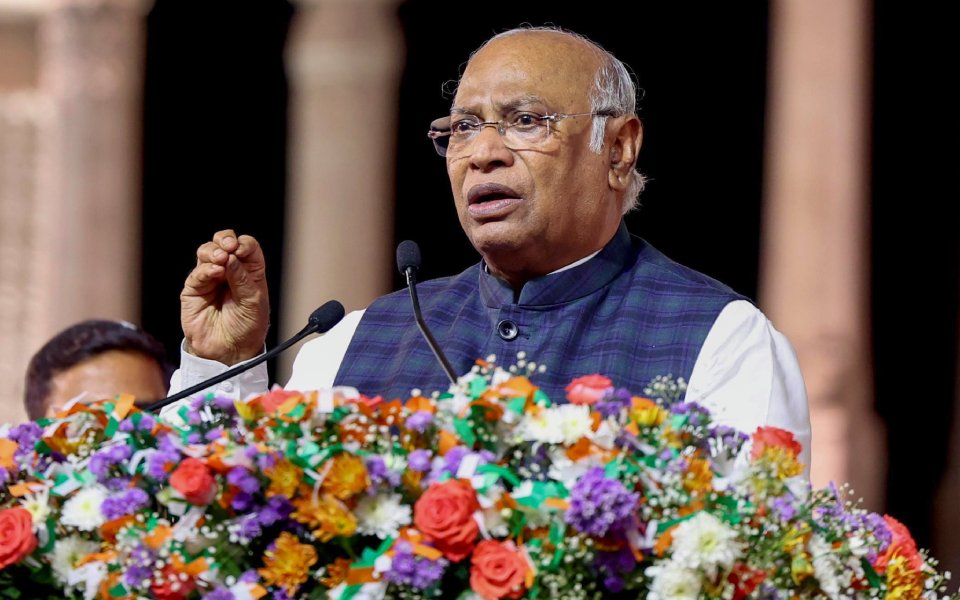
Hosapete (Karnataka), May 20 (PTI): Congress President Mallikarjun Kharge on Tuesday alleged that 26 tourists were killed in the April 22 Pahalgam terror attack as the Prime Minister Narendra Modi-led government did not provide security there.
He reiterated his claim that Modi had cancelled his Kashmir visit after receiving an intelligence report ahead of the Pahalgam terror attack last month.
Further, he targeted the BJP government over the MP delegations that will fan out to various countries post Operation Sindoor, alleging the party was not consulted on the matter.
The Centre picking Congress MP Shashi Tharoor to lead one of the delegations has resulted in a major row as he was not among the four leaders named by the opposition party to be part of the MPs' group.
"Twenty-six people were murdered in Pahalgam because the Modi government did not provide security there. The tourists who had gone there were not given security by the police, border force, or military," Kharge alleged.
Addressing a large gathering here, he said, "26 people were killed, but still Modi did not speak a word about it (lack of security) and spoke only what he wanted to.”
Stating that he has still not received answers to the questions he had raised recently, the AICC chief said the PM was supposed to go to Kashmir on April 17, but the intelligence department asked him not to proceed and cancel the visit, citing possible trouble there.
"When you knew it—when you cancelled your programme of travelling to Kashmir on April 17—why didn’t you tell tourists about it through the police? Why didn't you ask them not to go, as there might be some trouble? If you had told them, 26 lives would have been saved," he added.
He was speaking at an event to mark the Karnataka Congress government's two years in office. At the event, over 1.11 lakh title deeds were distributed to eligible beneficiaries whose "undocumented habitations" have been declared revenue villages.
Speaking on tensions with Pakistan, Kharge said Pakistan always wants to trouble India as they are weak, and they have tried to attack the country with China's support.
"Our country will never tolerate such things. We are united on this. So we extended support to the government in the fight against those who oppose our country. The country is important; then comes religion, caste, and other things," he said.
However, what has happened now is that Modi has become important, and the country comes next. "Special information is given to save him (PM), but not to protect common people and the poor…"
Noting that Modi recently, through the government, said that a delegation of MPs should be sent to foreign countries, Kharge said, "He did not ask us. Unilaterally, he said it, but for the sake of the country, we did not say anything, and we are sending our representatives as part of a delegation to foreign countries to speak for our country.”
Saving the country is the Congress’s aim, and it doesn’t look at party lines or credit or discredit in this regard. "We have to save the country, its people."
"We (Congress) got freedom for the country that was under slavery for years. Saving it is our duty. We prepared the Constitution for this country under the leadership of Ambedkar and Nehru—saving it is our responsibility and duty, and we will do it. BJP only lies," he added.
When all parties meet to discuss the country, Modi will be in Bihar for poll campaigning, Kharge said. All-party meetings were called twice, but the PM did not attend them.
"If you had patriotism, why didn't you attend that meeting after calling us. What is the reason. If we don't go to such meetings, we are traitors, but he, the one who doesn't attend, is a patriot. Just by making speeches, a country's welfare is not possible; everyone has to be taken together," he said.
Hitting out at the BJP for its Madhya Pradesh minister's remarks on Col Sofia Qureshi, Kharge said, "What kind of punishment should be given to such people? Comments are being made against a woman who is serving in the country's armed forces."
Congress has sought the minister’s resignation, but Modi is still keeping him.
"Remove the traitors in the BJP first and then speak…she (Sofia Qureshi) was targeted as her name had Qureshi. The BJP is filled with such bad people. Modi, first remove them," he said.
Congress fights for the country, and the BJP alone has not taken any contract for it, Kharge said.
Former PMs, the late Indira Gandhi and Rajiv Gandhi have sacrificed their lives for the country, and Mahatma Gandhi too sacrificed his life.
"You try to blame such a party and book cases against its leaders through agencies like the ED," he said.
Pointing to the ED case involving Congress's newspaper, National Herald, Kharge further said the notices are issued against his party leaders by the ED, Income Tax, and CBI with the aim of weakening them.
"But it is impossible. The Congress party will never bow down to anyone. We have given everything for the country, but those who are in power have not fought for the country. They are running a maladministration in the country," he charged.
Let the Truth be known. If you read VB and like VB, please be a VB Supporter and Help us deliver the Truth to one and all.
Ordinance issued to increase number of Supreme Court judges from 34 to 38
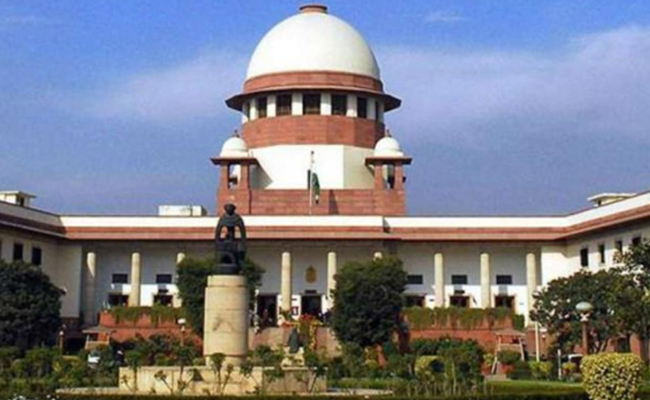
New Delhi (PTI): The government has promulgated an ordinance to increase the strength of the Supreme Court from the present 34 judges to 38, including the Chief Justice of India.
The law ministry notified the ordinance on Saturday, which amended the Supreme Court (Number of Judges) Act, 1956, to increase the sanctioned strength of the top court.
So far, the sanctioned strength of the top court was 34, including the Chief Justice of India (CJI). Now, the number of judges has been increased by four, taking the sanctioned strength to 38.
The top court will now have 37 judges, other than the CJI.
With the apex court having two vacancies at present, and the ordinance coming into force immediately, the Supreme Court Collegium will now have to recommend six names for appointment as judges in the top court.
A bill will be brought in the Monsoon Session of Parliament to convert the ordinance – an executive order – into a law passed by Parliament.
The Union Cabinet had cleared a draft bill on May 5 to increase the number of apex court judges.
The strength of the Supreme Court was last increased from 30 to 33 (excluding the CJI) in 2019.
The Supreme Court (Number of Judges) Act, as originally enacted in 1956, put the maximum number of judges (excluding the CJI) at 10.
This number was increased to 13 by the Supreme Court (Number of Judges), Amendment Act, 1960, and to 17 by another amendment to the law.
The Supreme Court (Number of Judges) Amendment Act, 1986, augmented the strength of judges from 17 to 25, excluding the CJI.
A fresh amendment in 2009 further increased the strength from 25 to 30.
Article 124(3) of the Constitution lists the qualifications required to become a Supreme Court judge.
An Indian citizen who has either served as a high court judge for at least five years, or as an advocate for 10 years, or is a distinguished jurist, can be appointed to the top court.
The strength of the Supreme Court is increased based on the recommendations of the CJI, who writes to the Union law minister. After consulting the finance ministry, the Department of Justice under the law ministry moves the Cabinet with a draft bill.