Another Karnataka Congress MLA strikes discordant note
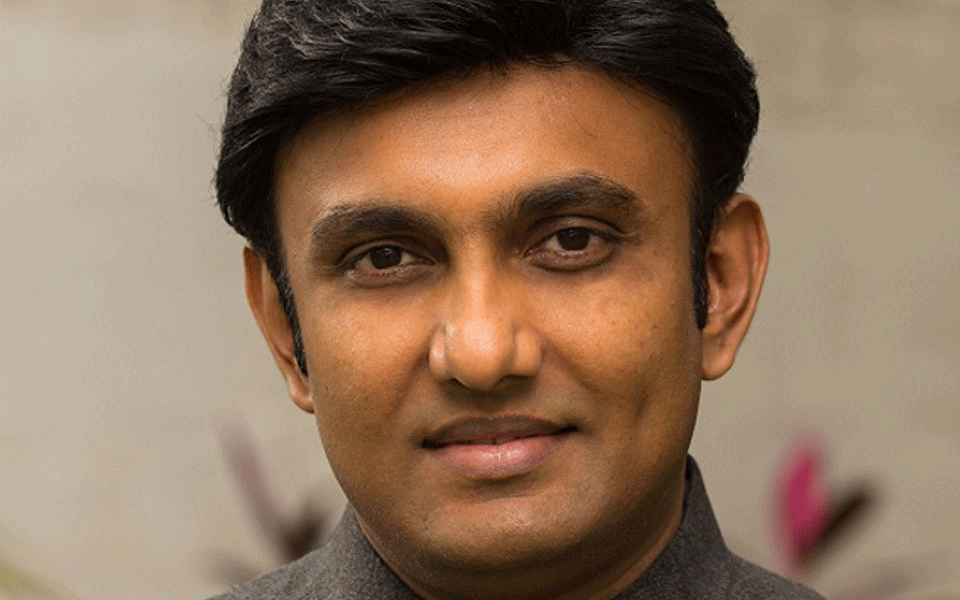
Bengaluru: In another note of dissent from the Karnataka Congress, MLA K Sudhakar questioned on Wednesday why the issue of alleged EVM manipulation was being brought into the discourse about the Lok Sabha exit poll predictions.
Sudhakar's stand is contrary to that of the Congress, which has joined other opposition parties in upping the ante on alleged EVM tampering or manipulation ahead of the counting of votes on Thursday.
The Congress MLA's remarks came a day after senior party lawmaker Roshan Baig unleashed a scathing attack on its state leadership, calling Pradesh Congress Committee (PCC) chief Dinesh Gundu Rao a "flop show" and party general secretary K C Venugopal a "buffoon".
Sudhakar, who had often been vocal in airing his grievances against the Congress-JD(S) coalition government in the southern state, tweeted on Tuesday night, saying EVM tampering and exit polls were two different things.
The Chikkaballapura MLA tweeted: "Personally I am confused why the issue of EVM manipulation is being brought into conversation while talking about the exit poll results.
"When in fact the exit poll results indicate the feeling of the voter at the conclusion of polling."
Later, talking to PTI, Sudhakar clarified that he had only said exit polls had nothing to do with EVM tampering.
"I have only spoken about exit polls because some people have a difference of opinion on them. I said it had nothing to do with EVM tampering...because exit polls are conducted on the polling day," he said.
The Congress MLA added that exit polls were conducted by media houses and different professionals who went to the polling booths, spoke to the voters and determined their opinion. "Whatever opinion is built, becomes part of the exit polls," he said.
"Sometimes they predict it right and sometimes they go wrong. So, how can you blame the EVMs for that?," he asked.
Locked in a battle with the Election Commission (EC) over the reliability of electronic voting machines (EVMs), the opposition pressed for their demand for increasing the tallying of the paper trail of votes (VVPATs) with EVM figures and submitted a memorandum to the poll panel in New Delhi on Tuesday.
In the memorandum, leaders of 22 opposition parties, including the Congress, demanded that the verification of VVPAT slips of five randomly-selected polling stations in an Assembly segment should be done prior to the initiation of counting of votes and not after the completion of last round of counting.
Let the Truth be known. If you read VB and like VB, please be a VB Supporter and Help us deliver the Truth to one and all.
TN Governor should invite Vijay to form govt, then prove majority: Former MP Prakash Ambedkar
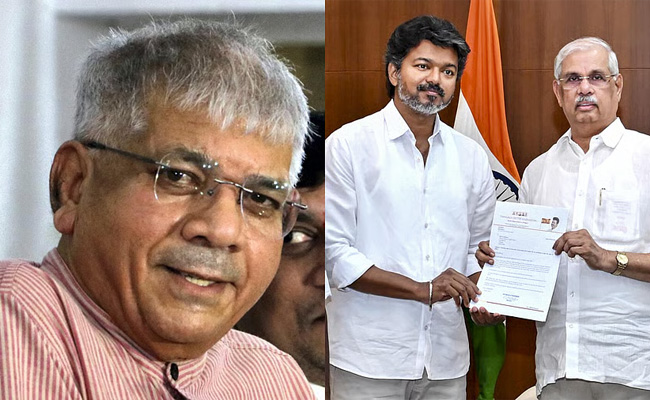
Mumbai: Senior politician and constitutional expert Prakash Ambedkar has opined that Tamil Nadu Governor Rajendra Arlekar should invite the Tamilaga Vettri Kazhagam President Vijay to form the government as his party emerged as the single largest party in the Assembly elections.
Ambedkar, who is a Mumbai-based advocate, activist and also the grandson of Dr. BR Ambedkar, is a former Parliamentarian.
Citing articles from the Constitution and similar incidents in the political history of the nation, Prakash Ambedkar has explained why Vijay cannot be stopped from forming the government in Tamil Nadu, reports Deccan Herald.
“Merely doubt over whether the TVK has the necessary number cannot suffice to withhold the invitation to the party to form the government. The Governor should invite Vijay, President of TVK, the single-largest party, to form the government and assume office as the next Chief Minister. After taking charge, as per the Article 164 (2) of the Constitution, Vijay will have to prove that his government has a majority in the House,” Ambedkar explained.
He also gave examples from India’s political history supporting his argument.
Ambedkar cited the example of the 1989 Lok Sabha elections and said that, although the Congress (I) emerged the single-largest party with 194 seats, Rajiv Gandhi declined the invitation by President R Venkataraman to form the government. “My friend Vishwanath Pratap Singh, leader of the National Front, was then invited and sworn in as Prime Minister on December 2, 1989,” he added.
He then recalled the 1996 elections to the Lower House of the Parliament, when the BJP emerged the single-largest party, but the Parliament was hung as the BJP lacked a majority. “Atal Bihari Vajpayee was invited by President Shankar Dayal Sharma to form the government and was sworn in as Prime Minister. Vajpayee resigned 13 days later on May 28, 1996, after failing to secure majority support in the Lok Sabha,” Ambedkar explained.