Bengaluru rains: Sai Layout still submerged days after rain; Residents question on relief efforts
_vb_08.jpeg)
Bengaluru (PTI): Even after a night without rain in the city, Sai Layout in North Bengaluru remains considerably waterlogged on Wednesday. This situation underscores the area's susceptibility as a low-lying residential area with enduring drainage issues.
The recent rainfall of 140 mm, which occurred from late Sunday night until Tuesday, has resulted in widespread flooding throughout the city; however, the inhabitants of Sai Layout have been particularly affected. Several residences on the ground and first floors remain inaccessible, and civic authorities are still actively involved in rescue and relief operations.
Presently, a team from the Bruhat Bengaluru Mahanagara Palike (BBMP) is engaged in efforts to clear drainage systems and pump out the accumulated water. Nevertheless, numerous residents have expressed their frustration with the gradual pace of these endeavors.
Surya, an IT professional residing in the area, conveyed his distress, stating, “For the past three days, it has been a distressing experience. A single instance of rainfall caused a nearly five-foot increase in water levels, inundating our entire home. We also lack access to potable water because the sump has been contaminated.” He further mentioned that the flooding problem in the layout recurs with each episode of rainfall.
Another resident remarked, "The absence of electricity for three days has rendered even those of us capable of working remotely unable to do so."
Residents have also articulated their concerns regarding what they perceive as a political exchange of blame concerning the absence of a lasting resolution. Many contend that the state and central governments are deferring responsibility, particularly in relation to a small railway culvert that consistently becomes obstructed during periods of rain.
A resident explained to PTI, "BBMP states that they are unable to clear the vent as it falls under the jurisdiction of Indian Railways, while railway officials have reportedly denied receiving any such request. This impasse has become a recurring justification, with no tangible progress observed year after year."
The Shirdi Saibaba Temple, after which the locality is named, has also sustained significant damage due to the flooding. Dayananda, the temple chairman, reported, “The entire temple has been damaged, and documents have been washed away. The generator, on which I invested Rs 6.5 lakh, is irreparable. Owing to inadequate planning, all the water from Hebbal is now being diverted here. Twenty years ago, this area was merely a jungle. I established this place with faith, and now the residents wish to leave.”
Ramesh, a long-term resident, echoed these concerns, emphasizing the chronic and unresolved drainage problems. "BBMP officials are present, but their progress is very slow. The primary issue is the railway track vent, which is insufficiently wide to allow proper water flow. A larger culvert is necessary to prevent our problems from persisting.”
Several families whose ground-floor homes remain flooded are reluctant to evacuate, indicating that they have no alternative accommodation. Many residents are unwilling to leave their possessions unattended. Some residents have also reported a lack of substantial evacuation assistance or temporary shelter provided by the government or BBMP.
The repetitive nature of this crisis has left residents feeling exhausted and disillusioned, as Sai Layout continues to confront the same challenges annually, despite assurances from authorities that have yielded minimal lasting impact.
Chief Minister Siddaramaiah and Deputy Chief Minister D K Shivakumar are scheduled to visit Sai Layout today as part of their assessment of flood-affected areas across the city. Residents are hopeful that their visit will lead to a permanent resolution to their ongoing difficulties.
Let the Truth be known. If you read VB and like VB, please be a VB Supporter and Help us deliver the Truth to one and all.
Ordinance issued to increase number of Supreme Court judges from 34 to 38
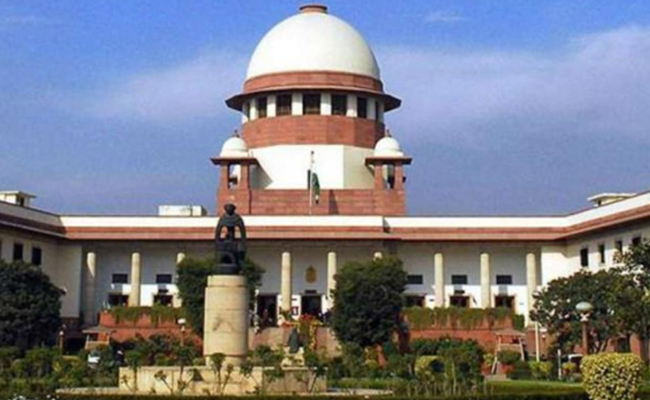
New Delhi (PTI): The government has promulgated an ordinance to increase the strength of the Supreme Court from the present 34 judges to 38, including the Chief Justice of India.
The law ministry notified the ordinance on Saturday, which amended the Supreme Court (Number of Judges) Act, 1956, to increase the sanctioned strength of the top court.
So far, the sanctioned strength of the top court was 34, including the Chief Justice of India (CJI). Now, the number of judges has been increased by four, taking the sanctioned strength to 38.
The top court will now have 37 judges, other than the CJI.
With the apex court having two vacancies at present, and the ordinance coming into force immediately, the Supreme Court Collegium will now have to recommend six names for appointment as judges in the top court.
A bill will be brought in the Monsoon Session of Parliament to convert the ordinance – an executive order – into a law passed by Parliament.
The Union Cabinet had cleared a draft bill on May 5 to increase the number of apex court judges.
The strength of the Supreme Court was last increased from 30 to 33 (excluding the CJI) in 2019.
The Supreme Court (Number of Judges) Act, as originally enacted in 1956, put the maximum number of judges (excluding the CJI) at 10.
This number was increased to 13 by the Supreme Court (Number of Judges), Amendment Act, 1960, and to 17 by another amendment to the law.
The Supreme Court (Number of Judges) Amendment Act, 1986, augmented the strength of judges from 17 to 25, excluding the CJI.
A fresh amendment in 2009 further increased the strength from 25 to 30.
Article 124(3) of the Constitution lists the qualifications required to become a Supreme Court judge.
An Indian citizen who has either served as a high court judge for at least five years, or as an advocate for 10 years, or is a distinguished jurist, can be appointed to the top court.
The strength of the Supreme Court is increased based on the recommendations of the CJI, who writes to the Union law minister. After consulting the finance ministry, the Department of Justice under the law ministry moves the Cabinet with a draft bill.