Bengaluru's silence zones among city's noisiest areas, reveals data
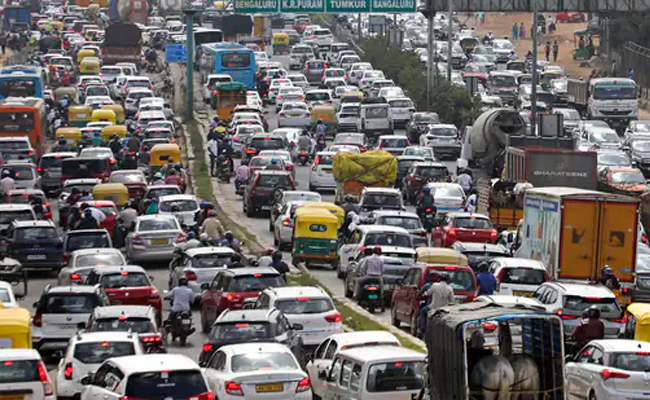
Bengaluru: Areas designated as 'silence zones' in Bengaluru, primarily around hospitals and educational institutions, have emerged as some of the noisiest pockets in the city, often recording sound levels far exceeding permissible limits, especially during night hours.
According to the Karnataka State Pollution Control Board’s (KSPCB) May data, cited by The New Indian Express, the RVCE Mysore Road zone recorded night-time noise levels of 57.8 decibel (dB), exceeding the legal limit by 44.5%, while the Indira Gandhi Institute of Child Health (NIMHANS) zone showed a 29% rise above permissible levels.
Ironically, even the KSPCB’s regional office complex at SG Halli, categorised under a residential category, showed one of the sharpest violations, with a 61.8% spike in noise levels at night.
Meanwhile, industrial zones like Peenya and Whitefield, typically assumed to be high-noise areas, were found to be compliant with noise regulations.
Between February and April this year, average night-time readings at silence zones like NIMHANS and RVCE Mysore Road hovered between 61 and 64 dB(A) — over 50% higher than permitted levels. RVCE even peaked at 70.3 dB(A), while NIMHANS recorded levels ranging from 56 to 63 dB(A). These areas are meant to remain quiet due to their proximity to hospitals and educational institutions, yet every month they show clear and repeated violations, added the report.
Prof Ashish Verma, Transportation Systems Engineering, Convenor, IISc Sustainable Transportation Lab, quoted in the report, highlighted the lack of noise barriers in Bengaluru, unlike cities such as Mumbai and Delhi. Citing IIT-Bombay as an example, where such barriers were installed to counter construction-related noise, he emphasised the urgent need for similar measures near hospitals and schools in Bengaluru.
Rajkumar Dugar, founder of Citizens for Citizens (C4C), pointed out the prevalence of illegal, multi-toned, and excessively loud horns, especially in silence and residential zones. “Noise pollution from vehicles, especially due to illegal horns and unnecessary honking, is a silent public health crisis. It affects physical and mental well-being, slows recovery in hospitals, and lowers productivity,” TNIE quoted him as saying.
Dugar also called for stricter enforcement against not just the use of illegal horns but their manufacture and fitting. “Noise monitoring in a city like Bengaluru cannot be limited to just 10 locations — KSPCB must scale up,” he added.
Let the Truth be known. If you read VB and like VB, please be a VB Supporter and Help us deliver the Truth to one and all.
VCK urges CM Vijay to enact stringent law against superstitious practices

Chennai (PTI): VCK MLA Vanni Arasu on Wednesday urged the newly formed Tamil Nadu government to enact a stringent law against superstitious practices, citing similar legislations in Karnataka and Maharashtra to curb exploitation in the name of black magic and rituals.
VCK, which won two seats in the 2026 Assembly election, has offered support to TVK to form a government during the floor test.
Speaking during the discussion on the confidence motion in the Assembly, Arasu highlighted that states like Bihar, Jharkhand, Chhattisgarh, Odisha, and Rajasthan already have laws against witchcraft and sorcery.
"From 2013 in Maharashtra and 2020 in Karnataka, laws providing imprisonment for those who deceive through superstitious means have been in practice," he stated. The party noted that rationalist Narendra Dabholkar had fought for such a law in Maharashtra before being murdered by "Sanatana terrorists".
The VCK MLA further called on the government to prioritise scientific temper over beliefs in astrology and sorcery.
"Our government should give priority to projects that develop science without giving room for superstitions like astrology and black magic," Arasu said, citing Article 51A of the Indian Constitution, which defines the development of scientific temper as a fundamental duty of every citizen.
The party demanded a special law to prevent honour killings as well, which Arasu claimed are rising in Tamil Nadu as they once did in North Indian states.
The government was also urged to enact legislation protecting the "200-point roster system" for SC/ST employee promotions, utilising powers under Article 16(4A) of the Constitution.
Highlighting the recent arrest of 40 Tamil Nadu fishermen by the Sri Lankan Navy, the VCK sought a permanent solution to protect them from such attacks.
The party called on the state government to take initiatives toward the "right of Eelam Tamils to rule themselves" and requested that the state officially observe May 18 as International Genocide Day.