BJP makes changes to PM's 2-day roadshow in Bengaluru due to NEET
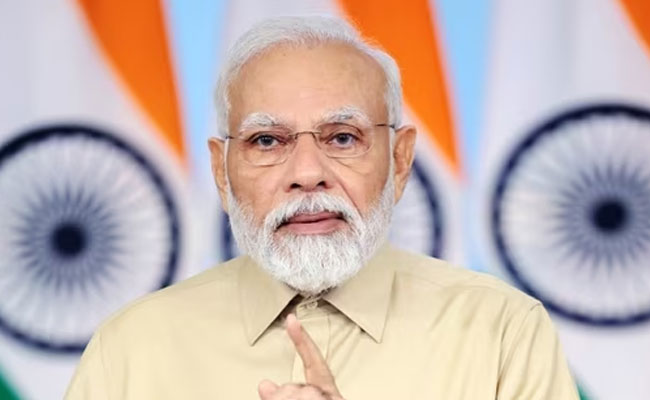
Bengaluru (PTI): Keeping NEET examinations in mind, the Karnataka BJP made changes in the Prime Minister Narendra Modi's two-day roadshow in Bengaluru, ahead of the Assembly polls in the state, by scheduling an extensive event on May 6 and a shorter one on May 7, Union Minister of State Shobha Karandlaje said on Friday.
The National Eligibility cum Entrance Test (NEET) is scheduled on May 7 (Sunday).
"PM Narendra Modi's road show will be on May 6 and 7, preparations are on for it. We had shared information in that regard to the public through the press. However, you (media) people informed us about the NEET exams on May 7 at 2 pm, and the 26 km roadshow will cause inconvenience for (students writing) exams," Karandlaje said.
Speaking to reporters here, she said, this was brought it to the notice of the Prime Minister, and Modi who pays special attention to children with initiatives such as 'Pariksha pe Charcha', asked us to ensure that no inconvenience is caused to even a single student going to the exam centre at any cost.
So the PM directed the state BJP to make changes in the programme, she said, as desired by him, certain changes have been made in the programme.
"Earlier we had said on May 6 that there would be a 10km road show, and on May 7 it would be 26 km. Changing that we will be now holding long distance one of 26 km on May 6 from Someshwar Bhavan RBI Ground in Bengaluru South to Malleshwaram's Sankey Tank between 10 am to 1.30 pm, and shorter one of about 10 km one between Kempegowda statue at Thippasandra to Trinity circle, that can be completed soon, will be held on Sunday from 10 am to 11/11:30 am, she said.
Further noting that not many exam centres are located on the stretch where the roadshow will be held on Sunday, she said if there are any students coming from that region, on showing their hall tickets, police officials have been directed to ensure that they reach exam centres on time.
The roadshow, earlier scheduled to be held for eight hours on Saturday alone, was then split into two parts on Saturday and Sunday from 10 am to 1.30 pm to prevent inconvenience to the general public in case the rally is held for a full day.
Accusing the Congress of conspiring to disrupt the roadshow on Saturday, by getting the ambulances linked to their workers and well-wishers or hospitals run by them, at places along the stretch of 26 km which the PM is likely complete in about 3 hours, Karandlaje said, they have conspired to bring a bad name to the Prime Minister's roadshow.
"We have requested the police to ensure that ambulances with patients reach the hospitals on time without any hindrance, we have also discussed with SPG in this regard....we are following up things," she said.
Let the Truth be known. If you read VB and like VB, please be a VB Supporter and Help us deliver the Truth to one and all.
RR beat RCB by six wickets in IPL
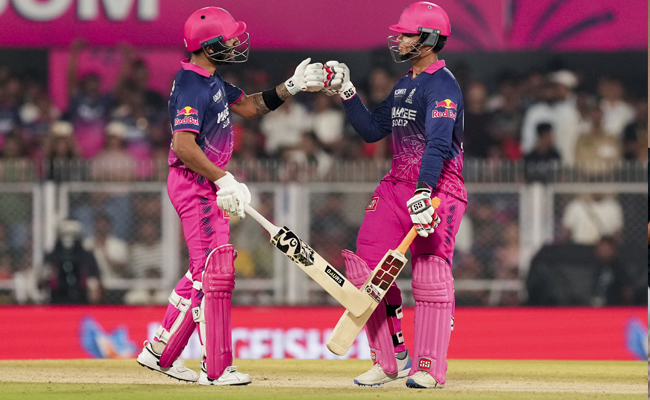
Guwahati (PTI): Blistering fifties by Vaibhav Sooryavanshi and Dhruv Jurel powered Rajasthan Royals to a six-wicket win over Royal Challengers Bengaluru in their IPL match here on Friday.
Sent in to bat, RCB rode on a fighting half-century by skipper Rajat Patidar (63) to post 201 for 8.
Virat Kohli (32), Romario Shepherd (22) and Venkatesh Iyer (29) also chipped in with useful contributions.
In reply, Sooryavanshi (78 off 26 balls) and Dhruv Jurel (81 not out off 43 balls) shared a 37-ball 108-run partnership for the second wicket to set the platform. Krunal Pandya (2/30) tried to bring them back with back-to-back wickets.
But Jurel, in the company of Ravindra Jadeja (24), completed the task with another 68-run stand, with two overs to spare.
For RR, Jofra Archer (2/33), Ravi Bishnoi (2/32) and Brijesh Sharma (2/37) took two wickets.
Brief scores:
Royal Challengers Bengaluru: 201 for 8 in 20 overs (Rajat Patidar 63; Jofra Archer 2/33, Ravi Bishnoi 2/32, Brijesh Sharma 2/37).
Rajasthan Royals: 202 for 4 in 18 overs (Vaibhav Sooryavanshi 78, Dhruv Jurel 80 not out; Krunal Pandya 2/30, Josh Hazlewood 2/44).