BJP misunderstood Rahul Gandhi's statement: Home Minister Parameshwara
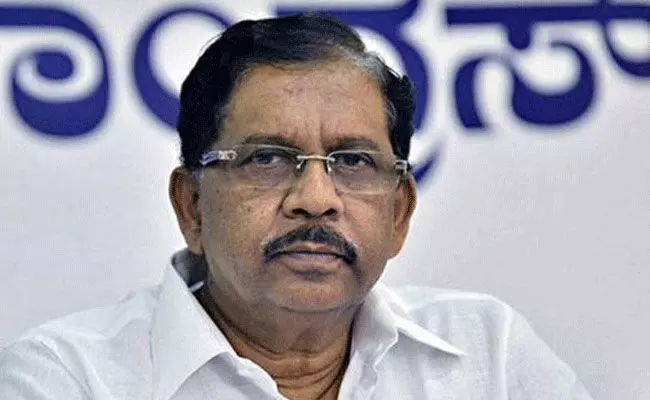
Bengaluru: Home Minister G. Parameshwara has stated that the BJP has failed to understand the statements made by Lok Sabha Opposition Leader Rahul Gandhi, leading to ongoing confusion among its members.
Speaking to reporters near his residence in Sadashiva Nagar, Parameshwara said that Hinduism promotes unity and peace among all sections of society. He clarified that Gandhi's remarks were directed at those who oppose these principles, indicating the BJP's misinterpretation of his speech.
Addressing the issue of changing the police commissioner in Bangalore, Parameshwara mentioned that he meets the Chief Minister daily to discuss various departmental issues that require attention and decisions. He highlighted the need for constant communication when making government decisions.
ALSO READ: Rules will be formed for transfer of police personnel: Home Minister G. Parameshwara
In response to DK Shivakumar's statement about issuing notices to those making public statements regarding the posts of Chief Minister and Deputy Chief Minister, Parameshwara explained that it is the party president's responsibility to issue such notices. He stressed that party members, legislators, and ministers should operate within the party's framework, and any deviations would be addressed by the party president and the disciplinary committee.
Regarding the new criminal laws, Parameshwara noted that while some provisions are beneficial, others require debate and revision. He acknowledged that millions of cases will be registered under the new laws, and staff training is underway. He also spoke on the importance of discussing these laws with the central government to address any issues.
Parameshwara also addressed allegations of illegal activities in MUDA by officials, stating that transfers and departmental inquiries are standard procedures. He assured that if any illegality is found, it will be handed over to the police for investigation.
Reacting to H. Vishwanath's allegations against Chief Minister Siddaramaiah, Parameshwara said that not all claims made by certain individuals are true and that the facts will be investigated before making any conclusions.
About actor Darshan receiving special treatment in jail, Parameshwara clarified that no special facilities are provided and invited those raising doubts to visit the jail to verify the claims themselves.
Let the Truth be known. If you read VB and like VB, please be a VB Supporter and Help us deliver the Truth to one and all.
Rickelton's ton in vain as SRH beat MI by 6 wickets
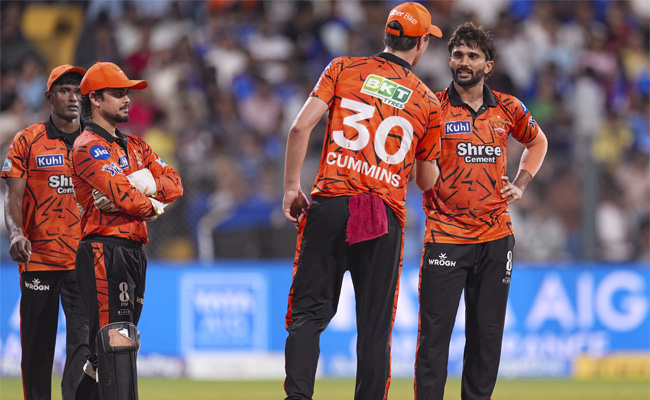
Mumbai (PTI): Ryan Rickelton's whirlwind unbeaten ton was overshadowed by Heinrich Klaasen's unbeaten 65 as Sunrisers Hyderabad defeated Mumbai Indians by six wickets in an IPL match here on Wednesday.
Chasing an imposing 244-run target, Travis Head (76 off 30) and Abhishek Sharma (45 off 24) shared 129 runs for the opening wicket to set the platform for SRH.
Klaasen (65 not out off 30 balls) then displayed his all-round hitting abilities to guide SRH home with the help of Nitish Kumar Reddy (21) and Salil Arora (30 not out off 10) in 18.4 overs.
Earlier, Rickelton's knock powered MI to 243 for five.
MI rode on a 93-run stand between Rickelton (123 not out off 55 balls) and Will Jacks (46 off 22) in 7.1 overs for the opening stand to power the side.
MI skipper Hardik Pandya scored a valuable 31 off 15 balls before being dismissed.
Praful Hinge (2/54), Eshan Malinga (1/29), Sakib Hasan (1/39) and Nitish Kumar Reddy (1/31) were the wicket-takers for SRH.
Brief Scores:
Mumbai Indian: 243 for 5 in 20 overs (Ryan Rickelton 123 not out; Praful Hinge 2/54).
Sunrisers Hyderabad: 249 for 4 in 18.4 overs (Travis Head 76, Heinrich Klaasen 65 not out; AM Ghazanfar 2/51).