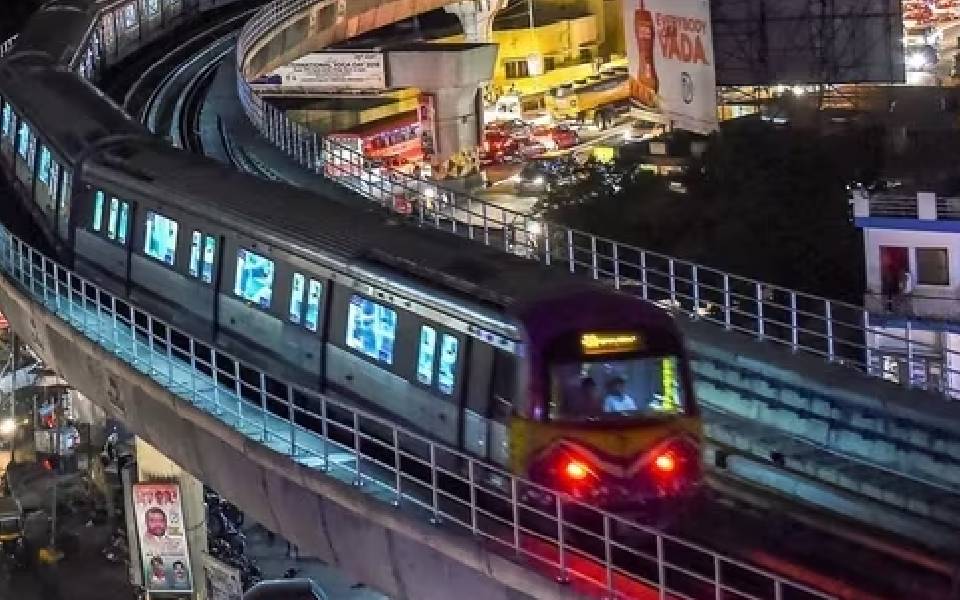
Bengaluru, Apr 23 (PTI): Bangalore Metro Rail Corporation Limited (BMRCL) on Wednesday announced that passengers found consuming chewable tobacco-based products within metro premises and trains will be fined.

For this, the BMRCL will strengthen its patrolling efforts during non-peak hours, it said.

According to the BMRCL, this step has been taken in an effort to address public grievances about passengers using chewable tobacco-based products and to avoid consequent spitting and littering within metro premises and trains.

Since possession of such substances cannot be detected through metal detectors, BMRCL said it has decided to implement random physical pat-down checks at all metro stations.

"While platform security guards will be sensitised to look out for such passengers, the central security surveillance room has already been instructed to monitor passenger behaviour and alert the concerned platform security staff immediately upon noticing any violations. Enhanced surveillance will now be carried out on all trains and metro stations, and guilty passengers will be fined as per BMRCL rules," it said in a statement.

Additionally, BMRCL will launch extensive awareness campaigns to educate passengers on the importance of refraining from using chewable tobacco-based products within metro premises.

"BMRCL requests all commuters' cooperation and to join hands with us in order to ensure a cleaner and more pleasant commuting experience," it added.

Get all the latest, breaking news from Karnataka in a single click. CLICK HERE to get all the latest news from Karnataka.

Let the Truth be known. If you read VB and like VB, please be a VB Supporter and Help us deliver the Truth to one and all.


Kolar (Karnataka) (PTI): Defence Minister Rajnath Singh on Tuesday said the investment into H-125 helicopter programme is "anticipated" to cross Rs 1000 crore, and create a number of jobs, and called it a "shining example" of mutually beneficial partnership with friendly countries in high-end manufacturing sector.

He was speaking at the inaugural ceremony of the final assembly line of H-125 helicopters here.

Prime Minister Narendra Modi and French President Emmanuel Macron virtually inaugurated the Airbus H125 light utility helicopter Final Assembly Line at Tata‑Airbus' facility at Vemagal Industrial Area in this district from Mumbai.

Singh, accompanied by his French counterpart Catherine Vautrin, congratulated Tata Advanced System and Airbus Helicopters on the inauguration of the project and recalled their earlier association as well.


"This project is a shining example of mutually beneficial partnership with friendly countries in high-end manufacturing sector," Singh said.

"The H-125 program investment is anticipated to exceed Rs 1000 crore and is likely to create direct and indirect employment opportunities for our skilled and hard working younger generation," he said.

Renowned for its exceptional reliability, versatility, and outstanding performance under diverse operating conditions, the H-125 has proven to be one of the most effective and trusted single-engine helicopters globally, he said.

He recalled that Tata Advanced Systems and Airbus had earlier joined hands for a project in Gujarat's Vadodara for the C-295 aircraft, which he described as a symbol of how Tata in particular and India in general can collaborate with international OEMs to contribute to the vision of a stronger India.

The Defence minister said "Make in India" and self-reliance have been the cornerstone of India's economic policy since 2014.

Singh recalled that this policy initiative was launched by PM Modi, under which India is committed to achieving self-reliance in critical technology and the manufacturing of high-end products and equipment through mutually beneficial partnerships.

"For more than a decade, India has been charting industrial development through large-scale infrastructure building, capital infusion in important sectors through a number of incentive schemes on the one hand, and providing a level playing field for facilitating investment on the other," he said.

He added that it has also been the government's focus to support small and medium industries and strengthen the startup ecosystem in particular. Overall, the focus has been on holistic industrial development, which not only caters to domestic demand but also addresses the needs of other countries.

Highlighting reforms in the defence sector, Singh said these measures have augmented the contribution of the private sector in the defence industrial ecosystem.

According to him, historically, Indian defence production was largely public sector-oriented due to requirements of high capital investment and long gestation periods, resulting in the private sector's contribution being far less than desired.

However, with reforms such as the corporatisation of ordnance factories, establishment of defence industrial corridors, and other initiatives to raise the private sector's share in total defence production, it now stands at almost a quarter of the country's total defence production.

Defence exports have also increased manifold, placing India among the top exporters in the world, he said.

Singh said the growth trajectory has given a massive boost to MSMEs and ancillary sectors, which have grown to more than 16,000 in number, with many foreign companies sourcing components from Indian MSMEs.

He invited companies to deepen the partnership through meaningful technology transfer and offer platforms to meet the security needs of other countries as well.

Union Civil Aviation Minister K Rammohan Naidu, who also attended the event said the H125 final assembly line set up by Tata and Airbus marks a defining moment for India's aerospace sector, calling it "a proud symbol of rising confidence in India's high-precision aerospace capabilities."

He described defence and civil aviation as "two strategic pillars of the Indo-French partnership" and said the new facility would reinforce "a single integrated aerospace ecosystem" by assembling both civil and defence variants.

Noting that India has risen from the 10th to the third largest civil aviation market in just 11 years, Naidu asserted that the country now has "the market, the export potential, the policy ecosystem, the skilled workforce and the strategic global partnerships to emerge as a rotary-wing manufacturing hub".

"The future of rotary aviation in South Asia will be designed, manufactured, certified, maintained and exported from India," he said, adding that the country is "not just flying high, but flying past all horizons" under the Make in India and Viksit Bharat 2047 visions.

Tata Advanced Systems CEO and MD Sukaran Singh said in this facility here, "we will start building helicopters without any government or defense orders."

"However, we will be ready to supply the defense forces as and when they want. The first helicopter will fly out this facility by mid 2027."