Bommai accuses Congress of having history of misusing Raj Bhavan to topple governments

Bengaluru: Former Chief Minister and MP Basavaraja Bommai has accused the Congress party of having a history of misusing the Raj Bhavan more than 56 times across the country to destabilize governments. Speaking to the media on Sunday, Bommai claimed that Congress has a history of manipulating the Governor's office to topple state governments, including in Kerala.
Referring to former Governor Hansraj Bhardwaj as "controversial and questionable," Bommai alleged that Bhardwaj had ordered an investigation against BJP leader B.S. Yediyurappa without sufficient grounds, a case that has since been dropped. He questioned whether Congress would apologize for this.
Responding to a question about the death of a PSI, he said that “the transfer racket has been in operation since the day this government came to power. They are not allocating any funds for development, and all the MLAs are entangled in it. As Chief Minister, all Congress leaders have instructed the MLAs to handle the transfers, thereby institutionalizing corruption. Transfers are occurring under their watch, with excessive demands for money. The entire group of employees is under immense pressure, with many facing severe stress. Those who pay the money become involved in corruption. Such deaths are happening because corruption is pervasive from top to bottom.”
Let the Truth be known. If you read VB and like VB, please be a VB Supporter and Help us deliver the Truth to one and all.
Ordinance issued to increase number of Supreme Court judges from 34 to 38
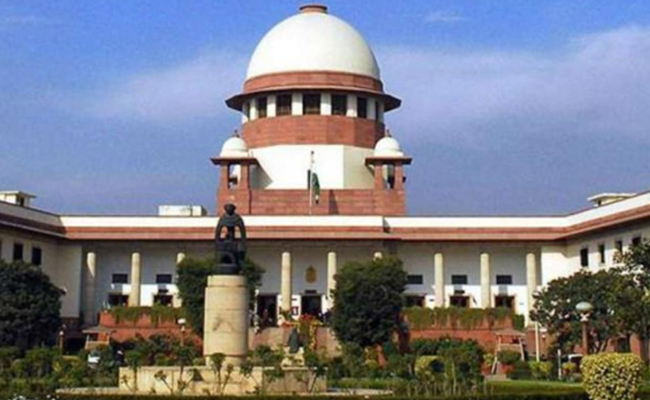
New Delhi (PTI): The government has promulgated an ordinance to increase the strength of the Supreme Court from the present 34 judges to 38, including the Chief Justice of India.
The law ministry notified the ordinance on Saturday, which amended the Supreme Court (Number of Judges) Act, 1956, to increase the sanctioned strength of the top court.
So far, the sanctioned strength of the top court was 34, including the Chief Justice of India (CJI). Now, the number of judges has been increased by four, taking the sanctioned strength to 38.
The top court will now have 37 judges, other than the CJI.
With the apex court having two vacancies at present, and the ordinance coming into force immediately, the Supreme Court Collegium will now have to recommend six names for appointment as judges in the top court.
A bill will be brought in the Monsoon Session of Parliament to convert the ordinance – an executive order – into a law passed by Parliament.
The Union Cabinet had cleared a draft bill on May 5 to increase the number of apex court judges.
The strength of the Supreme Court was last increased from 30 to 33 (excluding the CJI) in 2019.
The Supreme Court (Number of Judges) Act, as originally enacted in 1956, put the maximum number of judges (excluding the CJI) at 10.
This number was increased to 13 by the Supreme Court (Number of Judges), Amendment Act, 1960, and to 17 by another amendment to the law.
The Supreme Court (Number of Judges) Amendment Act, 1986, augmented the strength of judges from 17 to 25, excluding the CJI.
A fresh amendment in 2009 further increased the strength from 25 to 30.
Article 124(3) of the Constitution lists the qualifications required to become a Supreme Court judge.
An Indian citizen who has either served as a high court judge for at least five years, or as an advocate for 10 years, or is a distinguished jurist, can be appointed to the top court.
The strength of the Supreme Court is increased based on the recommendations of the CJI, who writes to the Union law minister. After consulting the finance ministry, the Department of Justice under the law ministry moves the Cabinet with a draft bill.