Yediyurappa resigns as CM, says will remain active in Karnataka politics
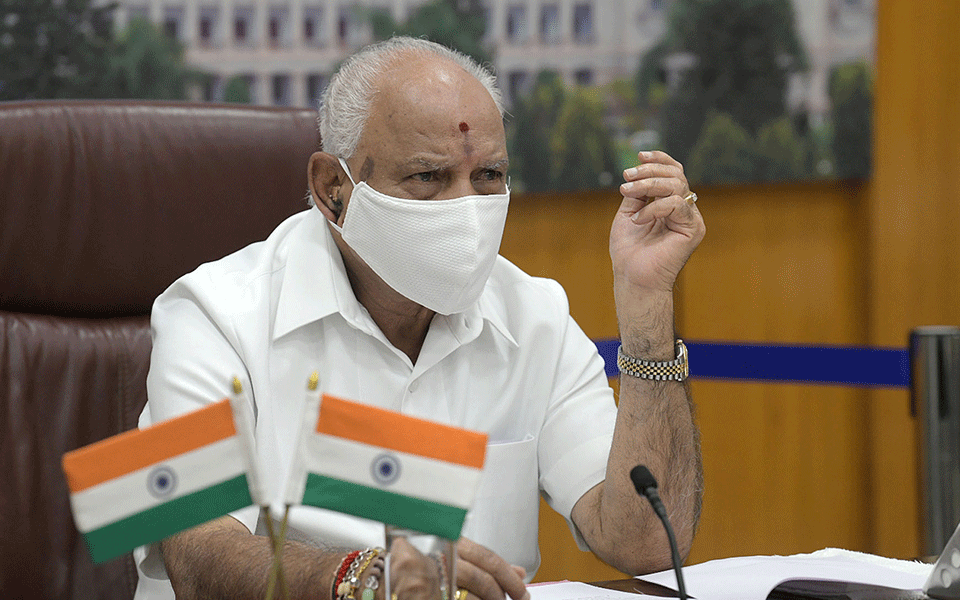
Bengaluru: After months of speculation about over his exit, B S Yediyurappa on Monday stepped down as the Chief Minister of Karnataka, coinciding with his government completing two years in office.
He termed these two years as "trial by fire", pointing out that he had to run the administration without cabinet in the initial days, followed by devastating floods and the challenge of Covid-19 management, among other issues.
The 78-year-old BJP veteran who submitted his resignation to Governor Thaawarchand Gehlot at the Raj Bhavan here, said he quit "voluntarily".
"I had decided to resign two months ago, as we complete two years of our government today. I thought it was apt to resign now and have submitted the resignation to the Governor, and he has accepted it," Yediyurappa told reporters emerging from the Raj Bhavan.
An official notification from the Governor's office said Gehlot has accepted Yediyurappa's resignation and has dissolved the Council of Ministers headed by him with immediate effect.
Thanking the party leaders and the people for giving him an opportunity to serve the state, he said, he had no "pressure" from the party's central leadership in Delhi, and has quit on his own "voluntarily", to make way for others to serve as the Chief Minister.
"I will not make any proposal on who should be the next Chief Minister, it is left for the high command to decide. Whomever they choose, I will cooperate and work with...I don't want to take any names," he said in response to a question.
Monday's developments now shift the focus to the BJP veteran's successor who could lead the party-led government for its remainder of term till 2023.
Among the names that have been doing the rounds as the probable successor to Yediyurappa are that of Union Minister Pralhad Joshi, BJP national General Secretary C T Ravi, its national organising secretary B L Santhosh and state Assembly Speaker Vishveshwar Hegde Kageri.
The names of Home Minister Basavaraj S Bommai, Revenue Minister R Ashoka and Deputy CM C N Ashwath Narayan have also been doing the rounds.
Industries Minister Jagadish Shettar, who has earlier served as the Chief Minister--is also seen as a contender.
Mining Minister Murugesh Nirani and MLA Arvind Bellad also seem to be in contention. Meanwhile, the Governor's office said Yediyurappa shall continue to function as Chief Minister till alternate arrangements are made.
Considered the architect of the first ever BJP government to the south of Vindhyas, Yediyurappa had headed the state four times.
Asserting that he will hundred per cent continue in politics and work for bringing BJP back to power from tomorrow itself, the Lingayat strong man said, "...there is no question of political retirement for any reason, I'm with the karyakartas and the people."
"Party has nurtured me to this height, most probably no other politician in the country has got the privileges that I have got."
Responding to a question whether he will accept, if there is an offer to make him the Governor, he said, "Atal Bihari Vajpayee had offered me to become the central Minister, when he was the PM, I had said no.
There is no question of becoming Governor. I will work to strengthen the organisation in Karnataka. I have not asked for any position, nor will accept it."
Yediyurappa who has played an instrumental role in building the BJP in Karnataka, had served as its state President, Member of Parliament, MLA and Deputy Chief Minister.
Earlier in the day, speaking at an event organised to mark his government's two years in office at Vidhana Soudha, the seat of state legislature and secretariat here, Yediyurappa had announced his decision to step down, as his voice choked and he turned emotional.
"Not out of grief, but with happiness," he said, as he thanked Prime Minister Narendra Modi, Union Home Minister Amit Shah and BJP National President JP Nadda for giving him an opportunity to serve as Chief Minister for two years, despite completing 75 years of age.
There is an unwritten rule in the BJP of keeping out those above 75 years from elected offices.
During the speech, Yediyurappa termed his tenure for two years as "trial by fire", recalling that he had to run the administration without cabinet in the initial days, followed by devastating floods and the COVID-19 management, among other issues.
Thanking the people of Shikaripura constituency for electing him to assembly for seven terms, Yediyurappa while speaking to mediapersons later said, no one in BJP was given the opportunity to hold any position after 75 years, but that he was allowed to become CM, despite crossing that age bar.
"... Am humbled and sincerely thank the people of the state for giving me the opportunity to serve them," he tweeted.
Asked about the future of those who had defected from Congress-JD(S) and are now Ministers, as they had helped BJP to come to power, he said, "all are together with us."
"I am confident that the next chief minister will also cooperate with those who helped in forming this government.
All will work together.
Let the Truth be known. If you read VB and like VB, please be a VB Supporter and Help us deliver the Truth to one and all.
Punjab elect to bowl against Chennai in IPL match
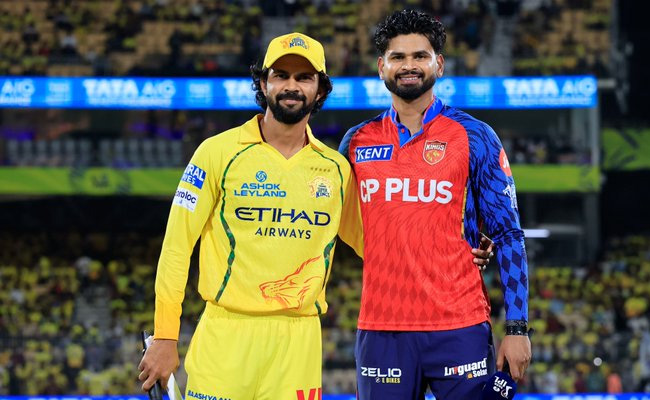
Chennai (PTI): Punjab Kings skipper Shreyas Iyer won the toss and opted to bowl against Chennai Super Kings in an Indian Premier League match here on Friday.
CSK made one change to their playing XI, bringing in Prashant Veer in place of Matt Short.
CSK had lost to Rajasthan Royals by eight wickets in the opening match while Punjab Kings defeated Gujarat Titans by three wickets.
Teams:
Chennai Super Kings: Sanju Samson (w), Ruturaj Gaikwad (c), Ayush Mhatre, Sarfaraz Khan, Shivam Dube, Kartik Sharma, Prashant Veer, Noor Ahmad, Anshul Kamboj, Matt Henry, and Khaleel Ahmed.
Punjab Kings: Prabhsimran Singh (w), Cooper Connolly, Shreyas Iyer (c), Shashank Singh, Nehal Wadhera, Marcus Stoinis, Marco Jansen, Xavier Bartlett, Vijaykumar Vyshak, Arshdeep Singh, and Yuzvendra Chahal.