Cauvery issue: Farmers' and pro-Kannada outfits observe bandh in Mandya
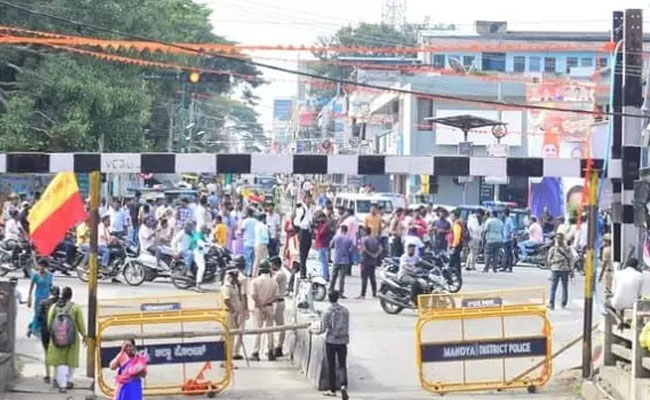
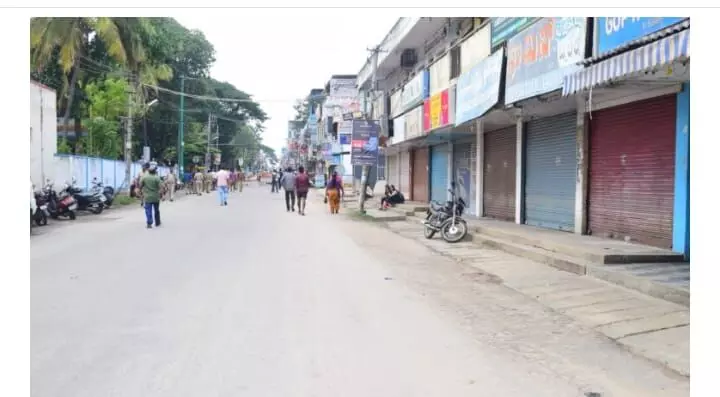
Mandya (K'taka) (PTI): In the wake of a call by pro-Kannada organisations for a 'bandh' to oppose the release of Cauvery water to Tamil Nadu from dams in Karnataka, most of the shops in the district headquarters town of Mandya, the Cauvery heartland, remained closed on Saturday.
Irrigation department officials told PTI that Karnataka was releasing 5,000 cusecs water to the neighbouring state as per the Cauvery Water Management Authority's direction.
Raising slogans alleging injustice to Mandya, where the Krishnaraja Sagar Dam on the Cauvery river is located, the protesters took out a march here.
They appealed to the people, especially shopkeepers and owners of various other commercial establishments including petrol and diesel service stations, to cooperate by observing a total bandh.
Extending their support, most of the shops remained shut and those who opened the shops, later closed down following the appeal by the activists.
A major protest took place at Sanjay Circle in the town where members of Mandya Rakshana Vedike, a fringe outfit, reached in the form of a bike rally.
They took out a march, raised slogans, staged a sit-in demonstration and rolled on the road alleging injustice to Mandya and Karnataka.
Security has been beefed up in the town with heavy deployment of police personnel at important places.
The Janata Dal (Secular) has extended its support to the Mandya bandh.
The Cauvery Water Management Authority (CWMA) had on Monday asked Karnataka to continue releasing 5,000 cusecs of water to Tamil Nadu for another 15 days, after the Cauvery Water Regulation Committee (CWRC) made such a recommendation last week.
The Supreme Court on Thursday refused to interfere with orders of the CWMA and CWRC directing Karnataka to release 5,000 cusecs of water to Tamil Nadu, following which protests erupted in different parts of the state.
Amid continuing protests in the state over the Cauvery issue with neighbouring Tamil Nadu, the Karnataka government on Friday said it will take all necessary steps to protect the interests of the people of the state and its farmers, by ensuring water for both crops and drinking water.
Karnataka has been maintaining that it is not in a position to release water, taking into account its own requirement for drinking water and irrigation for standing crops in the Cauvery basin areas, as there has been water scarcity due to deficit monsoon rains.

Let the Truth be known. If you read VB and like VB, please be a VB Supporter and Help us deliver the Truth to one and all.
What is Iran’s 10-point plan? Key demands ahead of US talks in Islamabad

Tehran/Islamabad: Iran has outlined a 10-point plan as the basis for upcoming talks with the United States, expected to begin in Islamabad on April 11, according to a statement from the Iranian Supreme National Security Council.
The plan lays out Tehran’s key political, military and economic demands, and is being seen as a framework for negotiations following the recent escalation in the region.
Strait of Hormuz at the centre
A major focus of the plan is the Strait of Hormuz, a critical global shipping route. Iran has proposed “controlled passage through the Strait of Hormuz in coordination with the Iranian armed forces,” which it says would give the country a unique economic and geopolitical position.
The plan also calls for the “establishment of a safe transit protocol” in the Strait that would guarantee Iran’s dominance under an agreed mechanism.
Call to end conflict
Iran has demanded “the necessity of ending the war against all elements of the axis of resistance,” signalling its expectation that hostilities should stop not only in Iran but also involving allied groups in the region.
US troop withdrawal
Another key demand is the “withdrawal of US combat forces from all bases and deployment points in the region,” indicating Tehran’s long-standing position against American military presence in West Asia.
Sanctions relief and compensation
The plan places strong emphasis on economic measures. It calls for “full payment of Iran’s damages according to estimates,” along with “the lifting of all primary and secondary sanctions and resolutions of the Board of Governors and the Security Council.”
It also seeks “the release of all Iranian assets and properties frozen abroad,” which have been a major point of contention for years.
Binding global guarantee
Finally, Iran has demanded that all these terms be formally recognised through “a binding Security Council resolution,” suggesting it wants international legal backing to ensure enforcement.
What this means
The 10-point plan reflects Iran’s broader push for security guarantees, economic relief and regional influence. The upcoming talks in Islamabad are expected to test how far both sides are willing to negotiate on these demands.