CM Bommai rejects rail infra proposals of Kerala govt, flags concerns over damage to environment
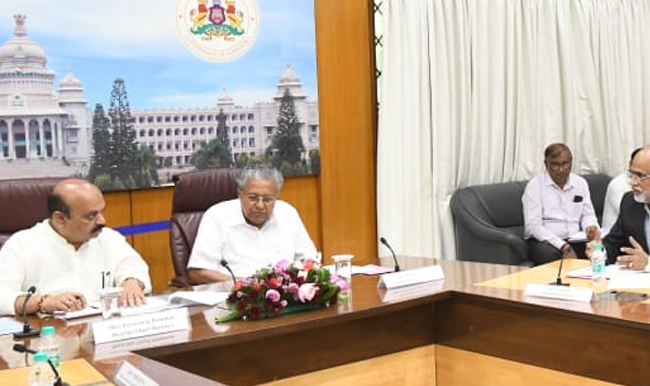
Bengaluru, Sep 18: The bilateral talks held between the governments of Kerala and Karnataka here on Sunday on various projects failed to yield results as Chief Minister Basavaraj Bommai turned down the proposals of his counterpart Pinarayi Vijayan, citing environmental concerns.
Bommai rejected all the key infrastructure related proposals of Kerala, saying it will damage the eco-sensitive zones and wildlife sanctuaries.
Vijayan called on Bommai in the city this morning to hold discussions on various projects and issues of mutual interest, as decided at the South Zonal Council meeting.
The projects that Vijayan and Bommai discussed were Kanhangad-Kaniyoor Railway Line via Panathur, Thalasseri-Mysuru Railway Line, underground tunnel passing through Bandipura National Park and proposal to increase bus services at night in this eco-sensitive zone.
Addressing reporters after the meeting, Bommai said, the Kerala government sought co-operation for its various railway projects including Kanhangad-Kaniyur Rail Line route, and other highway projects. The proposed Kanhangad-Kaniyur rail line project has a 40 km route in Kerala and 31 km in Karnataka." "However, this project is not very beneficial for Karnataka. Besides, it will pass through the rich bio-diversity and ecologically sensitive areas of the Western Ghats. So, the Kerala CM was clearly told that it was not possible for the State of Karnataka to give extended co-operation for this project." ... the Railways had said that it will review the project if both the states agree to it. We rejected it because there is no benefit to Karnataka from this Railway Line, he said.
Another Railway project that the state rejected was the Thalaseri-Mysuru Railway Line.
Vijayan discussed the old project of Tellicherry-Mysuru rail line route and he was told that it was not possible to give permission as the proposed rail route will traverse through Bandipur-Nagarhole National Parks and it will cause great damage to flora and fauna, Bommai said.
The Kerala CM proposed the construction of an underground rail route and even it was rejected flatly as it would damage the environment during the construction activities. Vijayan was informed that presently, two buses are operated during night through Bandipur National Highway, but he sought permission to allow four buses and that proposal was also rejected, Bommai pointed out.
He said Vijayan also told him that the National Highway Authority of India (NHAI) has proposed a new alignment touching the NH-73. He also apprised the Karnataka chief minister that this new alignment will not pass through the eco-sensitive zones.
We don't know what proposal the NHAI officials are coming up with. Let the NHAI give us a proposal. However, we will not allow any project in eco-sensitive zone, be it Nagarhole or Bandipur National Park, Bommai clarified.
However, a statement issued by the Kerala Chief Minister's Office said that both the states will jointly request the NHAI to implement the alignments from Tholpetti to Purakattiri and Sultan Batheri to Malappuram of the Mysore Malappuram Economic Corridor project as an alternative to the NH 766, passing through the tiger reserve, where night time travel restrictions are in place.
The Pinarayi Vijayan government also stated that Bommai has agreed to examine the proposed Kanhangad-Panathur-Kaniyoor railway line project, which will connect north Kerala and south Karnataka, and also seriously consider providing the necessary financial assistance for it.

Let the Truth be known. If you read VB and like VB, please be a VB Supporter and Help us deliver the Truth to one and all.
Four booked for tying 18-year-old to tree, beating him up in UP's Pratapgarh
Pratapgarh (UP) (PTI): Four people were booked here for the abduction and assault of a man who they allegedly tied to a tree and beat up, police said on Wednesday.
The incident, a video of which has gone viral, took place on Tuesday afternoon under the Kunda police station limits.
The FIR was registered on Wednesday evening based on a complaint from the victim's father.
According to Keshav Prasad Yadav, a resident of Mauli village, some people called his 18-year-old son Nikhil Yadav on the phone and asked him to come out of his house around 2.30 pm on Tuesday.
As he reached outside the village as instructed, the accused allegedly forced him into a car and took him towards the Tinpedwa forest area, where they tied him to a tree and assaulted, the complainant said.
The attackers also recorded a video of the incident and circulated it on social media. The purported video shows the men thrashing Nikhil one after another, while one of them is assumed to have recorded the act.
Kunda Station House Officer Manoj Pandey confirmed the incident and said efforts are underway to identify and arrest all the accused.
Meanwhile, Samajwadi Party president Akhilesh Yadav has shared the video on social media, describing the incident as reflective of a "dominant mindset" against the PDA (Pichda or Backward, Dalit, and Alpasankhyak or Minority), and demanded strict action against the accused.
_vb_80.png)