CM Siddaramaiah issues direction to restore damaged crest gate of Tungabhadra reservoir in 3-4 days
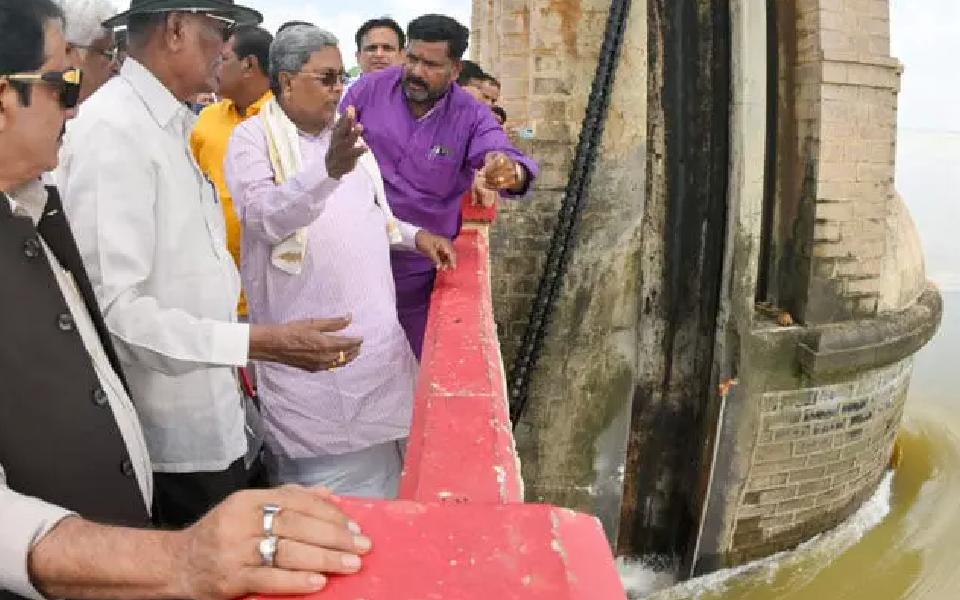
Koppal (Karnataka), Aug 13: Karnataka Chief Minister Siddaramaiah on Tuesday said he has asked officials and experts to fix within three to four days the damaged crest gate of Tungabhadra reservoir so that water from expected rains can be stored.
After inspecting the dam, he also assured that there is no need for farmers to worry. "I'm confident that Tungabhadra dam will be filled once again and I will come to offer 'Bagina' (traditional thanksgiving to the river). No politics on this issue."
One of the crest gates (19th gate) of the Tungabhadra reservoir in Koppal district was washed away after its chain link snapped on Friday midnight, following which the downstream areas were put on alert, as a huge quantity of water was being released.
"We were releasing water through ten gates, which included the 19th gate. The 19th gate got washed away after its chain link snapped...we have consulted dam safety experts and the repair works are on. Based on the advice of experts, the Tungabhadra Board will take appropriate decisions," Siddaramaiah told reporters.
ALSO READ: Tunga Reservoir gate chain link found weak; engineers, irrigation corporation officers inspect
He assured that there won't be any problem for farmers in the three states -- Karnataka, Andhra Pradesh and Telangana, who have sown crops, as water is flowing through all the canals and there will be any damage to crops. "There is no need for farmers to worry."
"...from August 17-18 there are expectations of above normal rains. I have asked experts to complete the work in three to four days, so that we can store the water from the expected rains, as we need 90 tmcft of water for standing crops. The government is at it, we want to complete the work at the earliest and want to ensure that farmers don't face any trouble. It is our responsibility," he added.
The dam is managed by the Tungabhadra Board with representatives from Karnataka, Andhra Pradesh and Telangana government representatives being its members; the Central Water Commission (CWC) appointee is the Chairman.
Andhra Pradesh Minister of Finance Payyavula Keshav, Minister for Water Resources Development Nimmala Ramanaidu, also MPs and legislators from that state were present during the Chief Minister's visit and his interaction with media.
Noting that the dam construction work began in 1948 and got completed in 1953, and from 1954 water is being released to canals, the Chief Minister said, "the dam is aged about 70 years. So far there was no chain link snap in this dam's 33 gates, now it has happened for the first time in the 19th gate."
This year the dam had received 115 tmcft of water out of which 25 tmcft was released through canals for fields of farmers in Karnataka, Andhra Pradesh and Telangana, he said. "For the first crop, 90 tmcft water is required and the dam currently has 90 tmcft of water. As of today there won't be any trouble for the first crop."
From the damaged 19th gate 35,000 cusecs water is flowing out, Siddaramaiah said, adding, "without reducing the water level, repair work cannot be done. We have to bring down the water level at the dam to 1,621 ft from 1,629 ft; when we do that 64 tmcft of water will remain in the dam and with that we will have to complete the repair work. "
It will take a minimum of four to five days for chain and gate to be installed and the repair work to be completed, he further said, adding that "The work has began since yesterday, gate will be ready tomorrow, Narayana Engineering, Hindustan Engineering and Jindal are involved in the work ."
Noting that it is for the first time in 70 years the chain link has snapped, the Chief Minister, citing experts, said it has to be changed at least once in 50 years. "Now, based on expert advice, the board and all the three state governments -- will follow things."
To a question as to who will be held responsible for the incident, Siddaramaiah said it will be looked into.
"The board maintains the dam, the board is headed by a Chief Engineer level officer appointed by the central government. Representatives of the Central Water Commission and all the three states are part of the board. Was there any fault of dereliction of duty on their part will be looked into," he added.
Noting that a detailed project report (DPR) worth about Rs 15,000 crore has been prepared for the Navali balancing reservoir across Tungabhadra river, the Chief Minister said it has been sent to the board, which will seek the opinion of Andhra Pradesh and Telangana. "If they give their approval, we will start the project. It is a multi state dam "
Earlier speaking to reporters on his arrival, Siddaramaiah rejected opposition BJP's criticism of his government being "irresponsible" in managing the dam, saying "the dam is managed by the board, whose head is appointed by the Government of India....I don't want to do politics on this issue."
ಮುಖ್ಯಮಂತ್ರಿ @siddaramaiah ಅವರು ಇಂದು ಹೊಸಪೇಟೆಯ ತುಂಗಭದ್ರಾ ಅಣೆಕಟ್ಟಿನ ಕ್ರಸ್ಟ್ ಗೇಟ್ ಮುರಿದಿರುವ ಸ್ಥಳಕ್ಕೆ ಭೇಟಿನೀಡಿ, ಪರಿಶೀಲನೆ ನಡೆಸಿದರು. pic.twitter.com/mjX92NzW6U
— CM of Karnataka (@CMofKarnataka) August 13, 2024
Let the Truth be known. If you read VB and like VB, please be a VB Supporter and Help us deliver the Truth to one and all.
4 workers die after being buried under coal slurry in Jharkhand's Dhanbad
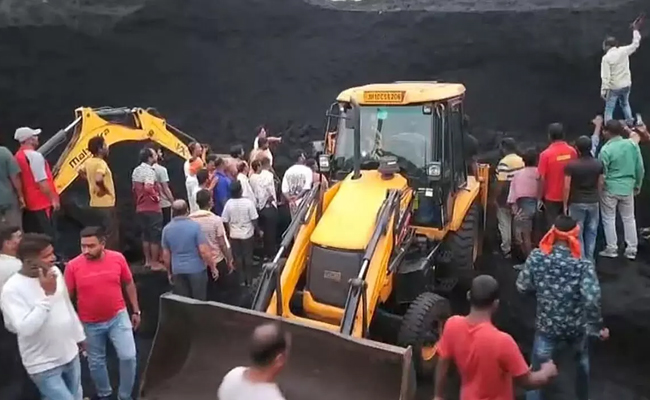
Dhanbad (Jharkhand) (PTI): At least four workers died after being buried under coal slurry in Jharkhand's Dhanbad district on Saturday, a police official said.
The incident took place at Moonidih coal washery in the command area of Bharat Coking Coal Limited (BCCL).
"Bodies of all four workers were dug out of debris during a rescue operation," Putki police station in-charge Waqar Hussain told PTI.
The incident took place when coal slurry was being loaded into trucks by workers, during which a large chunk of slurry fell and trapped several workers underneath, officials said.
The deceased have been identified as Manik Bauri, Dinesh Bauri, Deepak Bauri, and Hemlal Gope.
Meanwhile, the family members of the deceased and local villagers placed the bodies in front of the washery gate and began a protest.
They demanded compensation, jobs for dependents and action against those responsible for the incident.
Police and administration officials are trying to pacify the protesters, an official said.