"Coalition govt in coma; doubtful if CM Kumaraswamy will present budget": R. Ashok
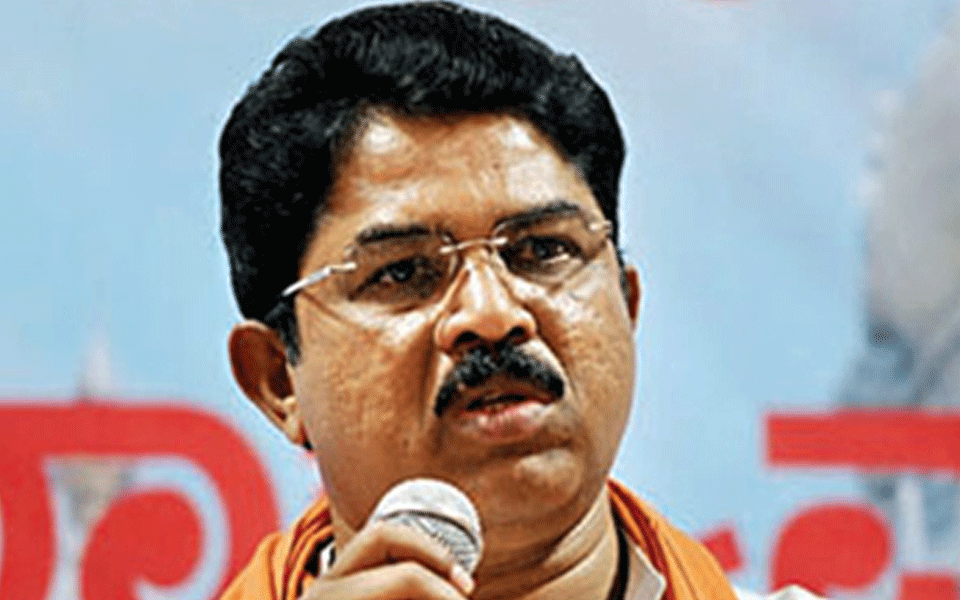
Bengaluru, Feb 2: BJP in Karnataka today took a dig at the constant squabbling between ruling Congress-JD(S), saying it was in a 'coma' and expressed doubts whether Chief Minister H D Kumaraswamy would even present the state's second budget on February 8.
Senior party leader and former Deputy Chief Minister claimed that 20 to 25 disgruntled MLAs of the alliance were out of the reach of their leaders and the coalition government was in a 'coma'.
He referred to Kumaraswamy's reported statement at a JD(S) legislature party meeting that he was not a chief minister for the last seven months, but 'just a clerk'.
"Whether he will present the budget or not, it is a doubt for us," he said.
He reiterated that the BJP would not make any attempts to topple the government and asked both parties not to blame the saffron party for not being able to control their MLAs.
"About 20-25 Congress-JD(S) MLAs not having trust in their party have been roaming around, away from the reach of their party leaders because of antagonism towards Congress, JD(S) and the Chief Minister- they are not in touch with them.
"Congress-JD(S) are trying to blame BJP for it, it is not right. If you don't have the mettle to control your MLAs, why do you blame BJP? you don't have the moral right to tell they (MLAs) have gone with BJP," he told reporters here.
Ashoka also said there was also 'confusion' within the coalition on contesting the polls together.
His statement gains significance in the backdrop of political turmoil in the state last month following alleged attempts by BJP to topple the H D Kumaraswamy led coalition government by poaching few Congress MLAs, who reportedly went incommunicado from the party leadership, and were camped at a hotel in Mumbai with plans to jump ship to the saffron party.
The developments had led to resort politics, with the Congress herding its MLAs to a resort outside the city, and BJP too camping its MLAs at a hotel in Gurugram fearing counter attempts by the ruling alliance to poach its members.
Four Congress MLAs had remained absent from the all important Legislature Party meeting that was seen as a show of strength amid alleged poaching attempts by the BJP.
All the four were served with notices, seeking an explanation on why action should not be taken against them as per anti-defection law.
On reports that some of these MLAs would resign ahead of the joint legislature session on February 6 and whether BJP would utilise the opportunity, he said the legislators would so if they wanted, but it only pointed to the 'confusion' in the ruling coalition.
Asked whether the BJP would approach the Governor, requesting him to ask the government to prove its majority, he said "We are not political sanyasis, we have also come to do politics."
Claiming that BJP's strength in the assembly has increased from 104 to 106 with the support of two independents, he said those without public support were now running the government.
"The person with 38 MLAs has become Chief Minister, this is anti-democratic, so we are not sanyasis... when the situation arises, we will utilise it hundred per cent."
On whether BJP would support Sumalatha Ambareesh,wife of late actor Ambareesh if she decided to contest as an independent from Mandya, Ashoka said the party would take a decision as and when the situation arises.
He said the BJP would talk to her if required, as the party too wanted to field right candidate in Mandya.
"Let's see....in politics nothing is stagnant, changes keep happening..whether this alliance will be there or not...
whether this government will be there or not, no one knows.
Even astrologers don't know, public also don't know, BJP also doesn't know," he added.
BJP's strength in Mandya is negligible, and there is no clarity yet among the alliance partners over which party will contest from the seat, which both consider their bastion.
According to sources, both parties want to field Sumalatha, banking on her late husband Ambareesh’s popularity in the region and sympathy wave following his death recently.
Sumalatha, herself a popular actress, has stated that she will need time to decide about entering politics. "I had no interest in politics earlier, but if I decide to enter politics it will only be from Mandya," she has declared.
Ambareesh had represented Mandya both in Assembly and Parliament from Congress. He had also served as Minister in both state and central government.
Let the Truth be known. If you read VB and like VB, please be a VB Supporter and Help us deliver the Truth to one and all.
MP cruise boat tragedy: Death toll rises to nine; search ops continue at Bargi Dam
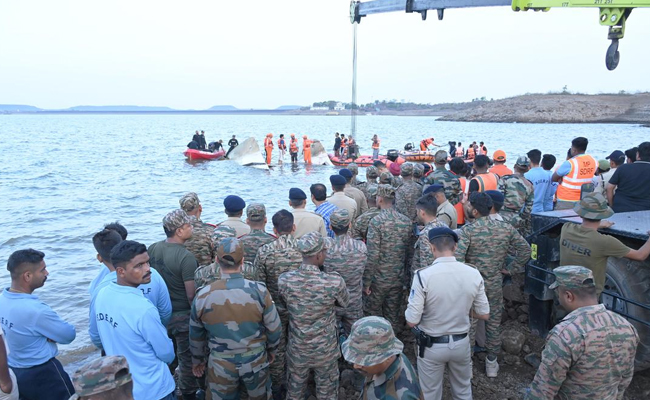
Jabalpur (PTI): The death toll in the Bargi Dam tragedy rose to nine on Friday, as rescuers recovered the bodies of five more persons who were on the cruise boat that overturned in the reservoir in Madhya Pradesh's Jabalpur.
Talking to PTI Videos, Madhya Pradesh Tourism Minister Dharmendra Bhav Singh Lodhi said, "Four bodies were recovered on Thursday, while five were found in the early hours during the rescue operation, taking the toll to nine."
As many as 22 people have been rescued so far, he said.
The minister said that a thorough probe will be conducted, and the issue of life jackets, raised by one of the survivors, will also be investigated.
The rescue operation is underway in full swing to trace the missing persons, Lodhi said.
A cruise boat with 29 passengers and two crew members onboard overturned in the Bargi Dam after encountering a sudden storm on Thursday evening, officials said.
The Bargi Dam is constructed on the Narmada River in Jabalpur district.
A search and rescue operation for the missing passengers continued overnight with teams from the Army, NDRF and SDRF joining in, State PWD Minister Rakesh Singh said.
Hydraulic cranes are being used to pull out the cruise boat from the water body, he said.
According to eyewitnesses, strong winds made the water choppy, prompting many on board to raise an alarm and ask the crew to steer the boat back to the banks.
However, the crew was unable to hear these shouts, and the boat drifted and then overturned, they said, adding that some locals rescued a few passengers wearing life jackets with the help of a rope.