Congress govt in Karnataka to come out with new bill on agri markets
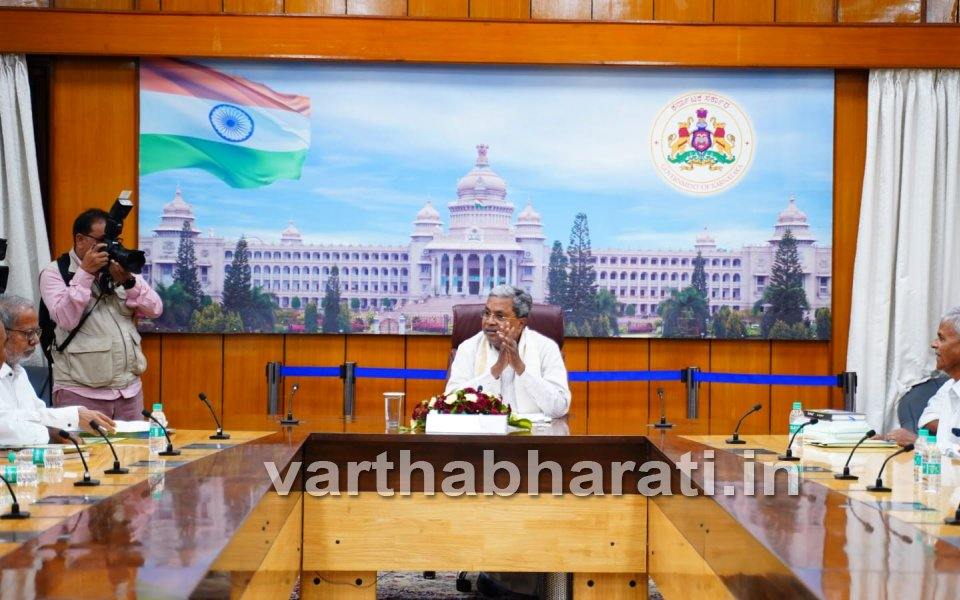
Bengaluru, June 15: The Karnataka Cabinet on Thursday gave its approval to a new bill on agricultural markets (APMC), replacing the one enacted by the previous BJP government in the state.
The new Bill will come up in the budget session starting July 3.
"We had said that we will change the APMC Act, the Cabinet has approved the new bill.
It will be introduced in the upcoming Assembly session," Agricultural Marketing Minister Shivanand Patil told reporters here after the cabinet meeting.
He said, "The intention with which the BJP government brought the law was not successful; for example their intention was to get good prices for farmers, but it has not been successful. Also more than one lakh families that were dependent like Hamals, traders, farmers have faced distress and bitter experience after this law came into effect, also trading at the market has come down significantly compared to 2019-20."
ALSO READ: Karnataka govt makes reading of Constitution's preamble mandatory in schools, colleges
"Cumulatively, the APMC markets used to earn a revenue of around Rs 620 crore in 2019-20, which has nosedived after BJP govt brought the law to around Rs 300 crore in 2021, Rs 200 crore in 2022, and Rs 194 crore in 2022-23. We need to arrest this fall and need to increase revenue of the markets, so bringing in new law is necessary," he added.
The APMC law that was brought in by the previous BJP government had removed restrictions on the sale of agricultural produce, thereby allowing private individuals to set up trade markets where farmers can sell.
It also curtailed the powers of local Agricultural Produce Marketing Committees (APMC) and allowed private individuals to start agricultural trading - buying and selling - if they hold a permanent account number (PAN). Before that, farmers had to sell only in notified markets or mandis.
Several farmer organisations and the Congress then in opposition had staged protests against the APMC law enacted by the BJP government.
Speaking about the changes that will be brought in, Patil said, "we are saying that wherever they trade -- whether inside or outside the market -- the laws that are applicable in the market will be applicable outside too. Also, it will be the same with respect to fees and penalty."
Let the Truth be known. If you read VB and like VB, please be a VB Supporter and Help us deliver the Truth to one and all.
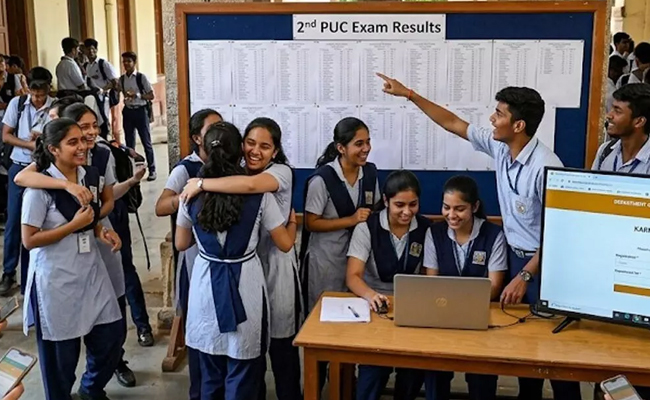
Second PUC results: Life convict clears exam with distinction, DGP lauds effort
_vb_63.jpeg)
Bengaluru: A life convict lodged in Ballari Central Prison has successfully cleared the second PUC examination.
Ashok Kumar S, who appeared for the examination under prison escort, secured 481 marks out of 600, registering 80.1 percent.
Director General of Police (Prisons and Correctional Services), Alok Kumar (IPS), shared the development on his official ‘X’ handle, commending the inmate’s achievement.
In his post, he stated that it was heartening to see a life convict score over 80 percent in the examination, adding that the inmate had appeared from Ballari Central Prison under escort.
It’s heartening to see that one of our life convict prisoners Ashok has obtained 80.1% marks in PUC exam. He appeared under Prison escort from Ballari Central Prison for his exams.
— alok kumar (@alokkumar6994) April 9, 2026
Glad to see that Walls of the prison has not subdued his hopes for a better future. pic.twitter.com/Nzlcy076SR
He further noted that the achievement reflected that the “walls of the prison have not subdued his hopes for a better future.”
Alok Kumar in his post also shared the result sheet of Ashok.
The Karnataka School Examination and Assessment Board (KSEAB) declared the second PUC results for 2026 on April 9.
A total of 6,32,200 students appeared for the examination across all streams, of whom 5,46,698 passed, recording an overall pass percentage of 86.48 per cent.