Congress hits back at BJP for questioning delay in deciding Karnataka CM
New Delhi, May 17: The Congress on Wednesday hit out at the BJP for criticising it over the delay in deciding the chief minister of Karnataka, and cited examples when the saffron party declared its chief ministers in Uttar Pradesh, Uttarakhand, Goa and Assam several days after winning the polls.
AICC general secretary in-charge for Karnataka Randeep Surjewala said that a section of the media has fallen victim to the "fake news factory of BJP on formation of next Congress government in Karnataka", asking whether they had questioned the prime minister the same way when he took seven to 10 days in deciding on chief ministers in several states.
"We understand the frustration of BJP in being decisively rejected by the brother and sisters of Karnataka bringing an end to the #40PercentBJPSarkara.
"I hope same people had questioned PM Modi when he took 7 to 10 days in deciding chief ministers of Uttar Pradesh, Assam, Goa and many other States. No one then whispered a word on the High Command culture. But the same forces and a select news outlets have objections to the process of dialogue, discussion, consensus adopted by Sh. Mallikarjun Kharge ji, which is in true democratic traditions," Surjewala said on Twitter.
ALSO READ: First-time flyer from Rajasthan held for smoking 'Beedi' inside plane
He also said that he has advised all Congress leaders to not issue statements on the issue of leadership. "Any out of turn remarks made from here onwards will be treated as indiscipline and action taken accordingly," Surjewala said.
Earlier, AICC general secretary, communications, Jairam Ramesh said on Twitter, "Just to refresh memories of PM's drum-beaters especially. 2017 UP Vidhan Sabha election results out on March 11th. Yogi appointed CM 8 days later on March 19th.
2021 Assam Vidhan Sabha election results out on May 3rd. Himanta Biswa Sarma became CM 7 days later on May 10th."
"There are many more such examples," he said.
Several BJP leaders are criticising the Congress for the delay in deciding on the chief minister's name in Karnataka amid hectic lobbying for the top post.
The results in Karnataka were declared on May 13 but the party has not finalised its chief ministerial face yet and the process of consultations is on.
Karnataka's two chief ministerial aspirants Siddaramaiah and D K Shivakumar held separate meetings with Congress president Mallikarjun Kharge on Tuesday as the party held hectic consultations to decide on who would lead the government in the southern state.
BJP's IT cell head Amit Malviya said a sorry state of affairs prevails in the Congress where Kharge sees himself more as a "postman".
"Want to watch circus? Watch the Congress select their CM in Karnataka," he said on Twitter.
Referring to the lobbying by Siddaramaiah and Shivakumar for the post of chief minister, Malviya said, "The BJP also holds discussions and deliberations to elect its CMs and has often ensured smooth transition of power, even between CMs. Despite elaborate consultations, you will never find BJP aspirants falling over each other, rallying supporters and issuing veiled threats to the party through the media."
"On the contrary, last evening, Lutyens journalists, who D K Shivakumar hosted at the Claridges, almost appointed Siddaramaiah as the Karnataka CM. Sorry state of affairs in the Congress, where President Kharge sees himself more as a postman, let alone being a decision maker or even part of the decision making team... He keeps referring to some High Command," he added.
A section of our dear friends of the media have fallen victim to the ‘fake news factory’ of BJP on formation of next Congress Government in Karnataka.
— Randeep Singh Surjewala (@rssurjewala) May 17, 2023
We understand the frustration of BJP in being decisively rejected by the brother and sisters of Karnataka bringing an end to…
Just to refresh memories of PM's drum-beaters especially.
— Jairam Ramesh (@Jairam_Ramesh) May 17, 2023
2017 UP Vidhan Sabha election results out on March 11th. Yogi appointed CM 8 days later on March 19th.
2021 Assam Vidhan Sabha election results out on May 3rd. Himanta Biswa Sarma became CM 7 days later on May 10th.…
Let the Truth be known. If you read VB and like VB, please be a VB Supporter and Help us deliver the Truth to one and all.
Davanagere South bypoll: Cong Muslim leaders allege internal conspiracy to defeat party candidate
Bengaluru (PTI): A rift within the Karnataka Congress surfaced on Friday, a day after the bypolls to two Assembly constituencies in the state, as a group of Muslim leaders alleged a "conspiracy" by some of their own senior party leaders to defeat the official candidate in Davanagere South.
However, they asserted that despite efforts by some within to project that Congress "betrayed" Muslims, the party candidate Samarth Mallikarjun will win in Davanagere South, the constituency where the community has a significant presence.
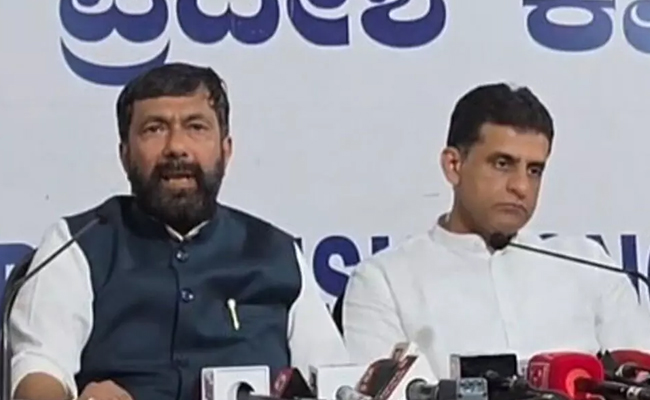
Chief Whip in the Legislative Council Saleem Ahmed, MLAs Rizwan Arshad, Yasir Ahmed Khan Pathan, MLC Bilkis Bano, and other Congress leaders addressed a joint press conference regarding this at the party office here.
"It is a sad thing that some senior leaders of our own party have conspired to defeat the Congress, despite this minorities have voted for the Congress. KPCC President (D K Shivakumar), the Chief Minister (Siddaramaiah) and the AICC General Secretary (Randeep Singh Surjewala) are aware of this. People have voted for Congress, its ideology and its five guarantee schemes," Ahmed said.
Noting that Samath Mallikarjun was given a ticket after taking all minority leaders of the party into confidence and following their consent, he said, "But after that because of some misconceptions, conspiracies have been hatched. But still, I'm confident that Congress candidate Samarth will win".
According to party sources, these Muslim leaders have also complained to AICC and state party leadership regarding attempts for "internal sabotage" in Davanagere South.
Though the leaders did not indicate who they were accusing. Several party sources said their attack was directed at Housing Minister B Z Zameer Ahmed Khan, among a few others.
Khan, who had openly demanded the Davanagere South ticket for a Muslim candidate, had initially stayed away from campaigning in the segment, citing his Kerala poll responsibilities. However, he addressed a press meet along with Samarth's father and Minister SS Mallikarjun at the request of Chief Minister Siddaramaiah.
MLA Arshad said that there was a massive social media campaign against the Congress party, by the BJP, SDPI and Independents, alleging "betrayal" of the minorities by the Congress. Some within the party, too, tried to project the same.
"We indeed demanded a ticket for the minority, and the party considered it. However, since we, as minority leaders, had to provide a unanimous candidate, we only put forward Abdul Jabbar's name because he is the MLC from the region, and he also pressured us. I think we first failed there, as ground-level party workers did not accept it and some other leaders believed he wasn't that popular," he said.
Arshad noted that the party finally named Samarth Mallikarjun as the candidate "after considering all factors and taking all Muslim leaders into confidence".
"However, some of us Muslim leaders who worked for the party's official candidate were projected as anti-Muslim on social media," he claimed.
Some leaders who accepted the party's decision to nominate Samarth as the party candidate during the meeting called to decide it later showed indirect signs of resistance, he said. "An attempt was made by others, including some within the Congress, to project that the Congress has betrayed the Muslims. This has caused us pain."
Bypolls for Davanagere South were held along with Bagalkot on Thursday. The election was necessitated following the death of sitting MLAs Shamanur Shivashankarappa and H Y Meti respectively.
Muslim disgruntlement appears to be a concern for the Congress in Davanagere South. With 14 of the 25 candidates in the fray belonging to the community, there are apprehensions within the party about a split in votes, which could benefit the BJP.
Given its significant presence in the constituency, the Muslim community strongly demanded the Congress ticket for Davanagere South. Some party factions had opposed giving the ticket to the Shamanur family.
Although the Congress was successful in persuading rebel candidate Sadiq Pailwan to withdraw from the contest, he remained in the fray as the move came after the deadline for withdrawal of nominations.