Congress leader Deshpande eyes winning streak for record 9th time; says could be his last election
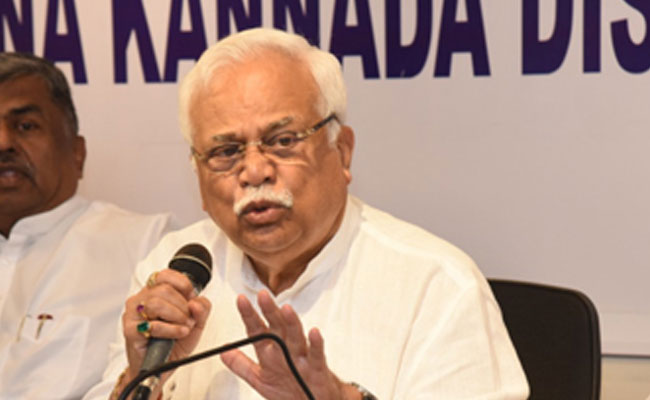
Haliyal (PTI): Veteran Congress leader R V Deshpande -- who is eying to create a record in Karnataka if he wins for the ninth time in the assembly poll this year -- said this could be his last election and noted he is not a man who will fight for the Chief Minister's post.
Among the Congress candidates in the state, Despande (76) is the senior most contesting for the ninth consecutive time. He also equals AICC President Mallikarjuna Kharge's record of winning the most number of assembly polls in the state.
Deshpande was originally not a Congressman. He switched over to Congress in 1999 from the Janata Parivar. Until then, he got elected to the assembly in four elections from the Janata Parivar.
In an interview to PTI, Deshpande said: "Kharge and I have won assembly elections eight times. If I win this time, it will be a record in the House. Nobody has won nine times."
Asked why he has been lying low and does not figure in the list of contenders for CM despite being the senior most, he said, "I am not lying low in a way because I am a very disciplined man. I am not in any race. ...there could be a desire for CM, but you should not fight for that."
He denied senior Congress leaders like Siddaramaih and D K Shivakumar were fighting it out for the CM's post, should the party win the May 10 Assembly polls.
"They have a desire. If I get an offer, I will have a desire. But I am the last man to fight for that."
Deshpande said he has worked with eight chief ministers from Ramkrishna Hegde till date. "I led padayatra against the mining mafia in Bellary. I have so many things to my credit," he said.
Moreover as per the Constitution, it is left to the legislative party and the high command to decide who should be the CM, he added.
Deshpande also mentioned, "most likely, this could be the last election (for him). If God and voters help, this could be a record... it is difficult to fit in the current politics as the political discourse has fallen very low."
Deshpande is contesting from the Haliyal assembly segment, where BJP has fielded Sunil Hegade, while S L Ghotnekar is contesting on a JD(S) ticket. The Aam Aadmi Party has fielded Gurudeep Singh Sandhu.
In a triangular fight in the Haliyal assembly segment that has 1.75 lakh voters, the dominant Marathi-speaking population will be a decisive factor. Gotekar -- a former MLC who defected from the Congress -- is a Maratha and it needs to be seen in which way the votes will shift. BJP is also trying hard to defeat Deshpande.
"Marathas have shown their secular credentials in all my elections. Earlier, there were Maratha candidates contesting from this constituency, I am confident that they will definitely vote for Congress and for the work I have done," Deshpande said.
The Congress will win with a reasonable margin, he added.
Let the Truth be known. If you read VB and like VB, please be a VB Supporter and Help us deliver the Truth to one and all.
RR beat RCB by six wickets in IPL
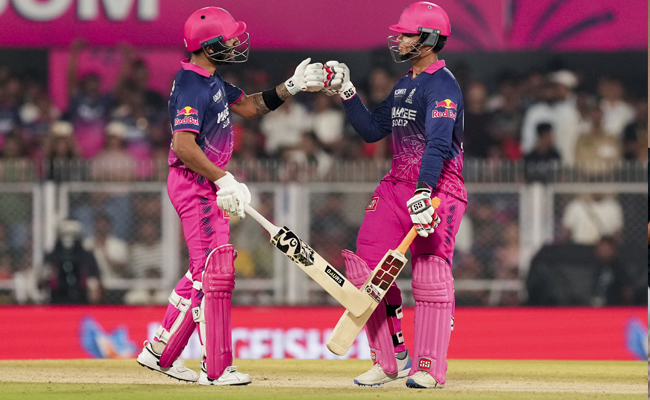
Guwahati (PTI): Blistering fifties by Vaibhav Sooryavanshi and Dhruv Jurel powered Rajasthan Royals to a six-wicket win over Royal Challengers Bengaluru in their IPL match here on Friday.
Sent in to bat, RCB rode on a fighting half-century by skipper Rajat Patidar (63) to post 201 for 8.
Virat Kohli (32), Romario Shepherd (22) and Venkatesh Iyer (29) also chipped in with useful contributions.
In reply, Sooryavanshi (78 off 26 balls) and Dhruv Jurel (81 not out off 43 balls) shared a 37-ball 108-run partnership for the second wicket to set the platform. Krunal Pandya (2/30) tried to bring them back with back-to-back wickets.
But Jurel, in the company of Ravindra Jadeja (24), completed the task with another 68-run stand, with two overs to spare.
For RR, Jofra Archer (2/33), Ravi Bishnoi (2/32) and Brijesh Sharma (2/37) took two wickets.
Brief scores:
Royal Challengers Bengaluru: 201 for 8 in 20 overs (Rajat Patidar 63; Jofra Archer 2/33, Ravi Bishnoi 2/32, Brijesh Sharma 2/37).
Rajasthan Royals: 202 for 4 in 18 overs (Vaibhav Sooryavanshi 78, Dhruv Jurel 80 not out; Krunal Pandya 2/30, Josh Hazlewood 2/44).