Congress will win over 140 seats, will abide by party's decision on CM issue: D K Shivakumar
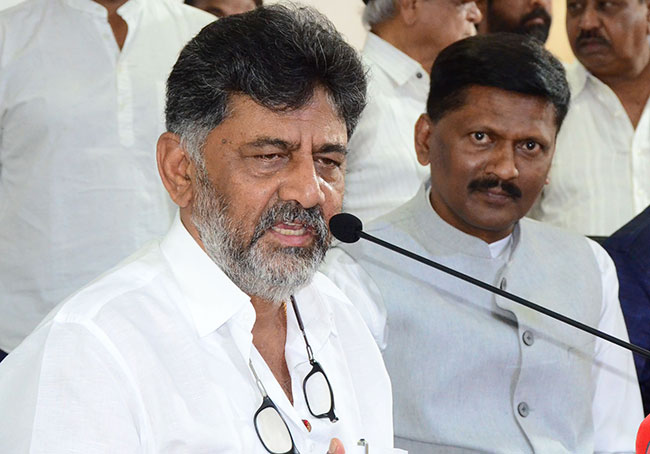
New Delhi(PTI): Karnataka Congress chief D K Shivakumar Saturday exuded confidence that his party would win over 140 seats in the May 10 assembly polls and asserted that he would abide by whatever the party decides on the issue of chief ministership.
In an interview with PTI, Shivakumar said the Congress will get a comfortable majority in Karnataka and the win would open the doors for the Lok Sabha elections as the party's victory in the state in 1978 had done.
The Karnataka Congress chief lashed out at the BJP for raising issues such as the Uniform Civil Code and National Register of Citizens in its manifesto for the assembly polls, saying it shows their "bankruptcy" of ideas and vision for the state.
He also claimed that since the BJP has no agenda and vision for Karnataka, the "Modi factor" will not work in the assembly polls this time.
Shivakumar, who is a leading aspirant for the chief minister's post along with former CM Siddarammaiah in case the Congress comes to power, said all stories of infighting in the party are created by media and there is no truth in them.
"The fact is that the Congress leadership is united and the party workers are very active in spreading our message both on the ground and in social media. We are putting a combined effort to ensure that the Congress comes back to power with a clear majority," he asserted.
On him being a strong contender for the post of chief minister, Shivakumar said his first priority was to ensure that the party wins a majority in Karnataka.
"For the last three years, the Congress party has been working on the ground starting from the Vaccinate Karnataka Campaign, to the 100 Not Out Campaign followed by Mekedatu Campaign to Freedom March and registering 78 lakh members of the Congress party. Then we made the Bharat Jodo Yatra a grand success in Karnataka," he said.
Congress leaders and workers have not taken rest for a single day in the last three years, he said, adding that whatever is being seen now is the faith of people that the party's hard work has won.
"For me, the party comes first and the chief ministership comes later. On the CM issue, I will abide by whatever the party decides," Shivakumar said.
Asked about the controversy surrounding the Congress manifesto talking about taking decisive action as per law, including imposing a ban on organizations such as PFI and Bajrang Dal, Shivakumar alleged that the BJP was trying to divide the society.
"The BJP government could not provide jobs to our youth. They failed to provide any relief to the common man when it came to inflation and price rise. Now they are trying to divide the society by inflammatory speeches," he alleged.
This will not work in Karnataka and people will sweep them aside, he claimed.
Asked about Karnataka being the gateway to the south for the BJP, Shivakumar said the people of Karnataka have "closed the gate on the BJP's face because of non-performance, corruption and large-scale unemployment in the state".
People are supporting Congress in a big way and the party is coming back to power, he claimed.
Asked about the BJP in its election manifesto promising to implement the Uniform Civil Code (UCC) and the National Register of Citizens (NRC) in Karnataka if it retains power in the state, Shivakumar said this is precisely the problem of the BJP.
They do not understand Karnataka and its people, the Congress leader alleged.
"Karnataka Assembly elections are being fought on local issues. The BJP, which could not deliver on any front during its governance, has also failed to give a narrative in these elections. This shows their bankruptcy of ideas and vision for the state," he said.
Asked about Prime Minister Modi raising the issue of abuses hurled at him, the Congress leader said the people of Karnataka are very civilized and they do not believe in using and even responding to crude language.
The Congress party too does not believe in using abusive language. It is the BJP that has mastered the art of twisting the statements and manipulating the people, he alleged.
On whether the Modi factor will work this time, Shivakumar said the Congress is fighting these elections on a progressive and development-based agenda.
"We will provide Rs 2,000 per month to every woman head of the family, 200 units of free power to every household apart from free bus travel for women in KSRTC/BMTC buses and a monthly allowance of Rs 3,000 to unemployed graduates.
"As I said, the BJP has no agenda and vision for the state and people can very well see this. So the Modi factor will not work this time in these assembly polls," he said.
Expressing confidence that the Congress would cross the 140-seat mark, Shivakumar said, "We will win 141 seats and form government with a comfortable majority. The BJP will be reduced to less than 60 (seats)."
On the message that would be sent out through the Karnataka polls for the 2024 general election, he said Karnataka was just the beginning.
"We are comfortably winning Karnataka elections and it will open the doors for the Lok Sabha elections. Karnataka people will give a message to the country. Earlier also at the time of Devraj Urs (former chief minister), when the Janata Party was in power at the national level in 1978, Karnataka had opened the door for Congress. Now again, Karnataka will play its role," Shivakumar said.
"We will form government in Karnataka in 2023 and in the country in 2024," he said.
Voting for the 224 assembly seats in the state will take place on May 10 and the results will be out on May 13.
Let the Truth be known. If you read VB and like VB, please be a VB Supporter and Help us deliver the Truth to one and all.
Real Madrid fines Valverde and Tchouaméni half a million euros each for altercation

Barcelona (AP): Real Madrid slapped players Federico Valverde and Aurélien Tchouaméni with half-a-million-euro ($588,000) fines on Friday for their altercation during practice.
The massive fines came a day after the midfielders tussled when the team trained. Valverde said in a post on social media on Thursday that no punches were thrown. But Valverde knocked his head on a table and he suffered a small cut that required a brief hospital visit.
On social media, Valverde initially called it a “meaningless fight” with a teammate and said “everything has been blown out of proportion."
His employers, however, considered it a significant enough breach of team discipline to nail both Valverde and Tchouaméni with fines that bite even the bank account of a top soccer player. The half-a-million euro penalties reflect the reputational damage the club was enduring in a chaotic end to a disappointing season.
In a statement, the 15-time European champion said its disciplinary action was concluded after both players expressed to the club “their complete remorse for what happened and apologized to one another.”
Madrid added they also apologized to their teammates, the coaching staff and club supporters, as well as showing their willingness to accept whatever disciplinary action the club deemed “opportune.”
Tchouaméni was back training with Madrid on Friday, two days before they play at Barcelona in a clasico. Madrid has to win otherwise Barcelona will be crowned La Liga champion.
After being notified of the fine, he posted a public apology to the club and its fans on social media.
“What happened this week in training is unacceptable,” Tchouaméni wrote. "I say this while thinking about the example we are expected to set for young people, whether in football or at school.
“Above all, I am sorry for the image we projected of the club.”
Valverde was not at practice due to the head knock.
Both players are set to play in the World Cup next month, with Tchouaméni playing for France and Valverde for Uruguay.
Chaotic end to a poor season
===================
The run-in between the players, who for seasons have played side by side in Madrid's midfield, came after they argued this week in previous training sessions. But tempers boiled over on Thursday. Spanish media was rife with reports that the players previously disagreed over the club's decision to let coach Xabi Alonso go after just months on the job.
It was not the only altercation involving Madrid players during training this week. Álvaro Carreras confirmed he was in a “minor” incident with a teammate. Spanish media said he and fellow defender Antonio Rüdiger got into a scuffle.
Álvaro Arbeloa, the coach who was promoted from Madrid's reserve team when Alonso was fired in January, will face tough questions on what went wrong inside the changing room when he gives a press conference on Saturday ahead of the clasico at Camp Nou.
Madrid is facing a second consecutive campaign without a major trophy amid rumors in the Spanish media that club president Florentino Pérez is considering bringing back Jose Mourinho to straighten out his underperforming team.