Corruption has become almost institutionalised, says Karnataka Governor Thaawarchand Gehlot

Bengaluru, Jul 3: Expressing serious concern over corruption, Karnataka Governor Thaawarchand Gehlot on Monday said it has become almost institutionalised, and the Karnataka government would take administrative and legislative measures to meet the challenge and eradicate it.
In his address to the joint session of both Houses of the State Legislature, he also said in the next five years, the state government would place emphasis on a people-centric economy.
"Karnataka, which stood tall and contributed immensely to the country, has landed into a state of distress. Bringing out Karnataka from economic distress shall be the priority (of the new Congress government)," Gehlot said.
Noting that narrow minds create divisions and differences between different communities, and the remnants of such a mindset still survive at various levels in the society, the Governor said the government would take all the steps to build a peaceful and loving society.
Gehlot said corruption has become so entrenched in our system that for many reasons it has become almost institutionalised.
ALSO READ: Ashok Pattan, Saleem Ahmed appointed Congress Chief Whips in Karnataka Assembly, Council
"Eradicating it is a major challenge. I seek your cooperation to meet this challenge and root out corruption. The government will take all necessary administrative and legislative measures in this regard", he added.
The Governor said under the 'Anna Bhagya' scheme, the additional five kg rice allotment of the state government would be given in the form of Direct Benefit Transfer of money at Rs 34 per kg per person directly into the bank accounts of the poor families each month.
This arrangement will continue until the quantum of rice for the additional five kg rice to all the poor households is tied up, he said, adding that the state government would make the state hunger-free through 'Anna Bhagya' scheme and 'Indira Canteens'.

Let the Truth be known. If you read VB and like VB, please be a VB Supporter and Help us deliver the Truth to one and all.
Op Sindoor demonstrated India's progression towards 'domain jointness,' says Army Chief
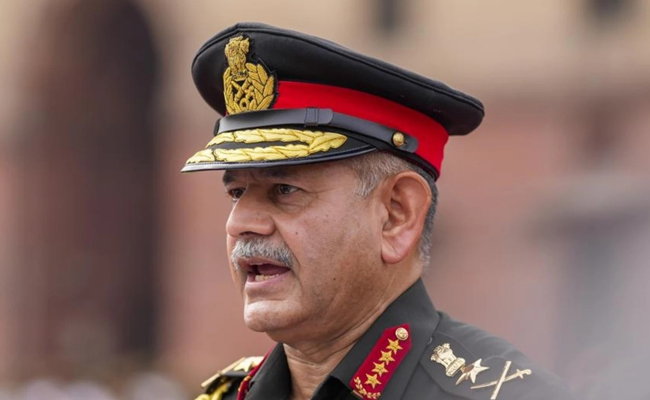
Bengaluru (PTI): Army Chief General Upendra Dwivedi on Thursday said Operation Sindoor demonstrated India's progression towards "domain jointness" and called the military offensive carried out inside Pakistani territory a "defining case study" of operational significance of integration.
In May last year, India had launched a military response targeting terror launchpads in Pakistan post the April 22 Pahalgam terror attack that killed 26 Indian tourists.
"Operation Sindoor was India's most powerful tool of progression towards domain jointness. But we need to achieve domain integration and fusion," General Dwivedi said.
He was addressing the "Ran Samvad" forum on "Land Forces visualisation of Multi Domain Operation (MDO)," here.
The army chief also highlighted the creation of an information warfare organisation and a psychological defence division following Operation Sindoor.
He said, "15 per cent of our effort was on managing the disinformation campaign."
He cautioned, however, that key challenges remain, particularly in synchronising operations across strategic, operational and tactical levels and addressing the growing prevalence of hybrid or grey-zone warfare.
"These are typically below the conventional military threshold, with the goal to exploit adversary vulnerability," he said, adding that non-kinetic operations are increasingly taking precedence.
"Operation Sindoor was India's most powerful tool of progression towards domain jointness. But we need to achieve domain integration and fusion," he said.
The Chief of Army Staff said his visualisation of MDO is not of six domains operating in parallel but all of them "in constant dynamic interaction where the weight shifts and the lead changes".
The Army chief stressed that modern warfare is no longer confined to geographical boundaries or single-service dominance, but is instead defined by continuous interaction across domains, stakeholders and levels of conflict.
"We are living through a dispersed, undeclared, multi-theatre, multi-domain war of our times. The question is not whether domains interact, it is how the interface is orchestrated across the battle space," he said.
General Dwivedi drew a distinction between land domain and land forces, explaining that while the former refers to the operational space, the latter represents the actors, comprising all six domains—land, air, maritime, cyber, space and cognitive—operating in a shared environment.
He underlined that these domains are no longer siloed but function through dynamic synergy.
Elaborating on the evolving battlefield, General Dwivedi noted that MDO has transformed warfighting into a layered, three-dimensional construct.
"In MDO, the battlefield is no longer a line on a map. It's a 3D -- cyber effects shaping the cognitive space, space assets cueing targets, and electronic warfare contesting every frequency simultaneously," he said.
He emphasised that commanders must develop cross-domain situational awareness from the tactical to strategic level.
Highlighting the operational significance of integration, General Dwivedi referred to Operation Sindoor as a "defining case study".
"It was a ground intelligence network coupled with cyber and EW (electronic warfare) inputs that gave the joint army-air force targeting, while the navy's repositioning shaped the strategic calculus simultaneously. No single domain decided the operation," General Dwivedi added.
He described such mutually enabling actions as the essence of MDO.
The Army Chief observed that while domains like cyber, space and cognitive operations benefit from centralised control, land warfare continues to rely on decentralised execution, creating a complex and adaptive system that must be aligned through central intent and technological integration.
On capability development, he said the Indian Army is transitioning steadily from concept to execution under a structured transformation roadmap.
He pointed to dedicated MDO war-gaming exercises since 2024 and the joint doctrine issued in August 2025 as milestones that have provided a unified operational framework across the three services for the first time.
General Dwivedi detailed several structural reforms underway, including the operationalisation of integrated battle groups, Rudra brigades, drone units, electronic warfare formations and cyber operations nodes.
He further underscored the importance of the "three Is" —integration, informatisation and intelligentisation—driven by technology but anchored in human decision-making.
"The human must remain in the loop exercising the judgment," he asserted.
The Army Chief emphasised the need for leadership transformation in the digital age.
"Commanders must evolve into techno-commanders, to build a force that does not know where one domain ends and another begins," he said.
Outlining the future roadmap, he identified "six Ds" shaping the MDO environment—dispersion, democratisation and diffusion among them—leading to imperatives such as diversification of assets, delegation of command and distributed response.
He called for a shift from "domain silos to domain fusion", describing a six-stage progression from domain purity to complete integration.