‘Countdown to start for Modi’s dethroning soon after Karnataka poll results’
Jignesh Mewani in a special interview
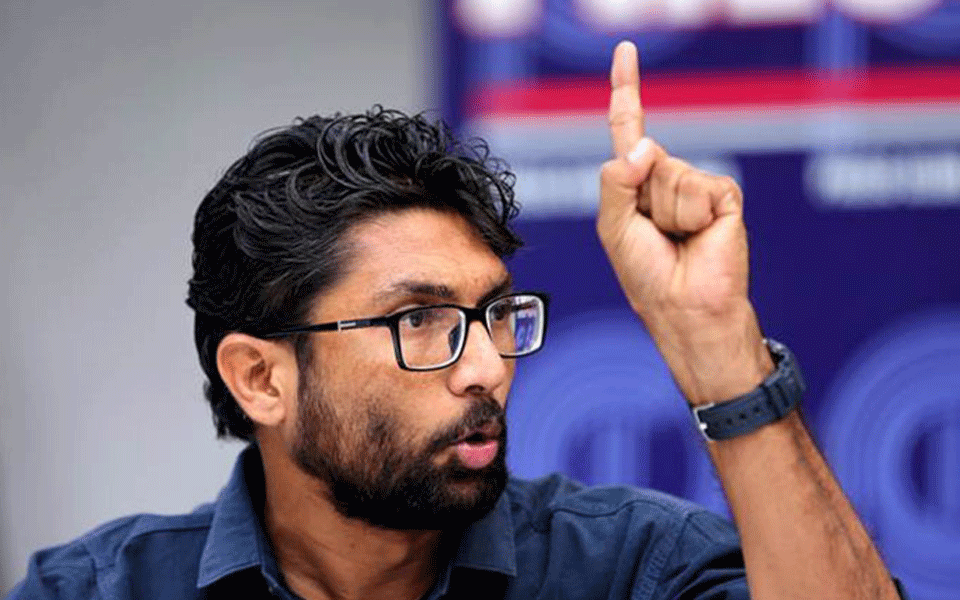
Bengaluru, May 11: Activist, youth leader and Gujarat MLA Jignesh Mewani spoke to Varthabharati in detail on various burning issues in the country including Karnataka Assembly election, national politics and administration of Narendra Modi-led NDA government, attacks, sexual harassments and exploitations on dalits, backward classes, minorities and women.
WB: What’s your opinion on Assembly election being held in Karnataka?
Jignesh Mewani: I have travelled almost all districts in the last 20 days. People have never accepted the BJP’s Hindutva and communal politics. The tradition of Basavanna, Narayanaguru and Sufi saints was deeply rooted among people of Karnataka.
WB: Don’t you think that religious issues are getting priority more than development issues in this election?
Jignesh Mewani: The Hindutva forces were not succeeded in dividing the Muslims. In Vijayapura, more than 5000 people have decided against voting BJP in this election. Those who speak about four years and one month, would follow divide and rule policy.
VB: Will the divide and rule policy get success in state?
Jignesh Mewani: More than 80 per cent of people would not believe their ideology. In spite of their efforts, they would not get more than 20 per cent votes. People are aware of this fact. The Save Constitution campaign conducted in the state after the assassination of Gouri Lankesh was successful in creating this awareness among people.
VB: What’s your reaction about Union Minister Ananth Kumar Hegde’s statement that they have come to power to change the Constitution?
Jignesh Mewani: I would congratulate Ananth Kumar Hegde. He has disclosed what he has inside in him. BJP and RSS do not want the secular society which respects all religions equally. They want communal and corporate culture.
VB: On Modi’s challenge to Congress leaders to speak 15 minutes about state government achievements.
Jignesh Mewani: Forget speaking about the achievements of the Siddaramaiah government for 15 minutes. Let BJP leaders speak about the achievements of four and half year old Narendra Modi government for four minutes. In their administration, more than 9 crore youth should have got the jobs as they promised. But not even one per cent of youth were given jobs. Moreover, because of GST and Demonitisation, around 75 lakh people have lost their jobs. If Narendra Modh has real concern, he could fill up more than 5 lakh doctors posts lying vacant in primary and community health centres in the country. More than 16 lakh posts are vacant in primary schools. In the name of cow, 28 Muslims were killed. We were in the first place in IT sector. But in the last four years, the jobs were cut. In 2016-17, total 59,427 people have got jobs and it was declined to 13,972 in 2017-18.
VB: Are you accusing that the central government has failed to check sexual harassment and rape on women?
Jignesh Mewani: Only after the protests and movements across the country against Kathua incident, the central government has passed an ordinance. Total 52 BJP MPs, MLAs, and leaders were facing serious charges like sexual harassment and cases were also booked. In some cases, FIRs were also registered. As to why, the person who has 56 inch chest is keeping mum on these issues? Now, BJP has changed as ‘Balatkari Jaanleva Party’.
VB: Is the central government failed in protecting dalits?
Jignesh Mewani: Central ministers like Ramdas Atavale, Ramvilas Paswan and MP Udit Raj have become Hanuma for this BJP’s self declared Rama. Let them clarify their stand in Unnao incident. Brother of Saharanpur district president Bheem Army was killed. Upper caste people have been attacking the dalits and Muslims. I would appeal to the dalits in the state not to vote for BJP. Every day, the country is witnessing rape on six women, murder of two-three dalits, and atrocity on dalits in every 15 minutes. Thousands of people have been working as scavengers. Instead of giving right to live, the tribals are being evicted.
VB: Will the Karnataka election be a referendum for 2019 Lok Sabha election?
Jignesh Mewani: Right from the day of announcement of Karnataka Assembly results, the countdown will start for dethroning Narendra Modi. If the youth and women understand the deceptive politics of BJP, they would never vote for BJP. Supreme Court Judges have come to the street to speak against injustice. Why did Modi silent on Justice Loya death case. Media, civil society and judiciary were facing pressure. As soon as Modi steps down from the power, the BJP leaders themselves would disclose the corruption files of Modi.
VB: Are you feeling the absence of journalist Gauri Lankesh?
Jignesh Mewani: The Congress government has failed in taking the investigation into Gauri Lankesh murder case into a logical end. The accused should have been arrested. As to why Narendra Modi and BJP are not questioning Congress government? Because, BJP people knew the fact that those who believe in their ideology and members of their Shakhas have killed her.
Technology is being developed to know whether Mars has water on its surface or not. Then what is the difficulty in developing a technology to stop deaths inside toilet pits while cleaning them? If it is done, then Modi’s Skill India would definitely get success, Mewani said.
Let the Truth be known. If you read VB and like VB, please be a VB Supporter and Help us deliver the Truth to one and all.
Single higher education regulator bill tabled in LS; Oppn flags ‘centralisation,' JPC likely
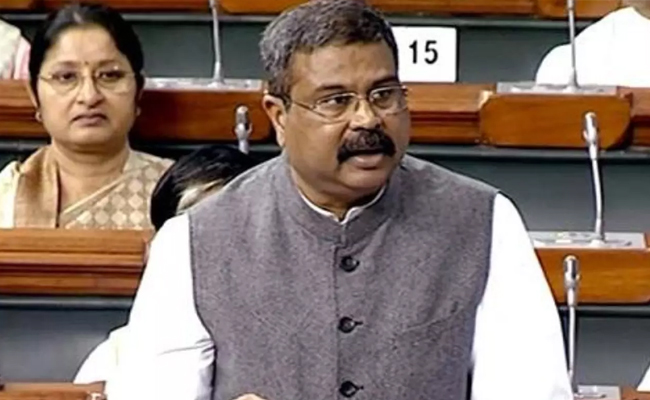
New Delhi: A bill to set up a 13-member body to regulate institutions of higher education was introduced in the Lok Sabha on Monday.
Union Education Minister Dharmendra Pradhan introduced the Viksit Bharat Shiksha Adhishthan Bill, which seeks to establish an overarching higher education commission along with three councils for regulation, accreditation, and ensuring academic standards for universities and higher education institutions in India.
Meanwhile, the move drew strong opposition, with members warning that it could weaken institutional autonomy and result in excessive centralisation of higher education in India.
The Viksit Bharat Shiksha Adhishthan Bill, 2025, earlier known as the Higher Education Council of India (HECI) Bill, has been introduced in line with the National Education Policy (NEP) 2020.
The proposed legislation seeks to merge three existing regulatory bodies, the University Grants Commission (UGC), the All India Council for Technical Education (AICTE), and the National Council for Teacher Education (NCTE), into a single unified body called the Viksit Bharat Shiksha Adhishthan.
At present, the UGC regulates non-technical higher education institutions, the AICTE oversees technical education, and the NCTE governs teacher education in India.
Under the proposed framework, the new commission will function through three separate councils responsible for regulation, accreditation, and the maintenance of academic standards across universities and higher education institutions in the country.
According to the Bill, the present challenges faced by higher educational institutions due to the multiplicity of regulators having non-harmonised regulatory approval protocols will be done away with.
The higher education commission, which will be headed by a chairperson appointed by the President of India, will cover all central universities and colleges under it, institutes of national importance functioning under the administrative purview of the Ministry of Education, including IITs, NITs, IISc, IISERs, IIMs, and IIITs.
At present, IITs and IIMs are not regulated by the University Grants Commission (UGC).
Government to refer bill to JPC; Oppn slams it
The government has expressed its willingness to refer it to a joint committee after several members of the Lok Sabha expressed strong opposition to the Bill, stating that they were not given time to study its provisions.
Responding to the opposition, Parliamentary Affairs Minister Kiren Rijiju said the government intends to refer the Bill to a Joint Parliamentary Committee (JPC) for detailed examination.
Congress Lok Sabha MP Manish Tewari warned that the Bill could result in “excessive centralisation” of higher education. He argued that the proposed law violates the constitutional division of legislative powers between the Union and the states.
According to him, the Bill goes beyond setting academic standards and intrudes into areas such as administration, affiliation, and the establishment and closure of university campuses. These matters, he said, fall under Entry 25 of the Concurrent List and Entry 32 of the State List, which cover the incorporation and regulation of state universities.
Tewari further stated that the Bill suffers from “excessive delegation of legislative power” to the proposed commission. He pointed out that crucial aspects such as accreditation frameworks, degree-granting powers, penalties, institutional autonomy, and even the supersession of institutions are left to be decided through rules, regulations, and executive directions. He argued that this amounts to a violation of established constitutional principles governing delegated legislation.
Under the Bill, the regulatory council will have the power to impose heavy penalties on higher education institutions for violating provisions of the Act or related rules. Penalties range from ₹10 lakh to ₹75 lakh for repeated violations, while establishing an institution without approval from the commission or the state government could attract a fine of up to ₹2 crore.
Concerns were also raised by members from southern states over the Hindi nomenclature of the Bill. N.K. Premachandran, an MP from the Revolutionary Socialist Party representing Kollam in Kerala, said even the name of the Bill was difficult to pronounce.
He pointed out that under Article 348 of the Constitution, the text of any Bill introduced in Parliament must be in English unless Parliament decides otherwise.
DMK MP T.M. Selvaganapathy also criticised the government for naming laws and schemes only in Hindi. He said the Constitution clearly mandates that the nomenclature of a Bill should be in English so that citizens across the country can understand its intent.
Congress MP S. Jothimani from Tamil Nadu’s Karur constituency described the Bill as another attempt to impose Hindi and termed it “an attack on federalism.”
_vb_22.jpeg)