Criteria, frameworks being decided for implementation of guarantees, says Minister Priyank Kharge
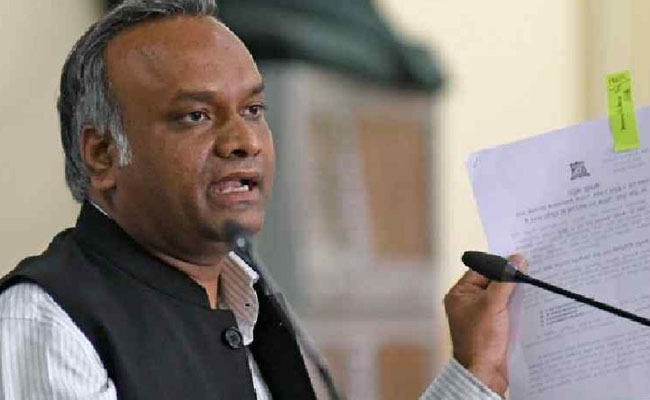
Bengaluru (PTI): With pressure mounting on the Congress government in Karnataka to implement the five 'guarantees' as promised to the people ahead of Assembly polls, State's Rural Development and Panchayat Raj Minister Priyank Kharge on Wednesday said criteria and frameworks are being decided for its implementation.
He said the criterion has to be fixed to implement the guarantees, as tax-payers money is involved.
In view of the implementation of five guarantee schemes, Chief Minister Siddaramaiah is today holding a meeting with all the Ministers of his cabinet and senior officials of the concerned departments at Vidhana Soudha, the seat of state secretariat and legislature, here.
The decision on implementation of guarantees is likely to be taken at the cabinet meeting on Thursday.
"Every scheme is based on a criterion, it is your (public) money, tax payers money is involved. We will have to put criteria. Tell me which scheme of the central- Modi government is free?" Kharge asked.
Speaking to reporters here, he said, "there will be criteria and we will ensure that everyone is benefited. Is it wrong to give priority to BPL (below poverty line), the government is for the poor."
"How to implement Gruha Jyoti, Gruha Lakshmi, YuvaNidhi -- the criterion and framework will be decided by today and tomorrow, there is no need to worry," he added.
The Congress had promised to implement the guarantees' 200 units of free power to all households (Gruha Jyoti), Rs 2,000 monthly assistance to the woman head of every family (Gruha Lakshmi), 10 kg of rice free to every member of a BPL household (Anna Bhagya), Rs 3,000 every month for unemployed graduate youth and Rs 1,500 for unemployed diploma holders (both in the age group of 18-25) (YuvaNidhi), and free travel for women in public transport buses (Shakti), on the very first day of assuming power in the state.
There is mounting pressure on the new government from opposition parties and various sections of people from across the state, to fulfill its five guarantees as promised ahead of polls.
Opposition BJP and JD(S) have accused the Congress of trying to "cheat" voters after coming to power by trying to attach conditions or criterion to the guarantees for their implementation, which were not mentioned ahead of polls.
Asked how the government will mobilise resources, the Minister said, "we will do it. First of all -- it is because of the central government and the double engine (BJP at both centre and state) government that was there -- our financial situation has worsened."
"Our GST share has not come, there was financial mismanagement during COVID-19, because of this Kannadigas are in debt today, I had raised this issue several times in the Assembly in the past," he said, now that our government has come, the priority will be to give financial stability to the state and its people.
After having accorded in-principal approval for the guarantees in the first cabinet meeting on May 20, Chief Minister Siddaramaiah had said they would "most likely" be implemented after the next Cabinet meeting. He had also said that initial estimates indicate it would cost the exchequer Rs 50,000 crore annually.
Let the Truth be known. If you read VB and like VB, please be a VB Supporter and Help us deliver the Truth to one and all.
UDF will have huge win in Kerala, NDA won't open its account: Cong leader Satheesan
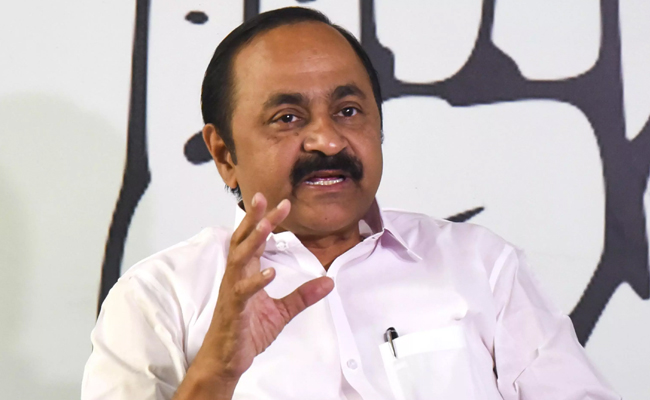
Kochi (PTI): Senior Congress leader V D Satheesan on Friday expressed confidence in a huge win by the UDF, claiming it will make a clean sweep in five districts, and brushed aside speculations that the NDA will open its account in Kerala.
Satheesan, speaking to reporters here a day after the conclusion of the Assembly polls, praised the performance of the UDF leaders and workers during the election, saying it was the best ever he has seen in the last 30 years.
He said that his claims of the UDF getting over 100 seats is not a mere statement, but based on the work the front has done during the last five years to bring back all those who had left it in 2005 and as a result, there was a huge wave in its favour in the state.
The leader of opposition in the state assembly, who contested from the Paravoor constituency, further said that the Congress-led front also had a major social backing from minorities and marginalised groups in the society.
Besides that, there was an anti-incumbency feeling among the people who were disappointed with the LDF rule, he claimed and said that the UDF provided them with a hope and an alternative which no other opposition had done in the past.
"All these factors will contribute to a huge win for the UDF and it would not be surprising if we make a clean sweep in Malappuram, Wayanad, Ernakulam, Idukki and Pathanamthitta districts. That is a total of 43 seats," he said.
According to him, the polling percentage increased because the UDF got people added to the electoral list.
He also brushed aside the LDF remarks about a woman or youth CM, saying that "they can make such statements now as they know they cannot win".
"Otherwise, why did they campaign with Pinarayi Vijayan as the main factor. Why did they say a third Pinarayi rule will come?" he asked.
He also claimed that the LDF's decision to spend government money on its political campaign, by putting up hoardings and carrying out social media programmes to sway voters, has also backfired as people realised that their taxes were being wasted like that.
Asked whether the NDA will open its account, especially in areas where the UDF claimed the BJP-led front had made a deal with the LDF, Satheesan replied in the negative.
He said that as of now he does not see any chance of the NDA opening its account in the state.