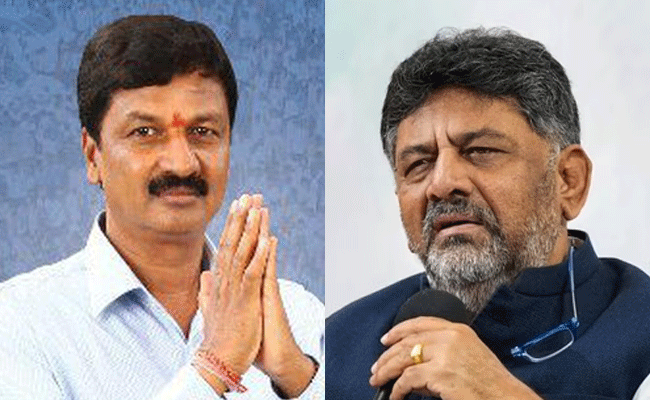
Belagavi (PTI): BJP leader Ramesh Jarkiholi, who had resigned as Karnataka minister about two years ago owing to a sex scandal, on Monday accused Congress state president D K Shivakumar of being involved in the conspiracy to discredit him, and demanded an inquiry by the Central Bureau of Investigation against the "racket" behind it.
Jarkiholi, a powerful minister holding the Water Resources portfolio, had resigned from his post in 2021 owing to the sex scandal, which had embarrassed the state government just ahead of a few states going to polls including West Bengal.
The woman, who was at the centre of the controversy, had alleged that the minister allegedly exploited her with the assurance of securing her a government job, a charge denied by Jarkiholi.
On Monday, the BJP Gokak MLA said the woman and her accomplices including two people from Mandya should be arrested to bring out the truth in the case.
"I demand that the state government should hand over the case to the CBI. The girl should be arrested along with her accomplices, including two people from Mandya, whose names I will disclose before the CBI," Jarkiholi said in a press meet at a private hotel here.
The former minister alleged that Congress leader Shivakumar tried to spoil his personal life.
"D K Shivakumar is unfit to be a politician. No one should spoil someone's personal life. I never made personal attacks," the BJP leader charged.
The former minister claimed he has evidence to prove that Shivakumar was behind it.
According to him, there are several sleaze videos of many politicians, including Congress leaders and top bureaucrats of the state, which are used for blackmailing.
"This is a very serious matter because many people have been honey trapped including Congress leaders and top officers who are being blackmailed. I urge the state government to hand over the case to the CBI," Jarkiholi said.
The BJP MLA also said he would hand over the audio/video files and documentary evidence of illegal money transactions to the CBI if the state government handed over the case to the central agency.
Shivakumar was not available for comments. The Congress has also not reacted to the BJP leader's allegations.
Since Jarkiholi had made indirect references to Congress MLA Laxmi Hebbalkar alleging that she was also part of the conspiracy, her brother Channaraj Hattiholi condemned the statement.
Addressing a press conference, Hattiholi, a Congress leader, said there was no clarity in the press meet convened by Jarkiholi.
"It is easy to make allegations. Instead of levelling charges and speaking lies, if you (Jarkiholi) make documents and evidence public, we will give you a reply," Hattiholi said.
He also wondered why the BJP government did not hand over the sex scandal case to the CBI forcing the Gokak MLA to demand it after remaining silent for nearly two years.
Let the Truth be known. If you read VB and like VB, please be a VB Supporter and Help us deliver the Truth to one and all.
New Delhi: A bill to set up a 13-member body to regulate institutions of higher education was introduced in the Lok Sabha on Monday.
Union Education Minister Dharmendra Pradhan introduced the Viksit Bharat Shiksha Adhishthan Bill, which seeks to establish an overarching higher education commission along with three councils for regulation, accreditation, and ensuring academic standards for universities and higher education institutions in India.
Meanwhile, the move drew strong opposition, with members warning that it could weaken institutional autonomy and result in excessive centralisation of higher education in India.
The Viksit Bharat Shiksha Adhishthan Bill, 2025, earlier known as the Higher Education Council of India (HECI) Bill, has been introduced in line with the National Education Policy (NEP) 2020.
The proposed legislation seeks to merge three existing regulatory bodies, the University Grants Commission (UGC), the All India Council for Technical Education (AICTE), and the National Council for Teacher Education (NCTE), into a single unified body called the Viksit Bharat Shiksha Adhishthan.
At present, the UGC regulates non-technical higher education institutions, the AICTE oversees technical education, and the NCTE governs teacher education in India.
Under the proposed framework, the new commission will function through three separate councils responsible for regulation, accreditation, and the maintenance of academic standards across universities and higher education institutions in the country.
According to the Bill, the present challenges faced by higher educational institutions due to the multiplicity of regulators having non-harmonised regulatory approval protocols will be done away with.
The higher education commission, which will be headed by a chairperson appointed by the President of India, will cover all central universities and colleges under it, institutes of national importance functioning under the administrative purview of the Ministry of Education, including IITs, NITs, IISc, IISERs, IIMs, and IIITs.
At present, IITs and IIMs are not regulated by the University Grants Commission (UGC).
Government to refer bill to JPC; Oppn slams it
The government has expressed its willingness to refer it to a joint committee after several members of the Lok Sabha expressed strong opposition to the Bill, stating that they were not given time to study its provisions.
Responding to the opposition, Parliamentary Affairs Minister Kiren Rijiju said the government intends to refer the Bill to a Joint Parliamentary Committee (JPC) for detailed examination.
Congress Lok Sabha MP Manish Tewari warned that the Bill could result in “excessive centralisation” of higher education. He argued that the proposed law violates the constitutional division of legislative powers between the Union and the states.
According to him, the Bill goes beyond setting academic standards and intrudes into areas such as administration, affiliation, and the establishment and closure of university campuses. These matters, he said, fall under Entry 25 of the Concurrent List and Entry 32 of the State List, which cover the incorporation and regulation of state universities.
Tewari further stated that the Bill suffers from “excessive delegation of legislative power” to the proposed commission. He pointed out that crucial aspects such as accreditation frameworks, degree-granting powers, penalties, institutional autonomy, and even the supersession of institutions are left to be decided through rules, regulations, and executive directions. He argued that this amounts to a violation of established constitutional principles governing delegated legislation.
Under the Bill, the regulatory council will have the power to impose heavy penalties on higher education institutions for violating provisions of the Act or related rules. Penalties range from ₹10 lakh to ₹75 lakh for repeated violations, while establishing an institution without approval from the commission or the state government could attract a fine of up to ₹2 crore.
Concerns were also raised by members from southern states over the Hindi nomenclature of the Bill. N.K. Premachandran, an MP from the Revolutionary Socialist Party representing Kollam in Kerala, said even the name of the Bill was difficult to pronounce.
He pointed out that under Article 348 of the Constitution, the text of any Bill introduced in Parliament must be in English unless Parliament decides otherwise.
DMK MP T.M. Selvaganapathy also criticised the government for naming laws and schemes only in Hindi. He said the Constitution clearly mandates that the nomenclature of a Bill should be in English so that citizens across the country can understand its intent.
Congress MP S. Jothimani from Tamil Nadu’s Karur constituency described the Bill as another attempt to impose Hindi and termed it “an attack on federalism.”