Decision will be taken after probe, Karnataka CM on irregularities in MUDA land allotment
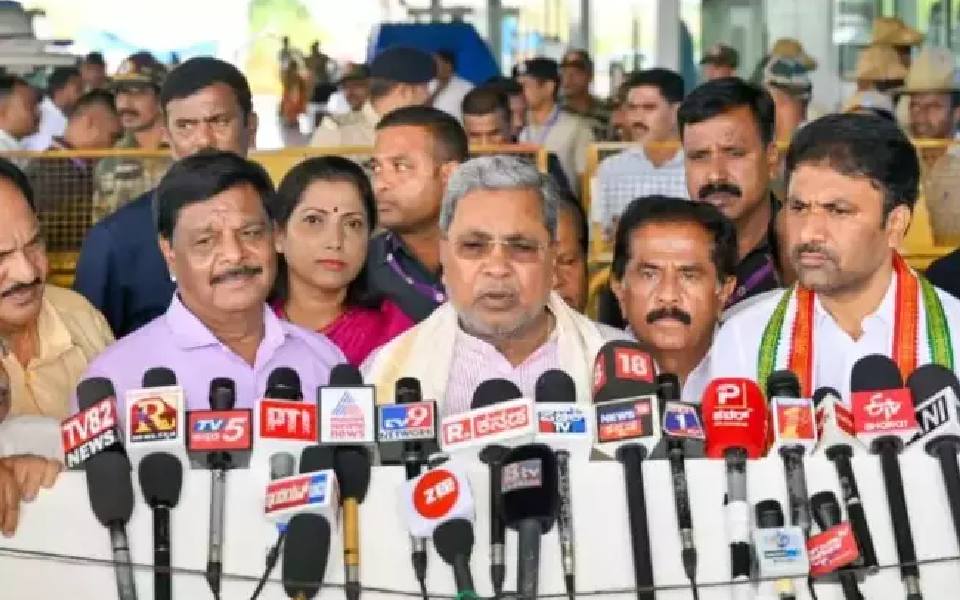
Bengaluru: Amid controversy over the alleged irregularities in the allotment of sites by Mysuru Urban Development Authority (MUDA) under the 50:50 scheme for land losers, and investigation is underway to ascertain whether there is any misuse in any allotment of MUDA plots. Karnataka Chief Minister Siddaramaiah on Wednesday stated that a decision on this will be taken after receiving a report from the team of senior IAS officers, who are investigating the matter.
He said, “An investigation is being carried out to find out whether there are any irregularities in the government body. All the plots have been put on hold. So there is no loss to the government. Those who have been allotted plots are being transferred and are being investigated by senior IAS officers.”
Responding to BJP’s allegations of misuse in MUDA land allocation and demand to transfer the case to CBI, the Chief Minister said, "Why are you saying to hand over everything to the CBI? Which case was handed over to the CBI when the BJP was in power. It was the BJP which made the law to allot land as an alternative for those who had given the land.”
ALSO READ: CM's wife "illegally" allotted alternative land in Mysuru, alleges BJP; Siddaramaiah denies charge
Furthermore, responding to Opposition leader R. Ashoka’s calls for the Chief Minister’s resignation, he stated, "I have no role in this case."
In addition, speaking about the Valmiki Corporation embezzlement case, he said the case has been handed over to the SIT and the investigation is going on. “Nagendra, the Minister for Tribal Affairs, has resigned. He has resigned because it was written in the corporation’s employee’s death note that the ministers had given a verbal order to the managing director for the embezzlement, the CBI has investigated the bank transactions.”
Let the Truth be known. If you read VB and like VB, please be a VB Supporter and Help us deliver the Truth to one and all.
Rickelton's ton in vain as SRH beat MI by 6 wickets

Mumbai (PTI): Ryan Rickelton's whirlwind unbeaten ton was overshadowed by Heinrich Klaasen's unbeaten 65 as Sunrisers Hyderabad defeated Mumbai Indians by six wickets in an IPL match here on Wednesday.
Chasing an imposing 244-run target, Travis Head (76 off 30) and Abhishek Sharma (45 off 24) shared 129 runs for the opening wicket to set the platform for SRH.
Klaasen (65 not out off 30 balls) then displayed his all-round hitting abilities to guide SRH home with the help of Nitish Kumar Reddy (21) and Salil Arora (30 not out off 10) in 18.4 overs.
Earlier, Rickelton's knock powered MI to 243 for five.
MI rode on a 93-run stand between Rickelton (123 not out off 55 balls) and Will Jacks (46 off 22) in 7.1 overs for the opening stand to power the side.
MI skipper Hardik Pandya scored a valuable 31 off 15 balls before being dismissed.
Praful Hinge (2/54), Eshan Malinga (1/29), Sakib Hasan (1/39) and Nitish Kumar Reddy (1/31) were the wicket-takers for SRH.
Brief Scores:
Mumbai Indian: 243 for 5 in 20 overs (Ryan Rickelton 123 not out; Praful Hinge 2/54).
Sunrisers Hyderabad: 249 for 4 in 18.4 overs (Travis Head 76, Heinrich Klaasen 65 not out; AM Ghazanfar 2/51).