Deputy CM DK Shivakumar dismisses allegations of any scam in Congress govt in K'taka
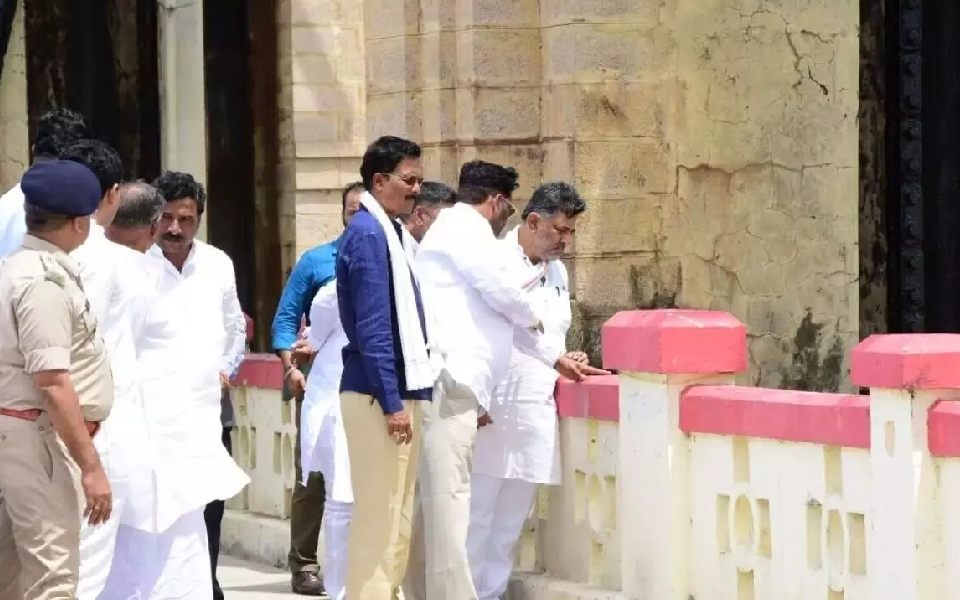
Channapatna (Karnataka), Jul 3: Karnataka Deputy Chief Minister D K Shivakumar on Wednesday dismissed allegations of any scam in Mysuru Urban Development Authority site allotment.
He said there have been no scams during the present Congress rule in the state.
Shivakumar's statement came as the opposition BJP alleged that there was about Rs 4,000 crore worth alternative site (plot) scam in Mysuru Urban Development Authority (MUDA) in Chief Minister Siddaramaiah's home town and staged a demonstration on Wednesday.
The BJP alleged that one of the beneficiaries of alternative sites scam was Siddaramaiah's wife, which the latter has categorically rejected.
ALSO READ: Decision will be taken after probe, Karnataka CM on irregularities in MUDA land allotment
Speaking to reporters after a 'Government at your doorstep' programme in poll-bound Channapatna, the Deputy Chief Minister said, "All the scams that the state witnessed have taken place during the BJP tenure. We will respond to all the allegations during the legislature session."
Asked about the experimental explosion at Baby Hills in Mandya district, he clarified, "The quarries near KRS dam take all necessary steps to carry out controlled explosions. The explosions can be carried out only at a specified distance from the dam."
Asked if JD(S) leader and union minister H D Kumaraswamy's 'Jana Samparka' programme in Mandya was a copy of his 'Government at your doorstep’ programmes, he said "Let him do it. It is good for the people if leaders do programmes like this, even if it is a copy of someone else."
Replying to a query on the announcement of candidates for the Assembly bypoll in Channapatna, he said, "Let the election dates be announced. Then the candidates will come and file nominations."
Channapatna bypoll is necessitated after former Chief Minister Kumaraswamy resigned as the JD(S) MLA after he got elected to the Lok Sabha as an NDA candidate and became Union Minister for Steel and Heavy Industries.
Let the Truth be known. If you read VB and like VB, please be a VB Supporter and Help us deliver the Truth to one and all.
J&K: One dead, seven hospitalised after consuming wild vegetable in Rajouri

Rajouri/Jammu (PTI): One person died while seven others, mostly children, were hospitalised after allegedly consuming a wild vegetable in Jammu and Kashmir’s Rajouri district, officials said on Saturday.
The incident was reported from Mohra village in the Kotranka subdivision, where members of two families consumed a wild vegetable following which they started showing symptoms of food poisoning on Friday evening, they said.
The affected persons were initially shifted to the Community Health Centre in Kandi and later referred to the Government Medical College Hospital Rajouri for specialised treatment.
Officials said an elderly man, identified as Mohammad Hussain (60), died during treatment, while seven other members of the two families are undergoing treatment at the hospital.
“Prima facie, it is a case of food poisoning, but the matter is still under investigation,” a doctor said.
Officials said an investigation into the incident has been initiated to determine the exact cause of the poisoning.