Seven new coronavirus reported in Karnataka, tally rises to 151 in state
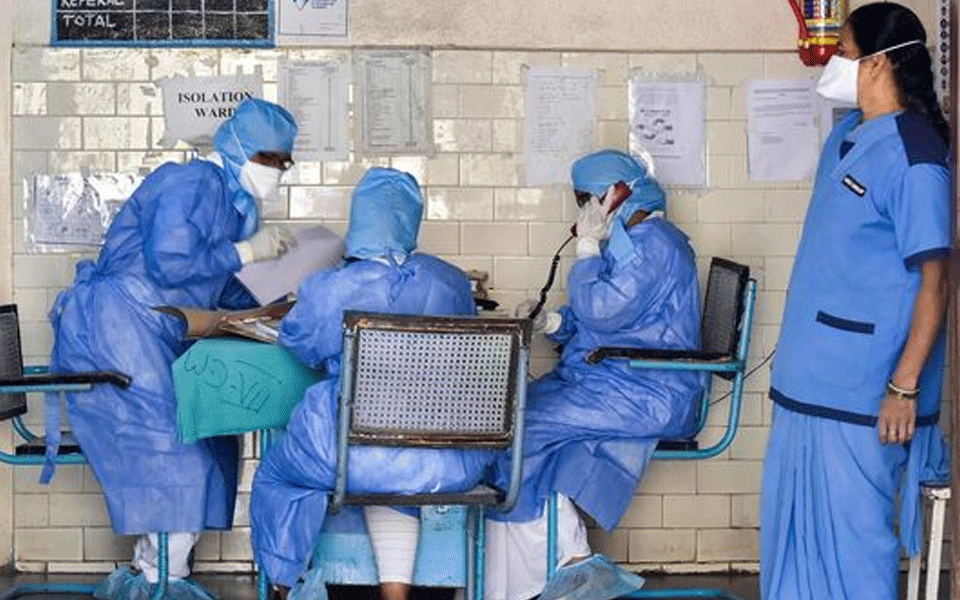
Bengaluru: Seven new novel coronavirus cases including five who had attended the Tablighi Jamaat congregation in Delhi, were confirmed taking the total number of patients in the state to 151 on Sunday, said the Karnataka Health department.
Those who joined the list of COVID-19 patients comprised a couple from Bengaluru, four from Raibagh in Belagavi and one person from Ballari, health department said in its daily bulletin on Sunday.
The 151 cases include four deaths and 11 discharges, the department added.
According to the bulletin issued by the department, a 68-year old man and his 62-year old wife who hail from Madiwala in Bengaluru had returned from Dubai on March 22.
They were quarantined at a private hospital and have been asymptomatic.
Of the five COVID-19 patients who attended the Markaz of Tabhligh-e-Jamaat, four are from Raibagh in Belagavi while one person is from Ballari.
While the Belagavi patients have been isolated at the district hospital in Belagavi, the Ballari patient has been quarantined at MDRS, at Alipur in Ballari and he is asymptomatic, the bulletin said.
The department said the contract tracing of all the patients is underway.
The government appealed people who had attended Tablighi Jamaat Congregation in New Delhi to contact 080- 29711171 Arogya Sahayavani, the medical helpline number.
The department said the Indian Council of Medical Research has issued an advisory to start rapid antibody based blood test for COVID-19 as a strategy for areas reporting clusters (containment zone) and in large migration, gathering or evacuees centres.
The department said out of 151 patients 12 have been discharged and 135 are active cases and four deaths have taken place. The deaths took place in Kalaburagi, Tumakuru, Chikkaballapura and Bagalkote.
Of the 151 cases in Karnataka, maximum 57 has been reported in Bengaluru, 28 in Mysuru, 12 in Dakshina Kannada, 10 in Bidar, eight in Uttara Kannada, seven in Belgavai, six in Ballari, five in Kalaburagi, three each in Davangere and Udupi and one each in Dharwad, Kodagu, Tumakuru, Bagalkote and Bengaluru rural.
In view of the increasing cases of COVID-19 in the state, Chief MInister B S Yediyurappa appealed to the people to strictly adhere to the lockdown.
Expressing his concern over the gradual increase in the cases, Yediyurappa said the damage caused by the COVID-19 worldwide is known to everyone and accordingly, the Prime Minister has announced nationwide lockdown till April 14.
"In our state, the number of coronavirus patients is increasing in Bengaluru, Mysuru, Bidar, Kalaburagi. Besides shutting down borders, prayers at all the religious places have been stopped and various other measures have been taken to prevent the COVID-19 from spreading further," the Chief Minister said in a statement.
He said people have to understand the importance of lockdown as the disease is dangerous for the country.
Let the Truth be known. If you read VB and like VB, please be a VB Supporter and Help us deliver the Truth to one and all.
TN Governor should invite Vijay to form govt, then prove majority: Former MP Prakash Ambedkar
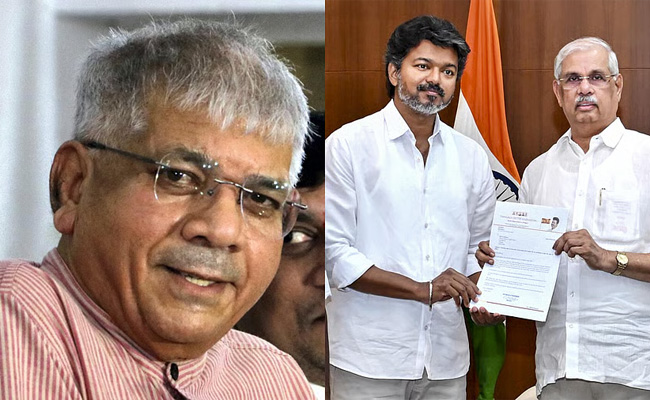
Mumbai: Senior politician and constitutional expert Prakash Ambedkar has opined that Tamil Nadu Governor Rajendra Arlekar should invite the Tamilaga Vettri Kazhagam President Vijay to form the government as his party emerged as the single largest party in the Assembly elections.
Ambedkar, who is a Mumbai-based advocate, activist and also the grandson of Dr. BR Ambedkar, is a former Parliamentarian.
Citing articles from the Constitution and similar incidents in the political history of the nation, Prakash Ambedkar has explained why Vijay cannot be stopped from forming the government in Tamil Nadu, reports Deccan Herald.
“Merely doubt over whether the TVK has the necessary number cannot suffice to withhold the invitation to the party to form the government. The Governor should invite Vijay, President of TVK, the single-largest party, to form the government and assume office as the next Chief Minister. After taking charge, as per the Article 164 (2) of the Constitution, Vijay will have to prove that his government has a majority in the House,” Ambedkar explained.
He also gave examples from India’s political history supporting his argument.
Ambedkar cited the example of the 1989 Lok Sabha elections and said that, although the Congress (I) emerged the single-largest party with 194 seats, Rajiv Gandhi declined the invitation by President R Venkataraman to form the government. “My friend Vishwanath Pratap Singh, leader of the National Front, was then invited and sworn in as Prime Minister on December 2, 1989,” he added.
He then recalled the 1996 elections to the Lower House of the Parliament, when the BJP emerged the single-largest party, but the Parliament was hung as the BJP lacked a majority. “Atal Bihari Vajpayee was invited by President Shankar Dayal Sharma to form the government and was sworn in as Prime Minister. Vajpayee resigned 13 days later on May 28, 1996, after failing to secure majority support in the Lok Sabha,” Ambedkar explained.