Farmers move Karnataka HC against Disneyland-style amusement park at Brindavan Garden

Bengaluru: Farmers from Mandya district have reportedly filed a public interest litigation (PIL) in the Karnataka High Court challenging the state government’s decision to transform Brindavan Garden, located at the Krishna Raja Sagar (KRS) dam, into a Disneyland-like space. The petitioners argue that the project poses serious environmental threats and undermines the interests of the farming community.
A vacation division bench of Justices B.M. Shyam Prasad and K.V. Aravind has issued notices to several authorities of the state and central governments, including the Ministry of Jal Shakti, National Dam Authority, state chief secretary, water resources, agriculture, forest and ecology departments, Kaveri Neeravari Nigam Ltd and other authorities of Mandya district, as reported by The New Indian Express on Thursday.
This was after they heard the petition filed by K. Boraiah and four others from KRS village and nearby areas, questioning the tenders issued to set up the amusement park in the name of Brindavan Garden Upgradation without statutory clearance, including from the gram panchayat.
The petitioners argue that the project violates Articles 48-A and 53A of the Indian Constitution, the Karnataka Forest Act, the Environmental Protection Act, 1986, and the Forest (Conservation) Act, 1980.
The petitioners contend that turning the historic garden into a non-agricultural commercial hub—expected to attract 10,000 visitors per day—would result in significant damage to the region's agricultural ecosystem, the report added.
The dam is around 120-years-old and this has not been taken into consideration by authorities, they further alleged.
The first notification was issued on September 9, 2024, and the third notification on March 15, 2025. The urgency behind the PIL stems from the state’s May 13 decision to call for tenders for the Rs 2,663 crore amusement park project, alongside a Rs 100 crore Cauvery Arathi event, TNIE mentioned.
The petitioners have urged the court to stay the tender process, calling the state government’s actions arbitrary, hasty, and disastrous for the agrarian sector.
The matter is scheduled for further hearing on June 9, 2025.
Let the Truth be known. If you read VB and like VB, please be a VB Supporter and Help us deliver the Truth to one and all.
Ordinance issued to increase number of Supreme Court judges from 34 to 38
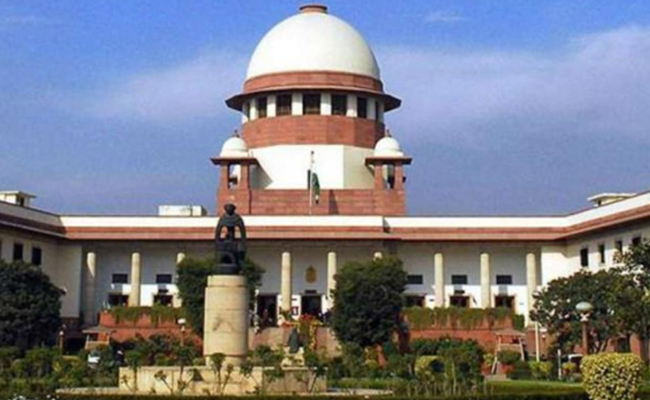
New Delhi (PTI): The government has promulgated an ordinance to increase the strength of the Supreme Court from the present 34 judges to 38, including the Chief Justice of India.
The law ministry notified the ordinance on Saturday, which amended the Supreme Court (Number of Judges) Act, 1956, to increase the sanctioned strength of the top court.
So far, the sanctioned strength of the top court was 34, including the Chief Justice of India (CJI). Now, the number of judges has been increased by four, taking the sanctioned strength to 38.
The top court will now have 37 judges, other than the CJI.
With the apex court having two vacancies at present, and the ordinance coming into force immediately, the Supreme Court Collegium will now have to recommend six names for appointment as judges in the top court.
A bill will be brought in the Monsoon Session of Parliament to convert the ordinance – an executive order – into a law passed by Parliament.
The Union Cabinet had cleared a draft bill on May 5 to increase the number of apex court judges.
The strength of the Supreme Court was last increased from 30 to 33 (excluding the CJI) in 2019.
The Supreme Court (Number of Judges) Act, as originally enacted in 1956, put the maximum number of judges (excluding the CJI) at 10.
This number was increased to 13 by the Supreme Court (Number of Judges), Amendment Act, 1960, and to 17 by another amendment to the law.
The Supreme Court (Number of Judges) Amendment Act, 1986, augmented the strength of judges from 17 to 25, excluding the CJI.
A fresh amendment in 2009 further increased the strength from 25 to 30.
Article 124(3) of the Constitution lists the qualifications required to become a Supreme Court judge.
An Indian citizen who has either served as a high court judge for at least five years, or as an advocate for 10 years, or is a distinguished jurist, can be appointed to the top court.
The strength of the Supreme Court is increased based on the recommendations of the CJI, who writes to the Union law minister. After consulting the finance ministry, the Department of Justice under the law ministry moves the Cabinet with a draft bill.