Have received thousands of letters from people offering me houses, says Rahul Gandhi
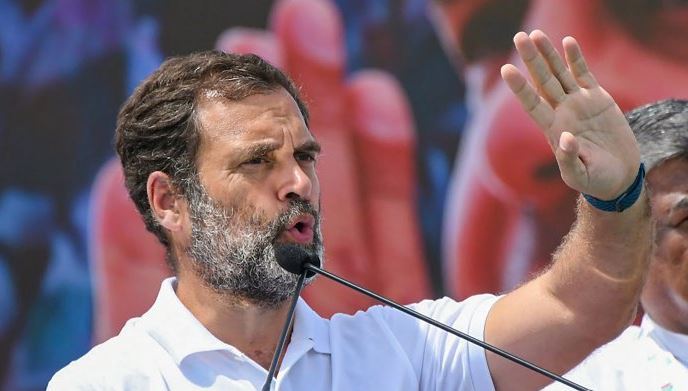
Vijayapura, Apr 23: A day after vacating his official bungalow in New Delhi following the Lok Sabha disqualification, Congress leader Rahul Gandhi on Sunday took a swipe at the ruling BJP saying it has done a good thing by taking back the house, as he has received thousands of letters from people inviting him to theirs.
The former AICC President said his house is in the hearts of the people and that he doesn't want any home.
Asserting that Congress is against BJP and RSS' ideology which "believes in spreading hate and violence", he said his party will fight it without any fear, and ensure its defeat.
"BJP has put several cases on me, they have removed me from the Parliament, they have taken away my house, but thousands of people wrote letters to me saying Rahul ji- come to our house. My house is in your (people's) hearts. I don't want any house. They have done good by taking the house," Gandhi said.
Stating that in the case he has been accused of using wrong words against OBCs, he said, "first of all I don't use wrong words against anyone. I respect every citizen of Hindustan. As I say, (I have) opened the shop of love in the market of hate."
Gandhi vacated his official bungalow in Lutyens' Delhi on Saturday and shifted to his mother Sonia Gandhi's residence, weeks after losing his Lok Sabha membership following his conviction in a defamation case.
Last month, he was sentenced to two years in jail by a court in Gujarat's Surat in a 2019 criminal defamation case over his "why all thieves have the Modi surname" remark. A day later, he was disqualified as a member of the Lok Sabha.
Gandhi was addressing a public meeting here after holding a massive road show, ahead of the May 10 Assembly polls in Karnataka.
Invoking 12th century social reformer Basavanna on his birth anniversary, Gandhi claimed Prime Minister Narendra Modi and ruling BJP leaders only spoke about the Lingayat philosopher in their speeches but didn't follow his teachings.
Calling the BJP government in Karnataka the "most corrupt in the country", he said Congress would win 150 seats out of the total 224 in the polls in the state, while the "40 per cent BJP government" would get only 40 seats.
"Basavanna had said don't fear, speak out truth. If we see today, there is BJP and RSS' ideology which is creating an atmosphere of hatred and violence in the country. Prime Minister and BJP leaders speak about Basavanna, but don't follow his teachings," Gandhi said.
He said Basavanna had spoken about helping the weaker sections of society, he did not say "help the billionaires".
"I have read about Basavanna's teachings. He has nowhere written that get the country's wealth to Adani. I spoke in Parliament, I asked the Prime Minister as to what was his relationship with Adani. The country's entire wealth, ports and airports are being given to Adani; what's your relationship," he said.
Claiming that his microphone was first switched off in the Lok Sabha for asking those questions, Gandhi said his speech was then removed from the House records, and at the end he himself was removed from the Lok Sabha.
"They think that the truth can only be spoken in Lok Sabha, but it can be spoken anywhere, even here," he said.
AICC General Secretary K C Venugopal, Karnataka Congress campaign committee chief M B Patil and KPCC working president Satish Jarkiholi, were among those present.
Earlier on Sunday, Gandhi began his two-day visit to the poll-bound southern state from Kudala Sangama, where he offered obeisance to Basaveshwara, also known as Basavanna, on his birth anniversary which is celebrated as Basava Jayanti. Basavanna is the founder of the Lingayat sect.
This visit of Gandhi is seen as an attempt by the Congress to bolster the Lingayat outreach ahead of the polls in an attempt to woo the dominant community. Lingayats constitute about 17 per cent of the State's population and are largely seen as the ruling BJP's vote base.
Highlighting Congress' 'guarantees', including 200 units of free power to all households and Rs 2,000 monthly assistance to the woman head of every family if voted to power, Gandhi said they are based on Basavanna's thinking.
"I have read Basavanna's thoughts, I searched whether there is any reference to 40 per cent commission, to find whether there is any reference to looting the people, but didn't find it anywhere. The BJP government in Karnataka is the most corrupt in the country, they take 40 percent commission in whatever they do," he claimed, as he hit out at PM Modi for his "inaction against corruption charges against his party leaders and government".
He said while the PM claims he was against corruption, he, however, does not look towards his left and right. Gandhi asked Modi to please look at "who is standing next to you--they are the ones who took 40 per cent commission, using the same money they ensured that the MLAs defected which led to the fall of the coalition government" in 2019.
Reminding people that they had not elected the BJP government to power, he alleged, "this is the government of thieveries, this is 40 per cent commission government, they had formed the government after stealing the MLAs."
"Prime Minister please tell the people, as to from where the money came to buy the MLAs. MLAs were brought in Goa, Madhya Pradesh, Karnataka and North East, from where did the money come? The money looted from people through corruption is used to buy MLAs."
When Congress comes to power, they will not be able to buy MLAs, as it will get 150 seats, and the BJP which is used to the habit of 40 per cent commission will get only 40 seats, he added.
Gandhi also urged the Prime Minister to make the UPA government initiated caste census data public, and asked why it was not being released.
"It is because you (Modi) don't want to share India's money among OBCs...if you don't do it we will first put pressure on you, then we will do it (after coming to power)," he said.
Gandhi also demanded to provide reservation based on population, and removal of 50 per cent cap on reservation.
Let the Truth be known. If you read VB and like VB, please be a VB Supporter and Help us deliver the Truth to one and all.
Two held in UP's Bijnor for contact with Pakistan linked Dubai handler
_vb_24.jpeg)
Bijnor (PTI): Two men were arrested in this Uttar Pradesh district on Friday for allegedly being in touch with a Pakistan-linked handler based in Dubai, police said.
Circle Officer, Najibabad, Anjani Kumar Chaturvedi said Uvaid Malik and Jalal Haider were arrested following inputs on their alleged links with Aqib, a resident of Meerut currently staying in Dubai.
According to police, Aqib had earlier come into the spotlight after a video surfaced on Instagram purportedly showing him displaying an AK-47 rifle and explosives.
During interrogation, the arrested men allegedly told police that Aqib used to incite youngsters against Hindus and encourage anti-national activities, the officer said, adding that detailed questioning of the accused is underway.
On April 6, Superintendent of Police (SP) Abhishek Jha said the video first surfaced in November last year. Aqib, a native of Sathla village in the Mawana area of Meerut, was allegedly seen in the video brandishing weapons.
Following the viral clip, a case was registered at the Nangal police station by sub-inspector Vinod Kumar. However, the then station house officer and investigating officer Satyendra Singh had recorded Aqib's statement and filed a final report, stating that the weapons seen in the video were toys, effectively giving him a clean chit.
Police said fresh developments have now revealed Aqib's suspicious links and the probe has been handed over to the Anti-Terrorist Squad (ATS).
The SP said action has been taken against the officials concerned, with the then SHO and investigating officer suspended and Circle Officer Nitesh Pratap Singh removed from his post.