Haveri: Rape case accused hold roadshow after bail, taken into police custody

Haveri: A group of accused in a rape case held a roadshow on Thursday night soon after being released on bail. The police have registered a fresh case in this regard and taken five of the accused into custody.
The Haveri Additional District and Sessions Court had granted conditional bail to seven accused after the rape survivor failed to identify them. Following the court order, videos surfaced on social media showing the accused conducting a roadshow with more than 20 followers in five vehicles from Haveri Sub-Jail to Akki Alur town.
The court had granted bail to Aftab Chandanakatti, Madar Saab Mandakki, Samiullah Lalanava, Mohammed Sadiq Agasimani, Shoaib Mulla, Tauseef Choti, and Rias Savikeri.
The rape survivor had filed a complaint stating that she was gang-raped on January 8, 2024. Following her complaint, 19 individuals were arrested. Of these, 12 were granted bail 10 months ago, while the bail pleas of the main accused had been repeatedly rejected.
Recently, the court granted bail to the remaining accused after the survivor reportedly failed to identify the accused.
The seven accused involved in the roadshow appeared before the Haveri District Court on Friday. It is reported that five of them were taken into police custody while returning from their court appearance.
Let the Truth be known. If you read VB and like VB, please be a VB Supporter and Help us deliver the Truth to one and all.
Ordinance issued to increase number of Supreme Court judges from 34 to 38
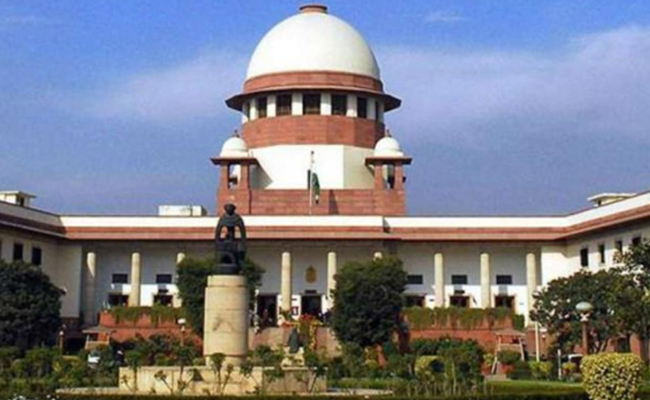
New Delhi (PTI): The government has promulgated an ordinance to increase the strength of the Supreme Court from the present 34 judges to 38, including the Chief Justice of India.
The law ministry notified the ordinance on Saturday, which amended the Supreme Court (Number of Judges) Act, 1956, to increase the sanctioned strength of the top court.
So far, the sanctioned strength of the top court was 34, including the Chief Justice of India (CJI). Now, the number of judges has been increased by four, taking the sanctioned strength to 38.
The top court will now have 37 judges, other than the CJI.
With the apex court having two vacancies at present, and the ordinance coming into force immediately, the Supreme Court Collegium will now have to recommend six names for appointment as judges in the top court.
A bill will be brought in the Monsoon Session of Parliament to convert the ordinance – an executive order – into a law passed by Parliament.
The Union Cabinet had cleared a draft bill on May 5 to increase the number of apex court judges.
The strength of the Supreme Court was last increased from 30 to 33 (excluding the CJI) in 2019.
The Supreme Court (Number of Judges) Act, as originally enacted in 1956, put the maximum number of judges (excluding the CJI) at 10.
This number was increased to 13 by the Supreme Court (Number of Judges), Amendment Act, 1960, and to 17 by another amendment to the law.
The Supreme Court (Number of Judges) Amendment Act, 1986, augmented the strength of judges from 17 to 25, excluding the CJI.
A fresh amendment in 2009 further increased the strength from 25 to 30.
Article 124(3) of the Constitution lists the qualifications required to become a Supreme Court judge.
An Indian citizen who has either served as a high court judge for at least five years, or as an advocate for 10 years, or is a distinguished jurist, can be appointed to the top court.
The strength of the Supreme Court is increased based on the recommendations of the CJI, who writes to the Union law minister. After consulting the finance ministry, the Department of Justice under the law ministry moves the Cabinet with a draft bill.