Hijab row: Karnataka HC says unseen hands at work to engineer social unrest and disharmony
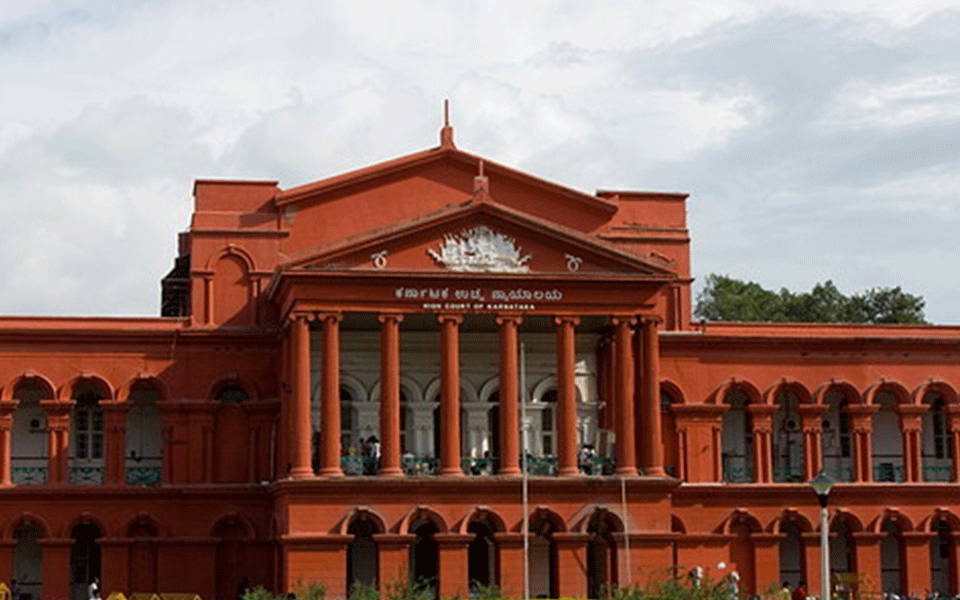
Bengaluru(PTI): The Karnataka High Court has suggested the possibility of some 'unseen hands' behind the hijab row to engineer social unrest and disharmony.
The court also expressed dismay over the issue being blown out of proportion.
"The way hijab imbroglio unfolded gives scope for the argument that some 'unseen hands' are at work to engineer social unrest and disharmony. Much is not necessary to specify," the three-judge bench headed by Chief Justice Ritu Raj Awasthi said in the order.
The full bench also comprising Justice Krishna S Dixit and Justice J M Khazi dismissed a batch of petitions filed by a few Muslim girl students from Udupi Government Pre-University Girls' College who sought permission that they be allowed to attend classes wearing hijab.
The court however, made it clear that it was not commenting on the ongoing police investigation.
During the course of hearing, some counsels had brought to the notice of the court the alleged involvement of the Campus Front of India (CFI) and other organisations in inciting the Muslim students.
When the court sought to know, Advocate General Prabhuling Navadgi handed over a letter in a sealed cover to the bench.
"We have perused and returned copies of the police papers that were furnished to us in a sealed cover. We expect a speedy and effective investigation into the matter and culprits being brought to book, brooking no delay," the bench noted.
The judges observed that all was well with the dress code since 2004.
It also said that they were impressed that even Muslims participate in festivals that are celebrated in the "Ashta Mutt Sampradaya" in Udupi where eight Mutts are situated.
"We are dismayed as to how all of a sudden that too in the middle of the academic term the issue of hijab is generated and blown out of proportion by the powers that be," the bench noted.
The court also declined to entertain petitions which had sought an investigation by the Central Bureau of Investigation (CBI) and the National Investigating Agency (NIA) as to the involvement of radical Islamic organisations and their funding by some foreign universities to Islamise India.
"There are other incoherent prayers. This petitioner opposes the case of students who desire to wear Hijab. Most of the contentions taken up in these petitions are broadly treated in the companion Writ Petitions. We are not inclined to entertain these two Writ Petitions filed in PIL jurisdiction, both on the ground of their maintainability and merits," the judges observed.
Let the Truth be known. If you read VB and like VB, please be a VB Supporter and Help us deliver the Truth to one and all.
Vision Konkani felicitates 2025 Kendra Sahitya Academy Awardee HM Pernal in Mangaluru
NRI Entrepreneur, Philanthropist Michael D'Souza urges community to support Pernal's literary work
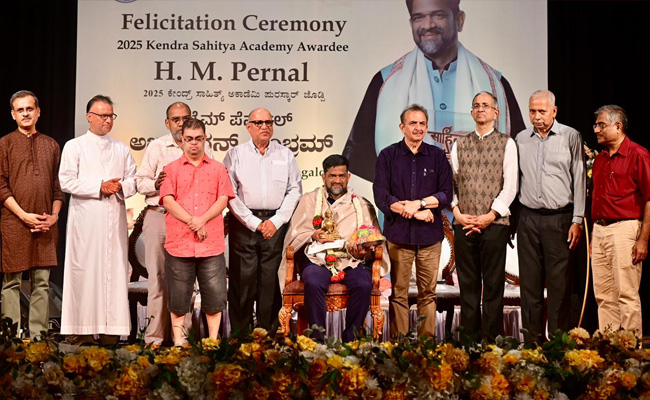
Mangaluru: Eminent Konkani writer and 2025 Sahitya Akademi awardee H. M. Pernal was felicitated at a grand function held at the Town Hall on Friday evening. The programme brought together literary figures, community leaders and admirers to celebrate Pernal's contribution to Konkani literature.
The felicitation ceremony was organised by Vision Konkani and presided over by NRI Entrepreneur and Philanthropist Michael D'Souza. Renowned Kannada poet and writer Jayant Kaikini attended as the chief guest.
The evening began with a musical presentation titled "Sitar Fusion" by Rafique Khan on sitar, Rajesh Bhagwat on tabla and Vaman Karkala providing rhythm accompaniment.
This was followed by a recital of H. M. Pernal's poems by Eddie Siqueira and Mahammad Muaad GM.
A special interactive session on "Celebration of Life and Literature" was later held with H. M. Pernal. The discussion was led by Shakuntala R. Kini and Wilson Kateel, offering insights into Pernal's literary journey and personal experiences.
During his address, Jayant Kaikini struck a humorous note by saying that the Konkan Railway Corporation Limited should reserve seats for Konkani writers. He said he was delighted that H. M. Pernal had received recognition for his literary work through the Sahitya Akademi award.
Kaikini expressed concern that while many people are writing poetry today, fewer are reading the works of established and accomplished writers. He noted that great artists throughout history have always shown interest in multiple forms of art rather than limiting themselves to a single field. Describing Pernal as an important pillar of Konkani literature, he said the writer's achievements deserved to be celebrated.
Presiding over the programme, Michael D'Souza said that quality is more important than quantity, and added that the same principle applies to literature. He called upon the community to support H. M. Pernal in his literary work and encouraged the veteran writer to continue serving the Konkani language. He also thanked all those who attended the event.
In his response, H. M. Pernal thanked the organisers, his family, community members and all those who had supported him over the years. He also shared his personal journey and recounted key moments from his life and literary career.
The programme included an introduction to the awardee, felicitation by the organising committee, and honours from various Konkani organisations.
Titus Noronha delivered the introductory remarks, while convener Melvyn Rodrigues proposed the vote of thanks.
The event concluded with a celebration attended by members of the Konkani literary community and admirers of H. M. Pernal.